

A Rock Obsessive to Systems Thinker — Alumni Profile, Wes Dripps ’92
For Wes Dripps ’92, connecting curiosity with action has shaped a lifelong commitment to sustainability — from childhood “treasure hunts” for rocks to leading the Center for Sustainability at Amherst and inspiring students to become systems thinkers in tackling real-world challenges.

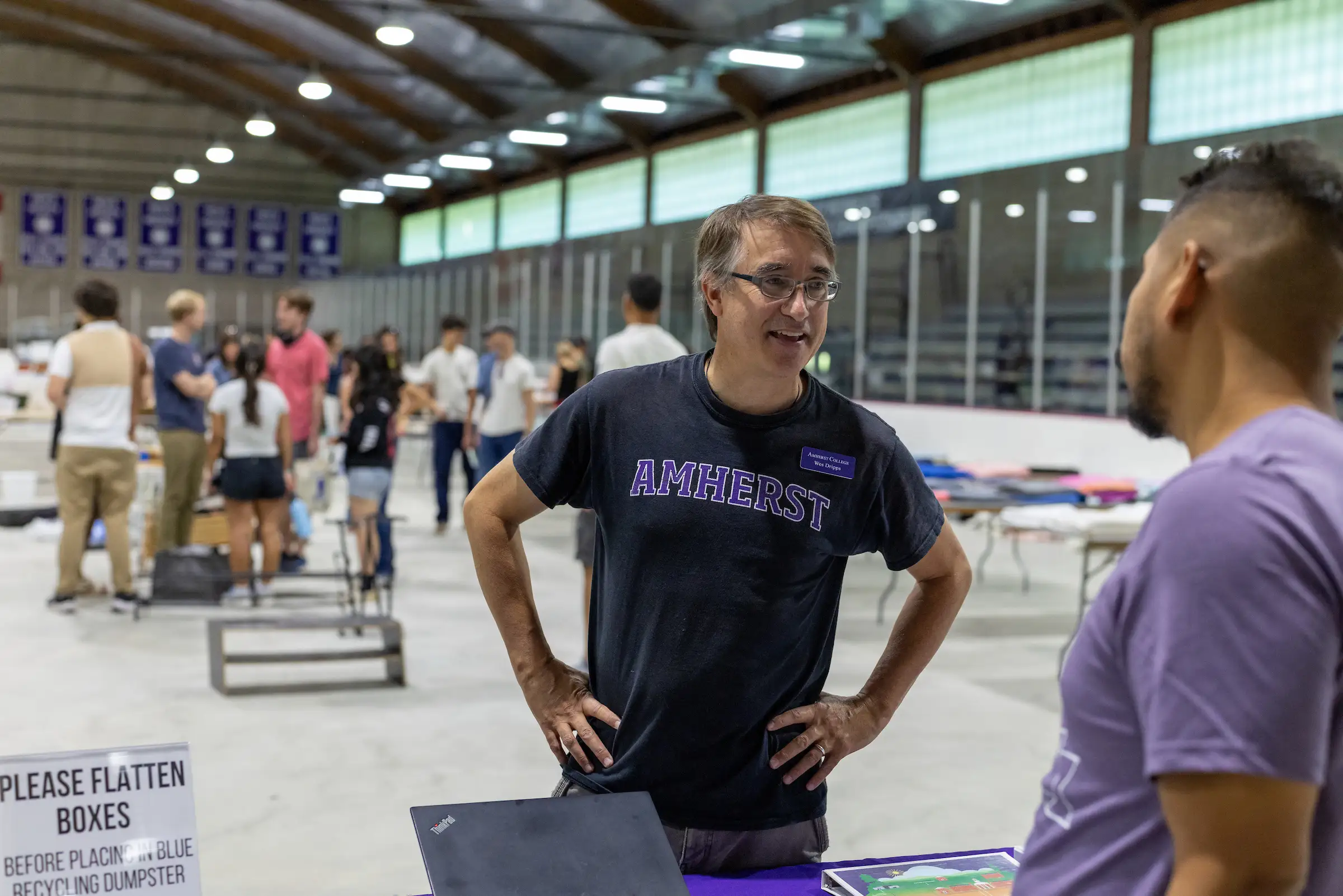
As an undergraduate, Wes Dripps ’92 spent hours alone in the Pratt Museum of Natural History (now Charles Pratt Hall), where the mammoth skeleton loomed over the exhibits, and often no one came in. “I was like a little kid in a playground,” Dripps recalled. Since returning to Amherst in 2022, he has been spending his days again in Pratt, which was refurbished into a dormitory in 2007. It also houses the Center for Sustainability, which he directs.
The Un-Amherst Amherst Student
Dripps’ love for nature, especially rocks, began as a kid at the K-12 Haverford School in Pennsylvania. While everyone else in his neighborhood was selling lemonade, he and his friend set up a stand to sell rocks unearthed from his friend’s backyard. His instinctive fascination with rocks grew when a middle school science teacher assigned him and his peers to create their own rock collections. His classmates bought fancy samples, while Dripps found his throughout Pennsylvania.
“I loved that it was my own kind of natural treasure hunt,” Dripps said. “I thought, ‘Oh my gosh, what am I gonna find today if I [go] to the site?’ … I’d say [my passion for] it never really died.”
Dripps carried this undying passion to Amherst College, where he took every geology class offered on campus, as well as archaeology classes at Smith College and courses at Hampshire and Mount Holyoke Colleges that included field trips to Death Valley. “I’m probably not the best poster child for the liberal arts and the open curriculum,” Dripps said. “I’m embarrassed to say that … more than half the courses I took in my time here were geology-related.”
Amherst’s geology department was — and is still — close-knit, where Dripps felt he could be active and involved from the moment he matriculated. He served as a teaching assistant (TA) for “Introduction to Geology” during his second semester and continued to do so for the rest of his time at Amherst. His time teaching prompted him to reflect on what he might do after graduating: “‘Wow, I can make a career out of this,’” he recalled thinking.
During the summer between his sophomore and junior years, Dripps, hungry for experience, went to eastern Montana as a field assistant to an Amherst alumna pursuing her master’s degree. Late Professor of Geology Edward Belt introduced him to the opportunity: He and the alumna studied rocky layers from around the time of the dinosaurs’ extinction. “The Badlands [were] beautiful,” Dripps said. “As far as the eye could see, [there were] these beautiful kind[s] of multicolored mounds of sediment, and no one around. I loved it.”
The next summer, he returned to Montana, this time to the Crazy Mountains Basin. “This was like pre-cell phone, pre-computer,” he said. With a field assistant from Hampshire, he pitched a tent at the end of an abandoned dirt road outside Livingston and spent a couple of months cooking on a camp stove and rinsing off in the nearby creek. “When the sun went down, it was time for bed, and when the sun came up, it was time to get up and go do field work,” Dripps said.
That fieldwork became his senior thesis, which he analyzed and wrote up in his final year. When asked for his fondest Amherst memories, he named “my summers in Montana” and added, “I realize it’s not here on campus, but when else could you get the opportunity to have a couple months to camp in rustic world, Montana, up in the mountains?”
The Burgeoning Impact of an Amherst Education
Dripps considers himself extroverted. But he soon found himself sitting alone in the Arizona desert for seven hours a day, a job right out of Amherst with the Water Resources Division of the United States Geological Survey. He chose water over other paths because of the era’s shortages and droughts. Conveniently, he added, “My last name is Dripps. I was like, ‘I’m really interested in water!’”
The solitude took getting used to. “It was complete silence, to the point that I’m like, ‘Did I lose my hearing?’” A colleague taught him to “invent things in [his] head,” and Dripps came to value [this] experience: “some of the most peaceful, thought-provoking, reflective time I ever had [was in the Arizona desert].”
The work was a crash course in real-world problems. He dealt with a water dispute between California and Arizona and jet fuel contamination of an aquifer at an Air Force base. It also gave him what he called “a sustainability science mindset.”
“Let’s not just talk about the problem. Let’s do something to address it,” he said, describing the process of becoming “a systems thinker — not only understanding the environmental side, but like, ‘Wow! This issue is impacting people’s lives. There’s a social component. It costs a lot of money to clean this up. There’s a financial component.’”
After finishing his work with the government, Dripps traveled to Zermatt, Switzerland, to teach 10th graders through the Swiss Semester program, again returning to rocks and teaching. The program allowed him to shape the curriculum, lead labs, and teach content for 50 minutes across four sections each day: “The dream job of every geologist,” he said.
“It spoiled me because where else can you be like: ‘I’m going to teach you about glaciers,’ and we talk about [them] in class, and, like, ‘Today, we’re going to go out and see a glacier, and you can touch the glacier.’ It was experiential learning on steroids,” Dripps recalled.
Dripps then received a master’s degree in Earth science from Dartmouth College and returned to the Swiss Alps to teach. Afterward, he sought to understand the private sector and worked in Washington, D.C., for Earth Satellite Corporation, a remote-sensing company that applied satellite imagery — then mostly a military tool — to nonmilitary work, such as mineral exploration, wetland mapping, and contaminant tracking.
He worked on projects in Alaska, Venezuela, and Bangladesh — even on Clint Eastwood’s private property —but his favorite trip was the fieldwork he did in Cyprus. At the base of Mount Olympus, he explored water in the Troodos Mountains, a rock assemblage he had read about in class.
After D.C., Dripps earned a Ph.D. in geology and geophysics from the University of Wisconsin-Madison, certain he was going to teach. He returned to the Swiss Semester for the third time (where he hopes to teach again someday) and then entered academia. After a brief stint at the Massachusetts Institute of Technology, he began teaching at the University of Massachusetts Boston and later spent 17 years at Furman University in Greenville, South Carolina, where he was a tenured professor and director of the Shi Institute for Sustainable Communities.
In reference to his initial work in water resources, as well as his plethora of career experiences, Dripps said, “Amherst prepared me very well … I feel pretty confident in my ability to figure things out. I was a sponge as well. I had to learn a bunch of things on the fly for my thesis … self-teach myself … [I was] able to figure out how I could self-teach or ask questions or shadow people … I was not afraid to ask if I didn’t understand.”
The Amherst Poster Child, After All
In 2022, Dripps felt proud of his accomplishments at Furman and ready for a new challenge, which coincided with Amherst’s opening for a director of sustainability. This position for the Center for Sustainability was new, since it would replace the previous Office of Environmental Sustainability. “I felt well-positioned to say, ‘Gosh, I want to take all this great knowledge and experience I have [at Furman] and bring it back to a place like Amherst that I love so much, and help my alma mater put sustainability on the map for us’ … I had such fond memories of my time being here that it was exciting to kind of think that I could come back and give back to the place that had come and launched my career.”
Leaving Furman and the classroom was not easy, he recalled. “I was really anxious and nervous about walking away from that,” Dripps said. “I was so comfortable in that space … When I pivoted from being a professor into my admin staff role here, a lot of my colleagues thought I was insane. They’re like, ‘You’re a full tenured professor, and you’re walking away from all that.’ But I don’t — I never second-guess myself.”
Just like his first work experience in water resources outside Amherst, Dripps said, his new role at Amherst feels more practical than his academic work, tackling real-world problems on campus. “I loved [my academic work] … [but when] I publish a paper, [sometimes it feels like] five people are going to read [it] ever. Whereas I feel like the work that I’m doing here now has a much longer, broader impact across the whole campus.”
Dripps sees the “grand challenge of sustainability science” as raising people’s standard of living while keeping environmental impact below crucial natural thresholds, and he doubts technology alone can meet it. Technological fixes tend to be reactive, he said, while most of the problems are “really more behavioral … a human-created challenge, and probably a human-created solution.”
Four years later, Dripps still holds the ambition he returned with: A sustainable world needs more systems thinkers. With so many specialists, he said, too few people look at grand challenges from “a true systems perspective,” and he believes that Amherst’s open curriculum, which allows students to examine topics across disciplines, is built to produce them. Ultimately, he hopes to “develop a culture of sustainability across this campus that is ingrained into everything we do.” An independent center on Tuttle Hill is his dream, but “I realize, baby steps. We have an office. That’s a great start.”
The Center’s most recent and visible student effort is the Kill-A-Watt Challenge, an electricity-reduction competition among the seven first-year residence halls. It began a few years ago with a suggestion from an eco rep, one of the sophomore peer educators assigned to each hall. Dripps worked with Facilities to get building-level data and set baselines, and in the 2026 challenge, all seven halls saw reductions. It won’t “radically change the world,” he said, but it gets first-year students thinking about their daily habits. “Real change,” he added, “needs a bottom-up grassroots [effort] at the individual level, and it needs large systemic change at the … political-governance-country level as well.”
Though Dripps no longer teaches classes, the Center employs 28 paid student staff members, which equates to “two full classes of students here at Amherst,” Dripps said. “I actually get to know them, maybe even better than I would [get to] know my typical students, because I’m now in a different work environment. We’re working on projects together. We’re co-thinking together.”
The proudest part of his career, his 20-plus years in higher education, he said, is watching students he has mentored go on to their own careers. Collaborative education allows students to realize that “[the sustainability challenge] is not something anyone can fix in isolation … We’re in this together.”
At home, Dripps still keeps a curio full of rocks, some from his childhood treasure hunts across Pennsylvania. As a student, he was, by his own account, “not the best poster child” for the open curriculum, a specialist who rarely strayed away from geology. Today, he argues the world has plenty of specialists and too few systems thinkers, and that Amherst is built to produce them. Self-teaching his way through his thesis fieldwork in a Montana tent gave him the confidence to learn whatever came next, and he has spent his career getting others to do the same.
His goal is partly to make his own office unnecessary. “If I’ve done my job really well, maybe in ten years when I retire, maybe there’s no longer a need for an office of sustainability because it’s been integrated into everything,” he said, before conceding it is “Pollyannish and idealistic.” Until then, he has 28 student staffers and a no-longer-empty Pratt. The museum where he once wandered alone beneath a mammoth skeleton is now full of students, and Dripps, once again like a kid in a playground, has company.
Comments ()