

Achieving the ‘Impossible’ — Alumni Profile, Thomas Mitchell ’87
As a legal scholar, reform drafter, and MacArthur Fellow, Thomas Mitchell ’87 has spent his career securing justice against all odds.
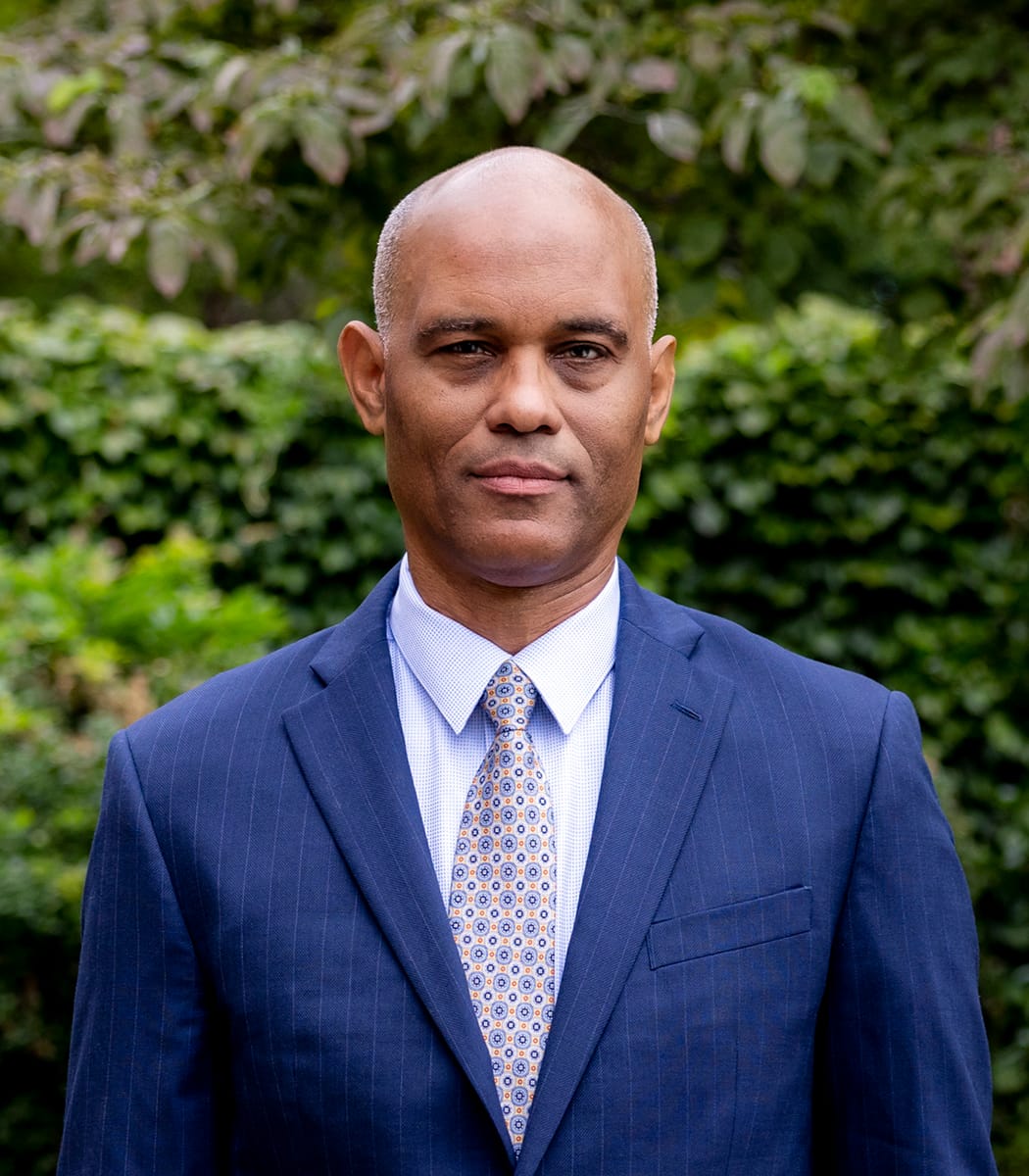
For Thomas Mitchell ’87, the word “impossible” does not apply. From combating systemic racial discrimination in Amherst athletics to creating a major legal reform addressing a form of property injustice not formally recognized 10 years ago, Mitchell pursues justice even when it appears unthinkable. His talent and potential have been notably recognized by the prestigious MacArthur Fellowship, but his work has already fundamentally impacted the college, our legal system, and the next generation of changemakers for the better.
Uncovering Amherst
Mitchell was born and raised in San Francisco, Calif., the child of two East Coast natives and medical doctors. Mitchell attended a private Catholic school for 10 years, where he was one of the first Black students to ever enroll in the institution, and then a competitive public magnet school where he was in the gifted program as well as a quarterback of the football team.
Wanting a college experience that prioritized academics, Mitchell set his sights on Amherst College. Initially, he thought the college did not recruit for football, as he was not contacted by coaches despite receiving attention from Ivy League schools. However, after enrolling, he soon learned that this was the result of a deeper issue within Amherst athletics.
“I was quite surprised to find out that when I showed up, actually they do recruit,” Mitchell said. The issue was that “they almost never recruited somebody who was African American, and if you then showed up, like me, no matter how you did [on] the practice field, they would give you little to no playing time.”
Mitchell observed a pattern where Black athletes would quit their teams after their first year because they felt like they were being treated unfairly. Mitchell himself experienced various racist incidents on the football team, including other players saying racially derogatory things to him in front of coaches.
When he tried talking to coaches and administrators at the end of his first season, they didn’t take his criticism well. “I met with the athletic director who cussed me out and threw me out of his office,” he said.
After this interaction, Mitchell began writing letters to The Student, voicing his frustrations with what he, and many other athletes of color, experienced at the college. In May of 1985, he helped lead a four-hour teach-in on racism on the Converse lawn, which soon led to a meeting with the Board of Trustees.
“I was asked to give my perspective, and that led to the president at the time, Peter Pouncy, forming a task force co-chaired by me and the athletic director, the same one who had thrown me out of his office,” Mitchell explained.
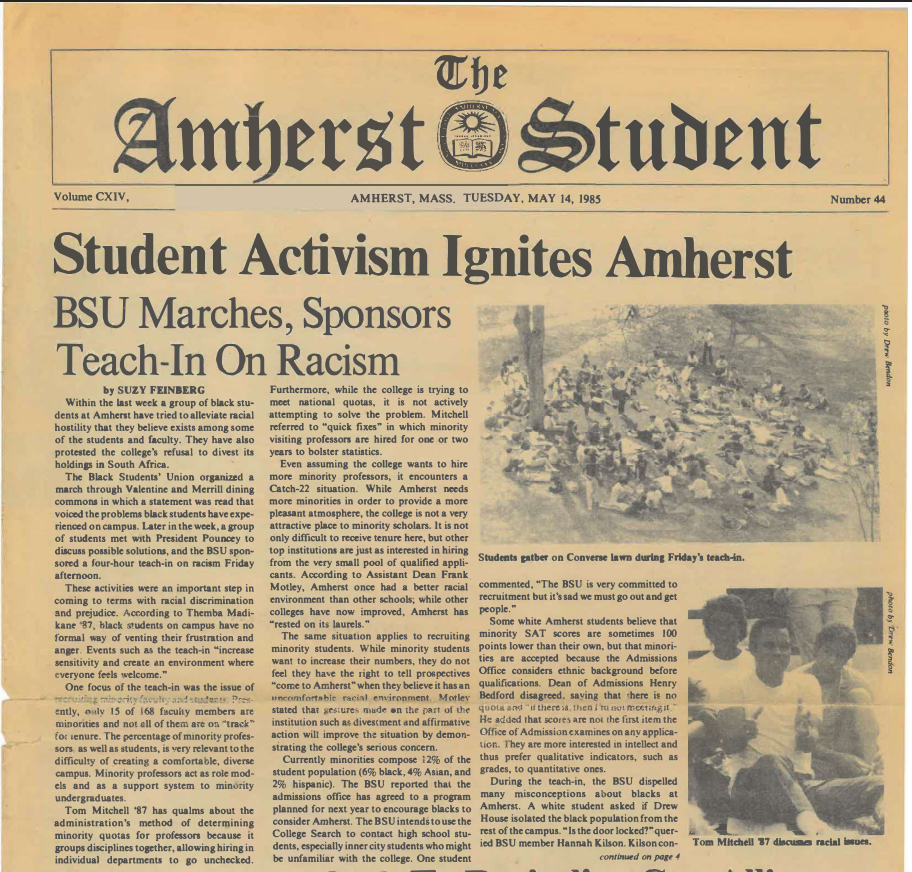
Before accepting the position, however, Mitchell made certain demands. “I told the president I would only accept it if he would give me access to 10 years of recruiting data,” he said. The data showed a history of discriminatory recruitment, which led to the hiring of the college’s first minority coaches.
“People like me were all of a sudden on the various teams, given chances when we were told that we weren’t good enough,” Mitchell explained. “But there were a lot of student athletes who were pissed off at me … We got some structural changes, but it kind of came at a cost.”
Despite the hardships Mitchell endured at Amherst, including financial struggles that jeopardized his matriculation before he received a full scholarship, he credits his experiences with inspiring his future legal career. In particular, he felt that his activism — through making data requests, crafting arguments, and considering remedies — taught him what it means to be a lawyer.
Alongside gaining an affinity for legal strategies, Mitchell’s success in achieving change confirmed his passion for committing himself unfailingly to what he believes in.
“To go up against that [structural issue] and actually prevail gave me this notion that there are a lot of things kind of wrong in our society that people often just think of as structural and something you can’t do anything about,” Mitchell explained. “Having that kind of early success in college … has given me confidence in my legal career and my law reform work.”
Learning Law School
Mitchell’s path to law school was heavily influenced by the financial difficulties he experienced while at Amherst. “I was able to stay [at Amherst], but I often started the semester two weeks late, not knowing whether I was going to be kicked out or not,” Mitchell explained. “And it had a bit of an impact on my grades.”
Ultimately, Howard Law School offered Mitchell a full scholarship; however, the school was not his first choice.
“Initially, I was like, ‘Yeah, no, sorry, I’ll just apply again next year, and maybe get a slightly higher LSAT.’” He decided to attend anyway, after a friend asked him: “‘Do you think if you went to Howard, you’d be the smartest person to ever attend?’”
Despite his initial misgivings, Mitchell found his time at Howard to be an “amazing experience.” In particular, he recalled the invaluable support of two African American faculty members who were also Amherst alumni — George R. Johnson Jr. ’73 and Michael Newson ’64 — who knew of his financial struggles and acted as his “guardian angels.”
Alongside his professors, Mitchell also felt inspired by the long tradition of civil rights architects who attended the institution — including class of 1915 Amherst alum Charles Hamilton Houston. “Being there very much inspired me and gave me the ethos of ‘I want to use my law degree to promote social and racial justice,’” Mitchell recalled.
Similar to this ethos of justice guiding his activism at Amherst, Mitchell also took up student organizing at Howard to bring about what he viewed as important institutional improvements.
“[Howard] had a law review that had not published in like two years,” Mitchell explained. “I led another activism to turn around the Howard Law Journal and to actually start publishing.”
This commitment was one of many factors that made Mitchell’s professors recommend that he become a law professor. However, Mitchell resisted, finding that he was most passionate about policy work. He pursued this path upon graduating from Howard, working on Capitol Hill as a legislative aide for a congressman from rural Texas, practicing law in D.C. at the firm Covington & Burling, and clerking for a federal judge.
One day, one of Mitchell’s Howard professors visited him at Covington and told him about an LLM program at the University of Wisconsin Law School called the Hastie Fellowship, which aimed to increase the number of tenured law professors of color.
Inspired by Wisconsin’s commitment to interdisciplinary scholarship and “the law in action,” Mitchell decided to apply to the fellowship.
However, from the beginning Mitchell affirmed that if he was going to be a professor, he was going to do it his way. “My goal is not to be a superstar among legal academics. I actually don’t really care about that. I want to do enough, hopefully, to make tenure, but I also want to have a life where I’m dealing with many different types of stakeholders, not just academics,” Mitchell said.
Exposing Heirs Property
As an aspiring law professor, Mitchell arrived at his primary academic interest through his personal experiences.
Mitchell described how his hometown of San Francisco had a significant Black population during his childhood in the 1970s, but that it declined in the years since leaving for Amherst. “Every time I went home, it really kind of had this emotional impact on me,” Mitchell explained. These experiences inspired Mitchell’s interest in displacement, which was affirmed by a fateful encounter with his family in Newark, N.J.
Mitchell’s relatives had migrated from the South in the early 1900s after a life of sharecropping, and while in N.J. for his grandfather’s funeral, Mitchell found a photo album with snapshots of his family living in the town of Americus, Ga. Seeing the photos as someone who had grown up in San Francisco was shocking: “The whole thing about slavery and Jim Crow — it’s kind of an academic concept in some ways,” Mitchell said. “[I realized] ‘Oh crap, my family is really from here.’” It kickstarted an interest in not only his family’s history but African American history in the rural South.
Mitchell’s interests in these themes crystallized when he stumbled across a microfiche of a newspaper article in the Library of Congress, describing a family in Georgia who had been effectively dispossessed. “It was just an article in some local rural newspaper on the back pages, maybe four paragraphs, but it just sounded so unjust,” Mitchell said.
Heirs property, which was not officially recognized as a legal term until Mitchell began writing about the topic in the early 2000s, refers to property passed between generations without the involvement of the courts and lacking any legal record. This status means that any co-owner of a piece of property — which increasingly are real estate investors — can use the courts to force a partition and sell the property against the other owners’ wishes, creating land loss that disproportionately impacts Black communities.
After learning about this concept, Mitchell went to a meeting of Black farmers in North Carolina during the first year of his fellowship and heard individuals talk about their experiences with this partition law. “They started describing to me how the law works, and nothing that they said was consistent with anything we had been taught in law school,” Mitchell said.
When Mitchell got his hands on the judicial opinions or orders from the farmers’ property cases, he was shocked to find that the dispossession they described was legally validated.
“I realized there’s basically this alternative legal system that if you are low-to-moderate income, applies to you,” Mitchell explained. “It is totally inconsistent with what’s in the casebooks. And that’s when I changed my [fellowship] thesis midstream, and I started writing about that.”
Mitchell soon began publishing scholarship about this concept with the ultimate hopes of reforming these partition laws; however, he was met with pushback. People would tell him that a change in this field was “impossible” because the individuals affected lacked political and social power. “Don’t waste your time,” Mitchell would hear. “Just be an academic.’”
Mitchell ignored these sentiments, and instead kept writing and doing field research across the rural South. He describes what happened next as “total serendipity”: soon after he published his law review article on heirs property, he got an interview request from Associated Press investigative reporters in New York who were writing what would soon become an award-winning 2001 series on Black land loss called “Torn from the Land.”
His contribution to the article got the attention of the American Bar Association, which formed a task force with Mitchell to address the injustice of heirs property partitions. The group submitted a proposal to the Uniform Law Commission (ULC), asking them to form a drafting committee to make reforms to the partition law and make it significantly harder to force partition by sale. Mitchell explained that the ULC accepts very few proposals, and that “they had never really done anything that kind of implicated social and racial justice.”
Therefore, Mitchell was shocked when, in 2007, the drafting committee was approved and he was asked to serve as the principal drafter, becoming just the second African American who had ever served in this role. He spent three years on the reform, and, unlike most drafters who “see their work as being done once they finish drafting,” began working tirelessly to get it enacted.
Securing the act’s adoption was not without challenges, however. Mitchell recalled how one Uniform Law Commissioner once told him that the reform was in jeopardy of being terminated because ‘“The folks are talking about it as ‘the Black act’ that's being drafted by ‘the Black principal drafter.’”
In response to this, Michael recrafted and universalized his entire message. He increased the number of stakeholders that would feel invested in the issue and formed coalitions that were “both grassroots, but also grass tops,” garnering support from organizations like the NAACP as well as the National Association for Realtors.
“It [was] all about respecting all kinds of stakeholders, and then learning how to develop messaging that responds to [them],” Mitchell said.
As a result of Mitchell’s careful messaging tactics, the Uniform Partition of Heirs Property Act has now been adopted by 27 states and jurisdictions from across the political spectrum. In 2027, five new states will be introducing bills to enact the Uniform Partition Act, and Mitchell now serves as a Uniform Law Commissioner in Massachusetts. Outside of debates in capitol buildings, the impact of the law that he drafted and helped enact cannot be overstated.
“The first time I saw a first-year property casebook that had the term ‘heirs property’ was about 10 years ago, and they cited the Uniform Partition of Heirs Property Act and my scholarship,” Mitchell said. “Now 80 to 90% of casebooks of first-year law students have a section about heirs property; it’s become part of the canon.”
Making Impacts With MacArthur
While working at Texas A&M University School of Law in 2020, Mitchell received a phone call from a representative from the MacArthur Fellowship, which provides a highly coveted, no-strings-attached cash award to individuals who show exceptional potential and creativity.
“I was thinking about developing the scholarship area … I was thinking about training the next generation, which was more than just teaching my regular courses,” Mitchell said of the years leading up to 2020. “The only way to do all that was to burn the candle constantly at both ends. [When] the MacArthur came along it was a huge validation of my work.”
Alongside reporters and media outlets, Mitchell was approached by Boston College Law School after the MacArthur announcement to build a center focused on property rights. “It just seemed logical that, to the extent I’m going to stay a professor, what I should try to do is build a center that had different pillars modeled after what had been successful,” Mitchell said. Alongside a research arm, a policy arm, and a legal training arm, Mitchell was resolute about having a community engagement division in his center.
“I first heard of heirs’ property by being out in the field. It wasn’t any book, it was being at that conference in North Carolina and hearing from the Black farmers about this great injustice,” Mitchell said.
Now the Director of Boston College Law School’s Initiative on Land, Housing & Property Rights, as well as the Robert Drinan, S.J. Professor of Law, Mitchell supervises an interdisciplinary staff of 10 professionals as well as a curricular concentration in real estate and community law, allowing him to tackle critical social justice issues on a much larger scale and train the next generation to take on this work.
Looking Ahead
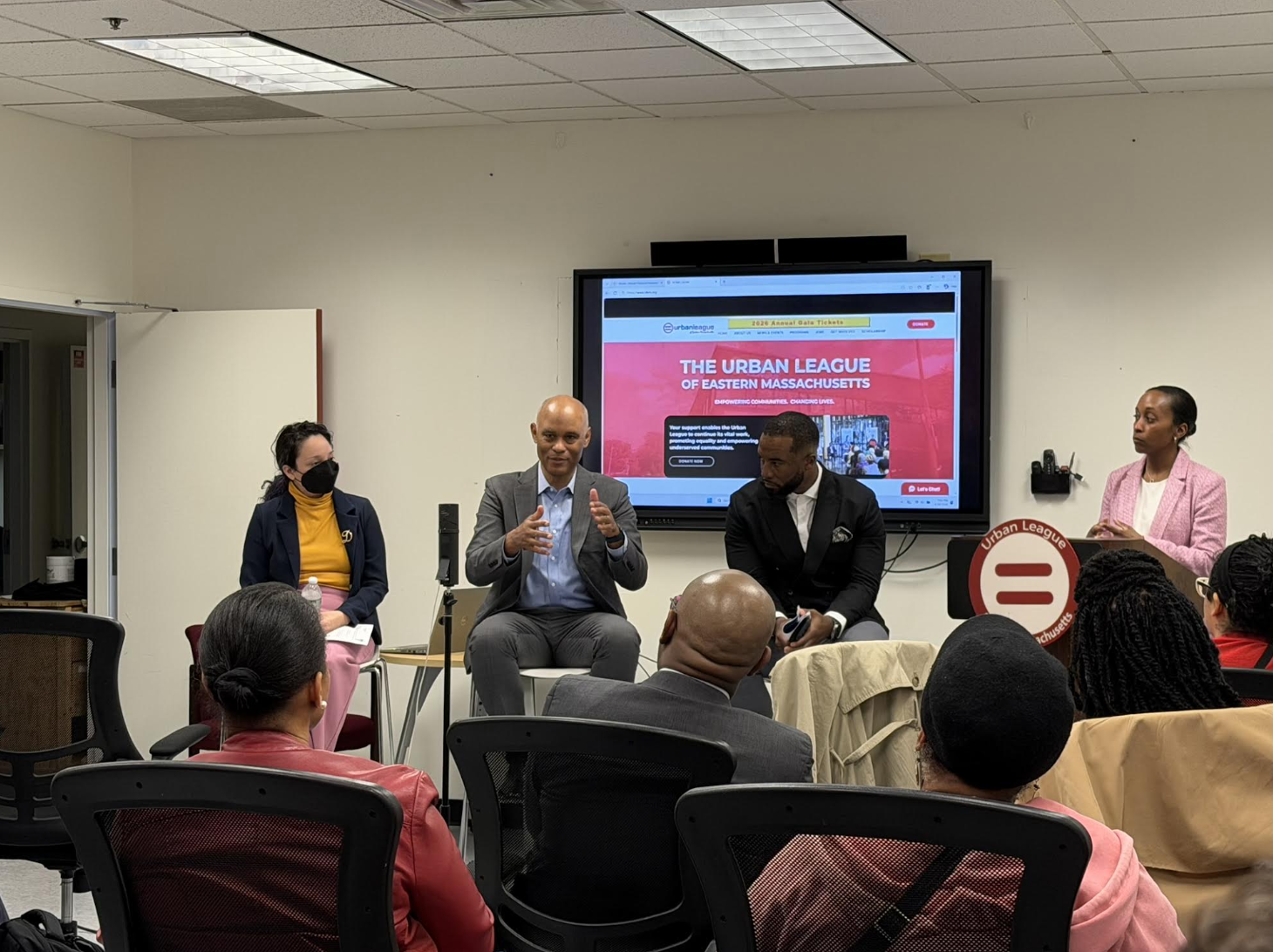
When reflecting on his career and time at Amherst, Mitchell emphasized Bryan Stevenson’s core principle of being present, showing up physically and emotionally even when it is painful or uncomfortable.
“I feel very fortunate that I’ve gotten to know this panoply of people from many different walks of life, many different types of expertise,” Mitchell said. “Get out of the ivory tower, get out of elite circles, and actually meet the folks on the ground, respect their knowledge.”
Mitchell also emphasized the importance of pursuing one’s passion outside of conventional notions of success, urging students to “dig deep about what your contribution is going to be at the end of the day when your obituary is written.”
Most significantly, Mitchell’s story is a reminder to everyone in the Amherst community to never stop advocating for the world and campus they wish to see. “I suspect that Amherst today is not a perfect institution because there are no perfect institutions,” Mitchell said. “I would encourage many people who are differently situated there — whether its students, staff, [or] administrators — to continue [toward] making Amherst a better place so it could be its best version of itself.”



Comments ()