

Amherst Men’s Crew: The Freshmen Impact
Assistant Sports Editor Ethan Niewoehner ’29 profiles Amherst Men’s Rowing Team, looking at the energizing impact of the freshmen class on the team’s trajectory.
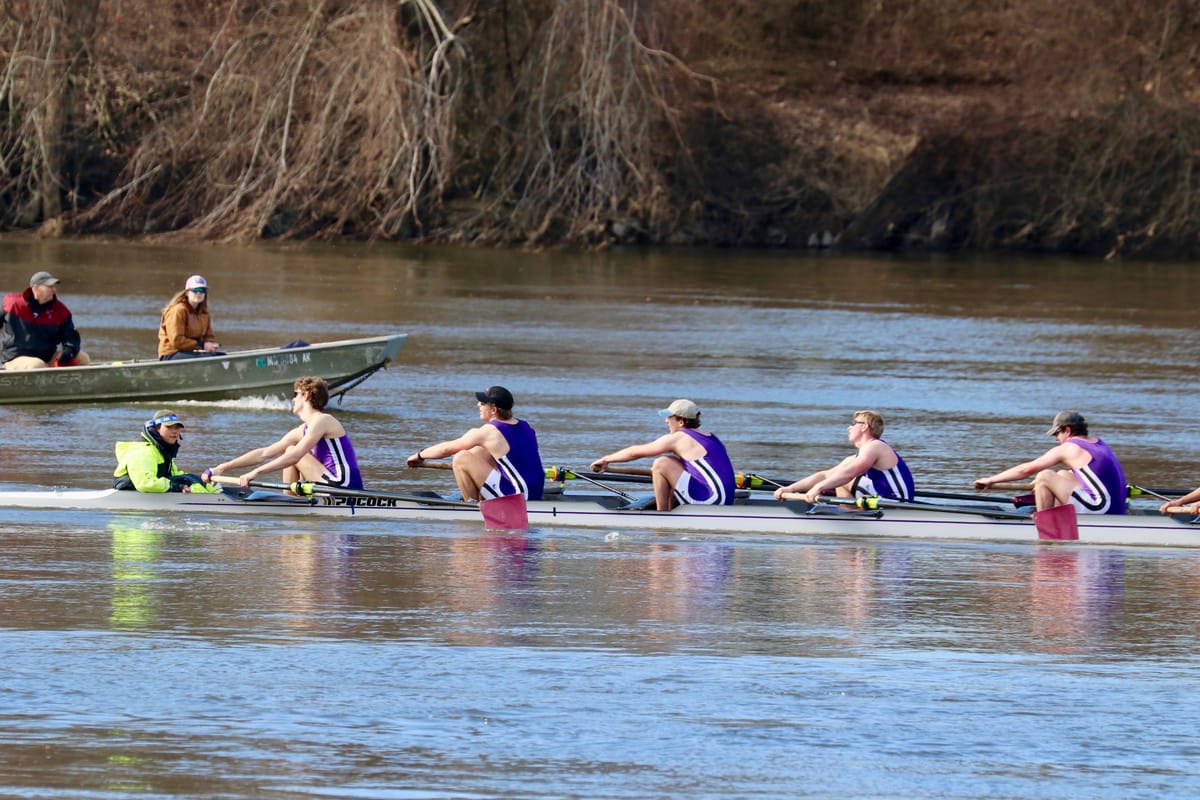
Amherst Men’s Crew: The Freshman Impact
Assistant Sports Editor Ethan Niewoehner ’29 profiles Amherst Men’s Rowing Team, looking at the energizing impact of the freshmen class on crew’s trajectory.
Tucked between locker rooms in Alumni Gymnasium, proudly holding ground in the heart of the college’s main athletic center, is a room reserved for Amherst College’s rowing program — the school’s crew team.
Those on crew call it the erg room, a shorthand for the ergometer machines housed therein. It’s a humble space — the majority of the floor plan reserved for the aforementioned machines, daunting pieces of exercise equipment on which users mimic rowing on open water, enabling them to build endurance and strength while stationary and indoors, yet inviting physical exertion, exhaustion, and pain. Notably, the ergometers are deployed side-by-side in front of a mirror stretching across the back wall — rowers suffer and improve together.
Crammed along the room’s periphery, tokens of the program’s culture and history give the space texture: shoe racks, Nordic skis, yoga balls, foam rollers, and crew apparel jostle against the front wall; old photos of medal-laden rowers and shells gliding through river water crown the back wall; and trophies from years prior pepper the windowsills.
Above the noise, however, and perhaps most revealing in understanding the current state of men’s crew, are four pieces of paper pinned up, which together constitute the men’s ergometer benchmark record book. The four sheets are prominently displayed, affixed atop a corkboard in the center of the near wall, and reflect the program’s strong history. The ledger presents top times in three different tests completed on the ergometer — the 500-meter, 2000-meter, and 6000-meter rows, respectively — stocked with formidable times set by rowers who, for the most part, graduated over one or two decades ago.
Head Rowing Coach Bill Stekl elaborated on how long-standing those top times have been, noting that he once thought they might remain “on the shelf forever,” going unbeaten indefinitely because of just how impressive they were.
But there’s been a shake-up.
Inked in pen above the printed rows of exceptional athletes past is a set of new times, and one new name. After 14 years, Alex Stone ’12’s 500-meter record has been surpassed; after twenty years, Matt Vanneman’s ’06 2000- and 6000-meter times have, at last, been bested. It is now Gus McGuire ’29, a freshman, who owns all three records following his performances throughout the spring test week held earlier this semester.
When asked to describe McGuire’s efforts, veteran rower Seb Pollock ’27 had two words: “phenomenal and inspiring.” During spring test week, McGuire smashed the 6000-meter record, resetting it by almost nine seconds. He gapped the 2000-meter time, shaving nearly four seconds off the previous mark. Perhaps most impressively, he took two full seconds off the 500-meter all-time best. Senior captain Hedley-Lawrence Apfelbaum ’26 contextualized McGuire’s performance, explaining how cutting time becomes increasingly difficult the quicker one rows, and emphasizing that in rewriting the records by the sizable margins that he did, McGuire had displayed “a whole different level of strength and fitness.”
McGuire’s example has served to stimulate the rest of the program. Pollock attributed his own redoubling of efforts to McGuire’s “smashing” of records. Fellow freshman rower Ido Kirson ’29 highlighted the importance of having McGuire as an example as well, saying that the team has rallied to emulate McGuire’s work ethic and commitment in the gym. Stekl says there has been an even broader impact, claiming that McGuire’s hard work has “inspired everyone, including [him], to reach a little higher for the golden ring.”
McGuire’s accomplishments and individual impact are noteworthy on their own but are only part of a greater development in men’s crew: namely, this year’s energizing infusion of freshmen into the team. Thirteen of the 21 rostered men’s team rowers are freshmen this year, a surge of dedicated participants who appear to have had a vitalizing impact on the program at large.
Pollock praised the group for how “committed, dedicated, and [strong]” they have been. Lawrence-Apfelbaum echoed his sentiments, noting, for comparison, that the team only attracts “four or five new first-year students” most years, and commending how “cohesive” and “accountable” the freshman group has proven to be.
For members of the freshman core, their group’s impact has been driven by an easy camaraderie and a shared mentality. McGuire called his freshman teammates “a really good group of guys to hang out with.” Another freshman rower, Beckett Lawrence-Apfelbaum ’29, built on this sentiment, reframing waking up in the morning to row as “getting up to be with your friends.” Critically, though, the freshman class is not only a group of friends, but one with a hardened work ethic.
Forging friendships and working hard have gone hand in hand; McGuire attributes the emergence of a freshman crew fraternity to the shared experiences of the grueling winter workouts, in which the incoming group’s “dedicat[ion] to improving their performance day after day” became obvious. Kirson emphasized how “hungry” they always are, and how showing up time after time has brought them closer together.
As McGuire says, “there’s not really a shortcut to going fast” in crew; grinding out hours on the erg and on the water is the only way to grow. Having a group of guys committed to that ideal, embracing the journey, has helped rejuvenate the team. As Beckett Lawrence-Apfelbaum noted, since each rower has opted into crew’s fraternity, an expectation has been established, that they owe it both to themselves and to their teammates to improve their times, to make the boat faster by working their tails off.
The dominant belief now is that improvement will come, an attitude buoyed by the role model of McGuire and enhanced by the collective zeal of the freshmen class. Stekl talked about “momentum” growing on the men’s team, and every rower I spoke with echoed that same sentiment. There are firm short-term aspirations; Pollock believes that the team can field competitive boats to “potentially [beat] some of the varsity crews” at regattas this April. There are also longer-term goals, focused a couple years down the line. As McGuire put it: “People see that they’ve got four years ahead of them in this rowing thing and by the end of those four years, with all the guys we got together, we could be seriously good.”
Crew at Amherst is only a club sport. This team cannot and does not recruit athletes from high school. Thus, they are at a competitive disadvantage with the other rowing squads — largely varsity boats — in the region, which Stekl called the “most competitive Division III collegiate rowing community in the United States.” But you wouldn’t know they were a club team if you weren’t told.
In their own room in Alumni Gym, surrounded by the proud legacy of a rowing program that had been a varsity sport here until the 1990s, McGuire, the freshmen class, and men’s crew at large are hard at work, fighting for themselves and for each other to develop men’s crew into the best version of itself, attempting to elevate the team into a competitive one in the region once more.
Pollock captured the hopes of the moment well: “I think the future of this [team], with the class of ’29, is headed in a very good direction.” Thus far, still early on in the process, he might just be right.


Comments ()