

An Undefeated Clash: Analysis of the 2026 Homecoming Matchup
Managing Sports Editor Ethan Niewoehner ’29 provides a rundown of what you need to know before the 2026 Homecoming football game.
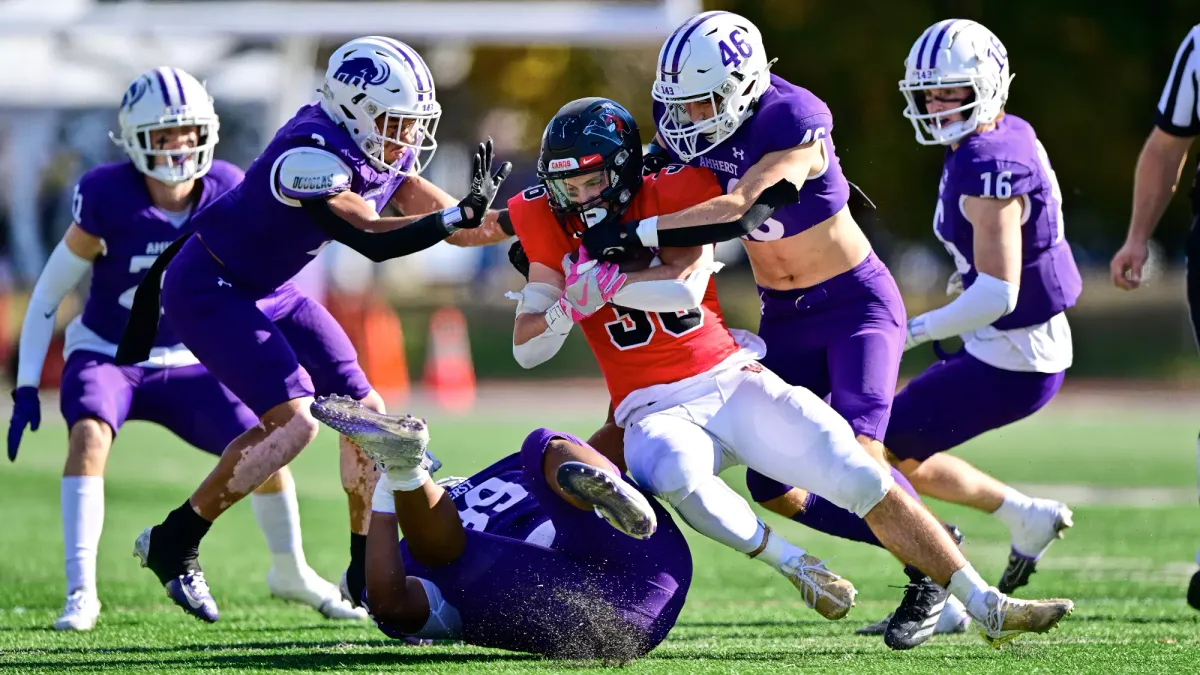
It’s Homecoming week! For the first time since 2015, Amherst will enter its most anticipated home game of the season undefeated, sporting a sparkling 5-0 record headed into Saturday’s matchup against the Wesleyan Cardinals. This weekend, students and alumni alike will take to Lehrman Stadium and envelop Pratt Field in a milieu of Mammoth pride. To properly equip all those attending, whether this be your 100th football game, 10th, or — let’s face it, most likely to be true at Amherst College — first, let’s break down this rivalry’s history and what to expect from both teams this Saturday.
Amherst first played Wesleyan in 1882, losing 8-4 to the Cardinals on a wet field in the neutral territory of Springfield, Mass. The Little Three rivals next met in 1886, and have annually squared off on the gridiron ever since (Covid, World War II, and a momentary dissolution of the Little Three structure in the early 1900s represent the only interludes in this otherwise continuous yearly football feature).
Though it took the Mammoths seven tries to first best the Cardinals, across 130 all-time matchups, Amherst boasts a commanding 73-48-9 series lead. However, while having dominated this rivalry for much of the 21st century – the Mammoths won 16 out of the 20 games from 2000 to 2019 – the Cardinals have flipped the script in the 2020s. Wesleyan is currently riding a four-game winning streak against Amherst, and their program has consistently ranked among the NESCAC’s best over the past half-decade.
Thus far in 2026, the Cardinals have matched what Amherst has accomplished, also bringing an unblemished record into this weekend’s showdown. Against a daunting opponent, how is Amherst going to turn the tide this Saturday?
The first step will be limiting Wesleyan’s prolific offensive attack.
Wesleyan quarterback Matt Fitzsimons is back under center as the Cardinal play-caller this season, and the senior has been torching NESCAC competition. After starting seven games last year and posting gaudy numbers in his first go-around, Fitzsimons has improved upon what was already an impressive baseline performance. This season, he is completing passes at a 73% clip and averaging nearly 300 passing yards per game. For reference, quarterbacks are considered accurate if they complete 60-65% of their passes and considered prolific if they average ~250 passing yards per game. Fitzsimons races by both targets.
He does so by throwing to a deep and talented stable of wide receivers. Blake Newcomb is the first name to know, as the senior has caught 22 passes for 442 yards and 4 touchdowns this year. He has led the Cardinals in receiving yards as well as surpassed 100 yards receiving three times this year, and poses an ever-present threat for the Mammoth secondary. However, only so much attention can be allotted to Newcomb, as Donte Kelly, Sean Cannon, Keith Capuano, and Diego Velez all also average at least 30 yards of receiving per game. Amherst has done a good job of holding opponents’ passing attacks in check this year, conceding only four passing touchdowns and limiting opposing quarterbacks to a measly 5.99 yards per attempt, so they can expect to somewhat curb the Cardinals’ passing attack. Winning the secondary battle, however, is only the beginning for this Mammoth defensive unit.
That is because Wesleyan is also effective in the ground game. A wrench in any defensive scheme, Fitzsimons is liable to scramble, doing so effectively albeit sparingly. He has only rushed the ball 25 times this season, but has turned a remarkable 20% of those carries into touchdowns. Moreover, the traditional Cardinal rushing attack packs plenty of its own punch. Matt Diaz and Angelo LaRose spearhead a running back tandem which has churned yards this year, each averaging 4.3 yards per carry.
Here though, is where Amherst excels. The Mammoth defensive front has lived up to their moniker this season, engulfing opposing running backs all season long. Duncan Jackson ’27 leads the unit in tackles with 20, though Morgan Wyatt ’28, Romain Avery ’28, and Josh Kuczynski ’28 all have nine or more as well. Outside of the trenches, what makes this Amherst scheme so effective against the run is the downhill nature of the linebacker core and secondary unit. The top six tacklers for the Mammoths are all linebackers or defensive backs, and those are the players who plug the holes and snuff out opposing runs, foiling most of the rushing attacks they have faced this year. Against Bates, Hamilton, and Bowdoin, Amherst allowed a combined 105 yards of rushing offense – one yard fewer than Amherst’s per-game average.
Given Amherst’s strong rushing defense, teams have tended to throw the ball more against the Mammoths than they normally do. That makes sense for this Wesleyan side that is eager to move the ball through the air. Therefore, one should anticipate ample passing this Saturday accompanied by a hotly contested ground game when Amherst is on defense. Wesleyan are averaging 34.8 points a game this year and have the second most explosive offense in the NESCAC. Amherst’s defense should temper some of that production — and one might even hope for a momentum-swinging turnover or two from a unit that procured four interceptions in one game earlier this season — but only so much can be asked of that side of the ball. Simply put, Amherst will need to score to win this game. They appear up to the task.
While Wesleyan has scored the second most points in the NESCAC this season, Amherst has tallied the third most, despite quarterback Marek Hill ’28 missing time. When he has been on the field, Hill has taken a step forward in his play this year, elevating this burgeoning Mammoth offense alongside him. Hill has improved across the board, cutting back on turnovers, throwing more touchdowns, and delivering passes with greater accuracy. His maturation manifests in twin sophomore studs Max Alexander ’29 and Jadon Davis ’29, who have been his beneficiaries, hauling in over half of Hill’s targets this year for 348 yards and 273 yards on the season, respectively. Look out for freshman speedster Cam Fowler ’30 in the passing attack as well, as Fowler leads the team in yards per catch, and though not a volume target, is an ever-present threat to burn the Cardinal secondary the long way.
Complementing Hill and his selection of downfield threats is an insistent Amherst run game. Dimitrius Smith ’27 and Michael Dunmore ’29 are Amherst’s go-to backs, and Hill provides the occasional spark with his legs as well. This running game keeps defenses honest against the Mammoths, and its primary purpose is to set up the chunk yardage plays found through the air by Amherst.
Wesleyan has predominantly played staunch defense this year, holding four of their five opponents to fewer than 13 points. Yet they are fallible. Against Hamilton, they conceded 38 points and were gashed by the Continentals for nine plays of 20 or more yards. Those explosive plays came on the ground and in the air, and were essential to Hamilton’s success against the Cardinals. Such plays would be invaluable for Amherst as well.
For the Mammoths, Saturday is by no means straightforward. Wesleyan is, by a margin, better than any of the opposition Amherst has faced thus far this season. Their offense is captained by a dynamic quarterback and anchored by a forcible run game. Their defense is sticky and stingy. Yet the Mammoths are not 5-0 by accident. They have showcased an unteachable and unshakable winning mettle every game of this season, and are by now comfortable if not even confident in trying game situations.
This Saturday, the environment at Pratt Field will be raucous, the Mammoth hosts invigorated and the Cardinal guests demoralized. While the game promises to be an offensive, action-packed affair, no certainty can be ascribed to its outcome. But how can one not be optimistic about this Amherst squad? How could one not like the chances of this defense and offense and team culture?
Win on Homecoming. Beat Wesleyan. Improve to 6-0.



Comments ()