

I Phone Detoxed for 16 Weeks, and I Refuse to Get Bricked
Staff Writer Irisa Teng ’29 dissects Amherst Students Against Phones, arguing that their sixteen-week personal phone detox shows the value of intentional, self-directed digital habits over imposed tech-fast programs.
Two weeks ago, the Association of Amherst Students (AAS) broadcasted a new initiative organized by “Amherst Students Against Phones” (ASAP). The goal was to get Amherst students to increase productivity by completely ditching their phone for 24 hours, from noon Sunday to noon Monday. First years Ido Kirson ’29 and AAS senator Beckett Lawrence-Apfelbaum ’29 had only practiced this tech fast for three weeks by the time they pitched their idea to the entire college.
I have practiced a weekly phone detox for the past 16 weeks with a different methodology that I still plan to refine for the rest of my life. Compared to ASAP's founders, I have had a very different and difficult experience with phone detoxes.
For more than three months, I’ve considered my own relationship with portable digital technology and social media addiction. I believe that ASAP is structured around an unstable time frame, relies too much on external accountability devices, such as the app “Brick,” and ultimately fails to tackle the core issue of phone addiction: giving into impulse over intentionality.
It goes without saying that everyone has a different relationship with their phone, and I am not a licensed psychologist. I am, however, a test subject who has consistently followed a detox schedule for 16 weeks and counting, so I’ve learned quite a bit about detaching from my phone.
My Detox
I started detoxing in the middle of winter break, after I realized that having daily 10-to-12-hour long screen times wasn’t sustainable. I needed to quit something that was feasible and feel in control without losing connection to that vibrant world of memes, music, and games I had cultivated. Challenging my self-restraint wasn’t new to me: I went on a 51-day Google Hangouts fast in 2020, and I quit caffeine starting January 2025. I could start detoxing from my phone now.
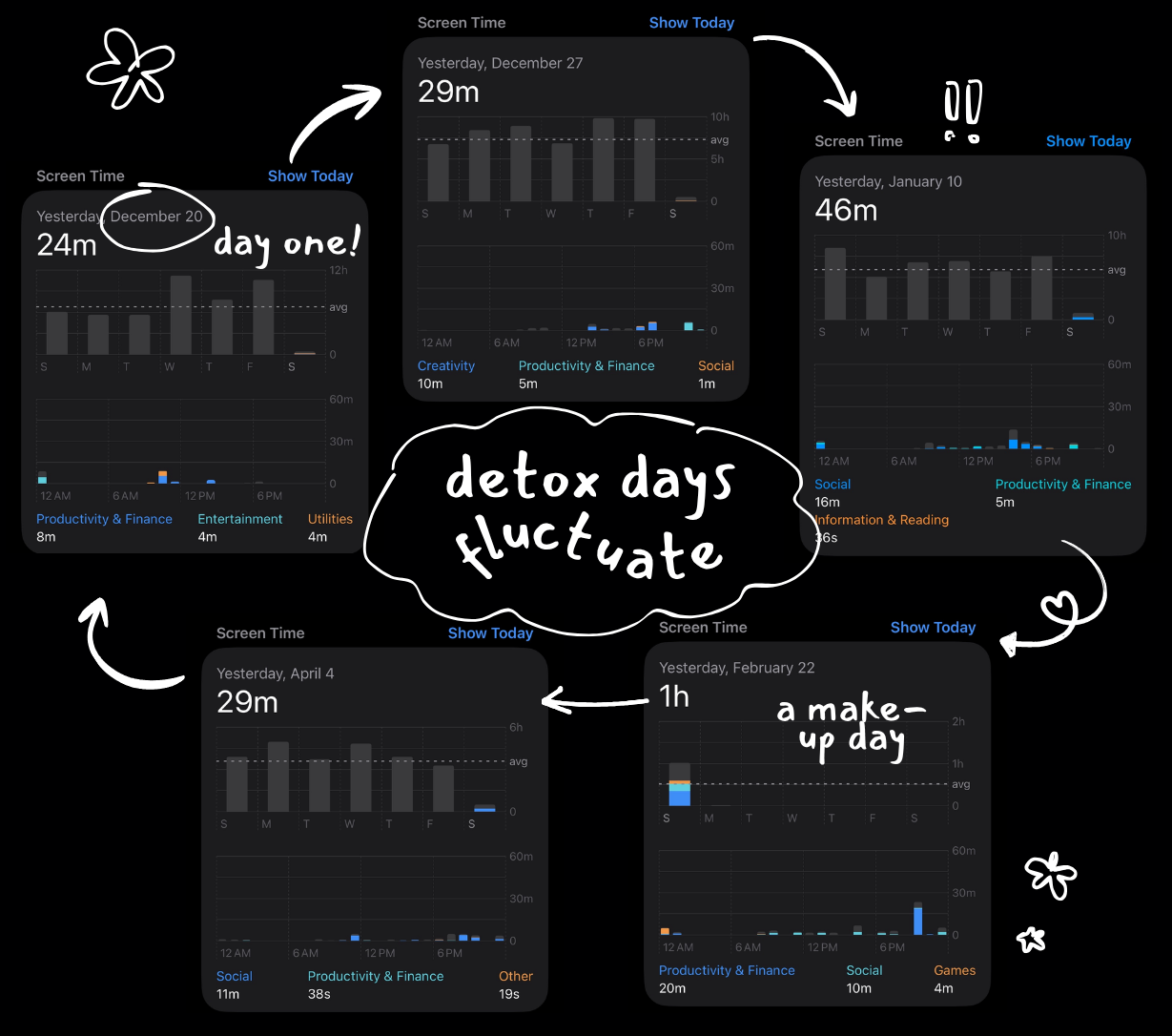
Of course, I couldn’t just throw my phone away: I text people on there! I take photos and listen to music while pacing around my house and campus! Instead, I aimed for a much easier target: once a week, I would lower my phone time to less than one hour.
- The detox starts every Saturday at 12 a.m. and ends the same day at 11:59 p.m.
- I will not have a screen time of over 60 minutes on my phone. This does not apply to laptops, TVs, and other devices.
- If my screen time exceeds 60 minutes, I must retry on Sunday and again on Monday until I succeed. At which point, I wait for Saturday again.
- I avoid looking at other people’s phones — or, as I call it, “secondhand screentime.”
I chose Saturday because it’s the easiest morning to get trapped in a cycle of bed rotting. I theorized that if I started off the weekend productive, then I’d be much less stressed by Sunday night. I picked a midnight-to-midnight time frame so I could easily check my screen time in Settings for accountability.
So, I put my detox into motion. The first thing I noticed was that I began using my laptop more often. Instead of scrolling, I watched longform YouTube videos and TV episodes. This didn’t change the fact that I was immensely bored; I itched to play the Watermelon Game while I watched “The Bear.” But I forced myself to set my phone face down and ignored it.
Before I knew it, the day was over. Even now, I jump for joy whenever the clock hits midnight, like some kind of anti-Cinderella. But if you’d asked me then how long I thought I’d be able to keep this up, I would’ve told you that I already knew I could do it forever. The day felt short enough, and I’d succeeded on my first try. I was excited to discover what else could be possible.
- I am not allowed to engage with the act of scrolling on social media in any capacity, whether on my phone, my laptop, or other people’s devices.
- I do not have to detox that day if I am travelling on a plane (inspired by Ramadan fasting rules).
Weeks later, I slowly refined my mission. I was initially afraid of using my phone at any time for longer than a few seconds, but I realized there were still innocent, non-addictive tasks I could use my phone for. I recorded long videos and took careful photos while staying under one hour. I stopped thinking of my free time as a void but as the opportunity to build something new within it. I joined a January Pages Challenge and read one chapter of “Wuthering Heights” every day — even when I wasn’t detoxing.
Ironically, the detox got harder after winter break ended. You would think that having more work to do meant the phone would become less relevant, but I found that everything revolved around it. My friends arrived back on campus, so I received more texts about hangout plans. I always needed to check my email, and there were more commitments I needed to keep up with. Who knew that pairing a stressful workload with phone withdrawal would only make everything worse?
But I knew I could do it. Inspired by my friends who already had lower screen times than I did, I started switching on a grayscale filter every Saturday. I removed both “tap to wake” and “raise to wake” so my phone would never turn on when I didn’t want it to. I created a focus mode that only allowed notifications for messages and calls; it was helpful that I’d already blocked all Instagram notifications for over a year. I continued to dumb down my phone without deleting or downloading any apps at all.
I paired all of this with more in-person commitments. I took harder classes, invested in an “everything journal,” and enjoyed 15-hour theater rehearsal weeks. This year, I have already watched thirty movies and read seven books, roughly double the amount I had finished last year before April.
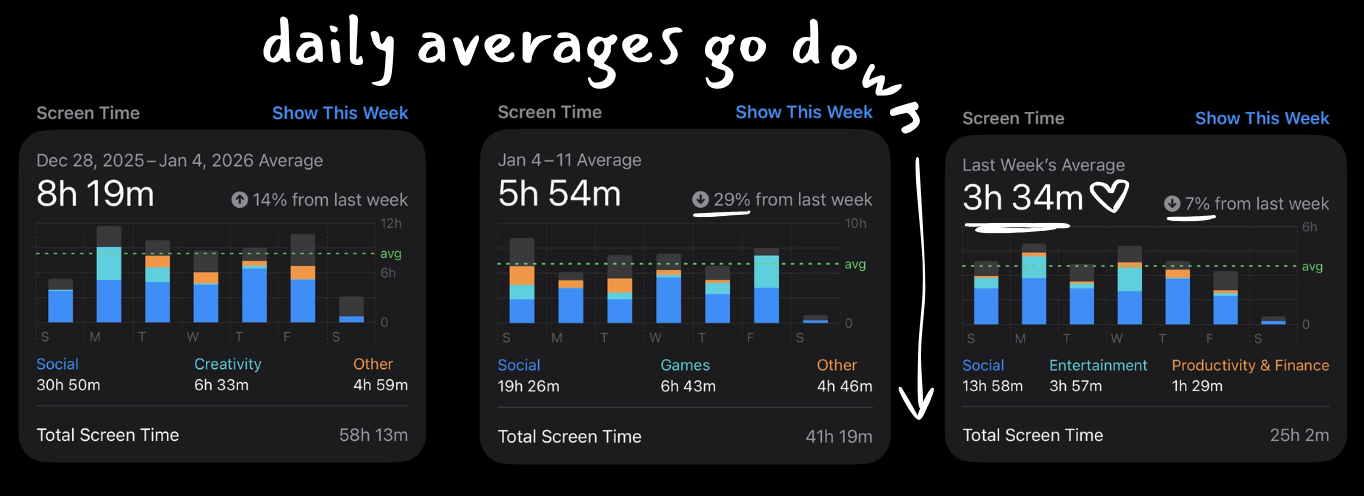
All of this was something to be proud of. By the end of every Saturday, I could confidently say to myself: yes, I did that, and just because I wanted to, without anyone holding my hand through it. Pride, I found, was the greatest dopamine boost of all. I beam inside each time I look back on this experience, knowing that I’ve successfully detoxed for 16 weeks. And counting.
Another Way Out
None of this is to say that it’s easy. None of this is to fall into the cliche trap of demonizing the phone — the very reason I chose not to participate in ASAP at all. The phone itself does not need to be a prison; what makes it addictive are the attention-stealing algorithms, invisible tactics like unlimited scrolling, and our daily enablement of these habits. All my friends know that I love my phone like a baby, and I revere the internet like no one else. But I cherish these things because we can physically overcome them; how beautiful is it to hold the world in your palm and be able to close it at will?
What I am trying to demonstrate is that it is possible to love your phone and still be in control.
When I first encountered AAS’s initiative, I cringed. Every element that made my detox successful was missing in ASAP: feasibility, simple methods of accountability, lifestyle changes, and intrinsic motivators. I saw ASAP as an easy, progressive-enough project that hinged more on passing interests and college optics than grounded in real-life experiences.
When I constructed my own detox, I made sure to put the responsibility on myself to disrupt my compulsions. Locking the phone away was just not possible; no one genuinely addicted to their phone would consent to that. In the past, I’ve used other focus apps such as Focus Flight, One Sec, or even Apple’s built-in app limits, but I’ve found that those are too easily bypassed. I didn’t want to replace my scrolling addiction with an overreliance on another app, as if I was asking my mom to manage my time for me.
So, I chose a post-detox measurement system instead. I threw myself into the fire and tested how long I could hold up. I trained myself to be able to hold my phone close and still not look. I turn it on, send a single text, and then turn it off without checking anything else. On non-detox days, I’ve recently started to feel disgusted, if not bored by my phone screen when I have no need for it. I’ll stare at my wallpaper and realize I have no impulse to look at anything else.
I can appreciate a well-intentioned movement to shift Amherst away from phone addiction, but I can’t appreciate one that recycles mainstream (and in my experience, failed) methods and doesn’t promise anything new. Why did we need to spend college funding on two $59 plastic boxes? Are we all supposed to purchase this ourselves after we graduate? What about Brick makes it so much better than any other productivity or focus app?
Additionally, ASAP chose possibly the most stressful time to set their phone fast — during the Sunday scaries, when everyone crams their weekend homework! I can’t emphasize enough how difficult it can be to detox your phone, especially after growing up alongside it. All my successes so far have been built upon weeks and years of trial and error in detoxing as a practice. Even after that, I still feel noticeably happier on non-detox days. I can’t imagine cramming all my work while not even being allowed to laugh at a pick-me-up meme.
But there’s another key factor I neglected to reveal. I said I started my detox because of my long screen time, but it wasn’t purely because of that. I had just watched the third season of “The White Lotus,” where a family gave up their devices for an entire week as part of a resort’s no cell phone policy. I watched this cliche — almost identical to ASAP’s initiative — and ironically, found inspiration. Though if I’d simply followed suit without letting the detox blossom and change to fit my needs, I would’ve never learned this much about myself, nonetheless been so successful.
To ASAP: I hope you learn not to fear your phone but to be grateful for the pliability that it carries. Or if you prefer, I hope you fear phones forever, and let it drive you to reflect on and change the rest of your life without relying on buzzwords. Just as I was inspired to improve upon the phone fast in “The White Lotus,” I pray someone else is inspired to move beyond yours. But I know this inspiration won’t have come from getting Bricked.

Comments ()