

Memos From the Film Society: “Pillion” Reviewed
Staff Writer Harry Finnegan ’28 reviews “Pillion,” which centers around the relationship between a dominant biker and his new partner. Finnegan writes about deep themes of love, intimacy, and power that is explored throughout the movie.
You’re asked to define one word over the course of “Pillion” (2025), and it isn’t the one in the title. The word pillion itself refers to the slightly higher seat at the back of a motorcycle that lets one person sit on the main seat and steer while someone else holds on for dear life behind them. Director Harry Lighton often uses the image of this seat in his film, in very different ways each time, but he never defines the word — one can reach the end of the movie without knowing its meaning at all. Instead, the word he actually wants you to define is rather devilish in its simplicity: love.

The apparent love within the film comes from its central relationship between a dominant biker, Ray (Alexander Skarsgård), and a newly submissive parking attendant, Colin (Harry Melling). Lighton charts their relationship — including all the ups and downs of a liberal BDSM couple — with a wonderfully assured hand for a first-time director. His characters often express things quietly or wordlessly, with dry humor lacing dramatic scenes. All the while, nothing feels muddled, and the ambiguities at play only make the viewing experience stronger.
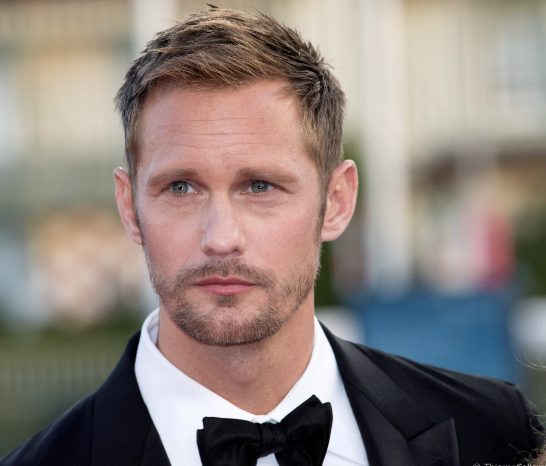
The film is largely a two-hander — a given, since it deals so intimately with a single relationship. Both Skarsgård and Melling are up to the daunting task given to them by Lighton. Skarsgård, described within the movie’s dialogue as being “impossibly handsome,” is a rising star, a Swede playing a Brit, and an enigma within the film. But the layers he adds to Ray through his word choices and on-screen actions allow the viewer to work to understand his interior conflicts, even while the character stays at a distance unable to be truly crossed.
Melling, in the main role as the sensitive and sweet Colin, is the linchpin of the entire project. If you’ve seen Melling before, it’s likely either as Edgar Allan Poe in “The Pale Blue Eye” (2022) or from his childhood role as Dudley Dursley in the “Harry Potter” films, and he brings a bit of each into Colin. From Poe, he steals the soulfulness, the eyes that feel like they are constantly seeing deep into the depths of the other characters, and might even see through to the audience. From Dudley, he takes the sense of childishness that Lighton recontextualizes as naivete and a hope-filled wistfulness for love. These two factors, combined with a new and mature persona as a leading man, make Colin an unusually realistic romantic lead that Melling realizes to his fullest extent.
You’d be forgiven if, after reading these character descriptions, actor praises, and especially seeing the trailers and reading other reviews, you thought this was a romantic comedy, or even simply a romantic movie. While it certainly has funny moments and interactions that sweep you off your feet, Lighton’s film isn’t trying to do that, for better or worse. Colin and Ray are in a relationship that is real, not like those usually seen in romantic comedies or even most romantic dramas. This is not a light occurrence of love, and it would perhaps be best to ignore those trailers that painted it as such.
The heaviness in their relationship comes in more ways than drama. This film is highly sexual. Lighton explores their intimacy in a graphic yet never gratuitous way. If you were to watch even the tamest moments in person, you would certainly be shocked, but in this movie, everything feels normal. Melling and Skarsgård also work hard to sell these scenes, as do the legions of intimacy coordinators that must have been hired to put it all together.
Of course, there is the question of how much this needs to be shown on screen. An increasingly prevalent conversation continually surrounds depictions like this, all concerning the extent to which sex scenes are relevant to a story. Lighton, seemingly aware of this conversation, structures the movie so that each of these scenes serves a purpose, either advancing the plot or the characters.
But he still necessarily leaves this question unanswered. That big, undefined word is always hanging over every image: love. Colin and Ray exist at the intersection between a purely sexual relationship and something more complex. The push and pull of romance and sex are always at different levels in any partnership, and theirs is no different. Through the depiction of their time together, Lighton turns questions of relationships and intimacy on the audience: What boundaries do you establish? What do you want from a relationship? These questions are ambiguous and difficult, and ones that Lighton has the wisdom to let the viewer answer for themselves.
However, despite all the openness to interpretation, Lighton still nudges the needle in one specific direction. Specifically, his sympathies land more firmly on the side of Colin, the more romantic of the two, as opposed to Ray’s sexual focus. It is difficult for the audience to ignore this bit of authorial intervention, even if it does follow naturally from Colin’s status as the main character. Just this little bit of judgment may seem minor, but it’s enough that it almost threatens to collapse the whole ambiguous picture.
Still, viewers can understand the relationship without giving in to either side. Lighton’s direction remains clear, visual, and dynamic throughout, and you get extremely close to both main characters. It’s an intimate film, metaphorically and literally. If you put in the work to define love, yours and the film’s, for yourself, and if you let the images sink in, any viewer is sure to be rewarded.


Comments ()