

Michael Sandel Speaks on Meritocracy and Higher Education
On Wednesday, Professor of Government at Harvard University Michael Sandel gave a talk titled “Meritocracy and the Common Good: What Makes Higher Education ‘Higher’?” Sandel warned that one of the main issues with meritocracy is that it creates a false impression of deservedness.
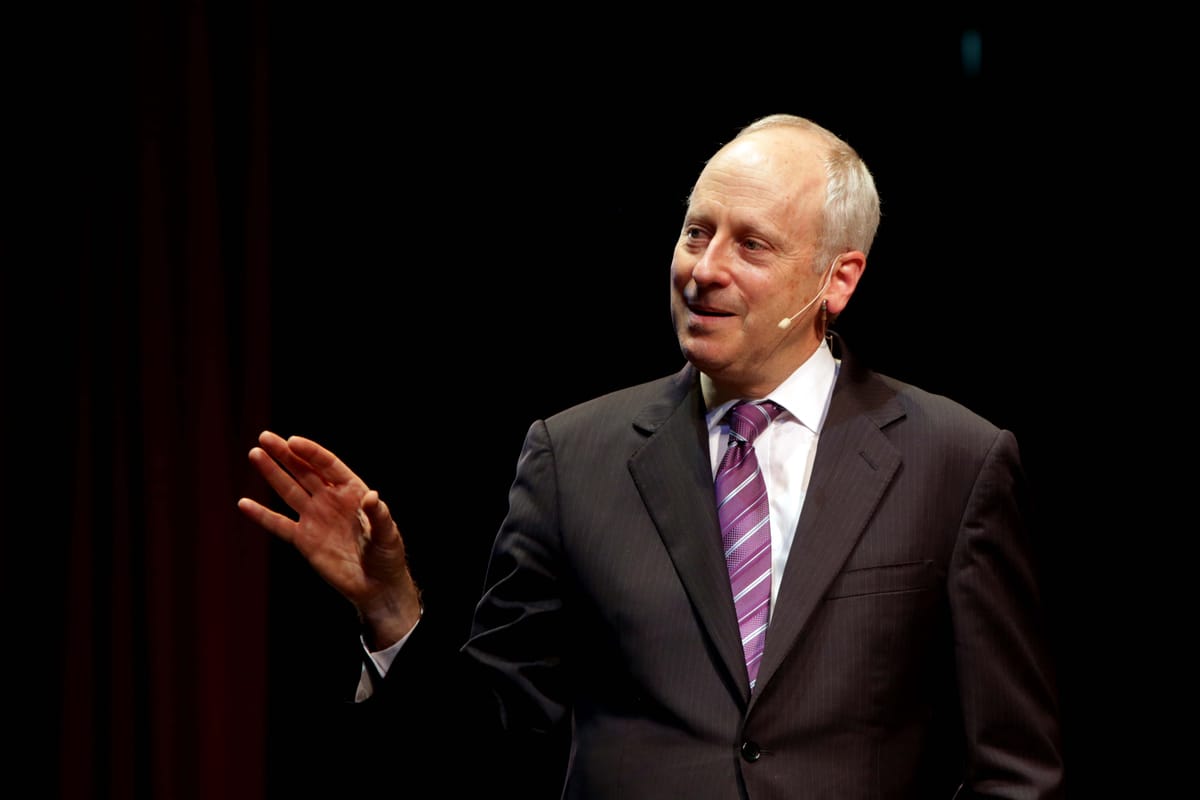
On Wednesday, the college hosted Anne T. and Robert M. Bass Professor of Government at Harvard University Michael Sandel for his talk, “Meritocracy and the Common Good: What Makes Higher Education ‘Higher?'”Attendees received copies of Sandel’s most popular book, “The Tyranny of Merit,” in which he interrogates the productivity of a meritocracy. This discussion raised critical questions of the role of higher education in America’s “meritocracy,” and how Amherst can offer more equitable opportunities for “the common good.”
William Nelson Cromwell Professor of Jurisprudence and Political Science Austin Sarat introduced the talk, recognizing that many Amherst classes over the years have read Sandel’s books. Sandel’s books on justice, democracy, ethics, markets, and the common good have been translated into more than 30 languages, and he has been described as “the world’s most influential living philosopher.” Sarat explained that the idea for the event came to him in the spring of this year, when faculty gathered “about engaging students with the question of not what they want to be, but who they want to be.” Sarat made it clear that his priority to teach students not only vocational skills, but “people” skills as well, is one that is shared among other educators at the college.
Sandel opened by explaining that America’s meritocracy is inequitable, as the divide between its “winners” and “losers” is only deepening. People in a meritocracy credit succeed with hard work and “deservedness.” If one succeeds, it is a product of their own doing, and by implication, those left behind also deserve their fate. This is a dangerous assumption, he said, as everyone’s paths to success are not equal: Some people are simply born more talented than others, and these talents are only rewarded if people are fortunate enough to live in a circumstance or time when these talents yield success.
Sandel warns that one of the main issues with meritocracy is that it creates a false impression of deservedness, fostering hubris in winners and shame in losers. He explains that the term “meritocracy” actually originated as a dystopian idea. Its coiner, British social theorist Michael Young, worried that the more realized a meritocracy gets, the more judgment and humiliation gets placed on its losers.
This led Sandel into the current political moment, where he categorized working-class backlash against elites as frustration with the meritocracy. He argued that Americans have falsely been fed the “rhetoric of rising,” upward mobility that is contingent on higher education. He explained that the completion of higher education became a prerequisite for success, positioning American colleges and universities as the determiners of who succeeds.
Universities have profited from this power, as admissions percentages are the most common metric for college rankings. Since it is in a college’s best interest to lower its admissions percentages, its ultimate goal is to exclude. This is a part of a broader trend in American society — where institutions participate in a “cult of exclusivity,” according to Sandel.
But meritocracy is unfair not only to those excluded from pathways to success; Sandel argued that it is also unfair to those who are sorted in. He explained that the cult of exclusivity has created an environment where adolescents face intense pressure to succeed, fostering competitive mindsets at a young age. He pointed to the college admissions process, in which students and their parents will do anything to get their child “sorted” into a prestigious college, so they can get “sorted” into a prestigious job.
Sandel explained that a meritocracy makes people constantly chase a moving target, a “soul-destroying demand.” He reminded the audience that, though a meritocracy suggests upward mobility is within reach, few people actually achieve this transition. He pointed to a study of 1800 universities across America that found only about 2% of American college students rise from the bottom fifth of the income distribution to the top fifth, a rate that’s similar across most types of colleges. The study reported that this rate has been slipping, because the colleges that did this best, like SUNY Stony Brook and Glendale Community College, enrolled fewer low-income students over the 2000s.
Sandel concluded that the system of meritocracy corrupts the purpose of learning in higher education, as universities and their students get increasingly focused on vocational success. He proposed that the “equality of condition” should govern society. This system would honor the dignity of all work, not just credentialed work, with the goal of reminding people to work for the common good.
Sandel reminded the audience that “we are not self-made, nor self-sufficient,” and that instead, we must remember that “we are engaged in a mutually beneficial society in which we all rely on each other.” Colleges have the opportunity to lay the groundwork for this system by expanding educational opportunities outside of their exclusive campuses. Radically, he even suggested some colleges admit students based on a “lottery of the qualified.” Regardless of whether or not one agrees with Sandel’s proposed solutions, his talk is a reminder for students and colleges to “answer to a higher mission” — one for the common good.


Comments ()