

Presidential Spotlight Discusses Liberal Arts Education
On Thursday, Professor of Russian and Director of the Center for Humanistic Inquiry Michael Kunichika, and President Michael Elliott hosted a webinar as part of the college’s Presidential Spotlight Series. The webinar discussed the advantages of a liberal arts education amid various challenges.
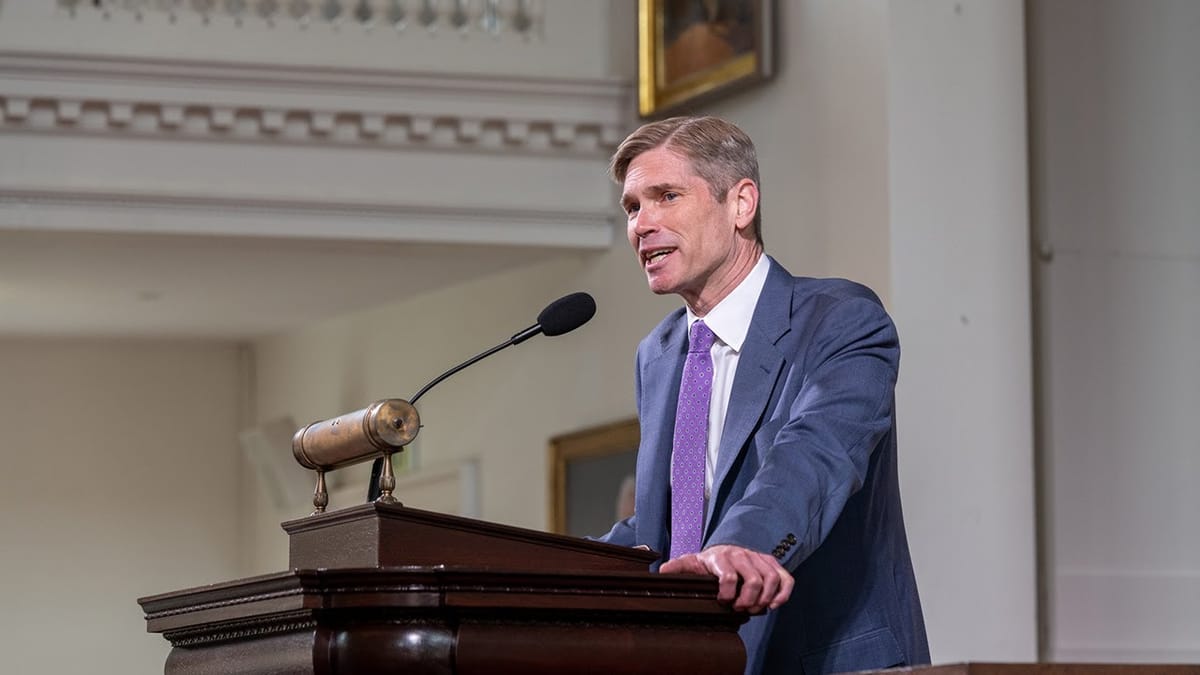
On Thursday, President Michael Elliott was joined by Michael Kunichika, chair of the Russian department and director of the Center for Humanistic Inquiry, for a conversation on the pertinence of a liberal arts education amidst challenges to higher education, such as rapid artificial intelligence (AI) development and debates surrounding open inquiry.
The webinar, titled “A Liberal Arts Education in a Changing World,” is part of the college’s Presidential Spotlight Series. Hundreds of students, alumni, and faculty attended the event, and over 50 participants submitted questions in advance. Questions revolved around themes including the advantages of a liberal arts education, challenges around institutional AI policies, and the student body’s shift away from humanities.
Elliott noted the faculty’s efforts to make Amherst seem less like a place that students simply “pass through” and “pick up a credential” from. He and Kunichika focused on navigating the balance between making Amherst more than a pre-professional experience, equipping students with the skills to be successful in the world beyond Amherst.
“We have to think about [education] in a nontransactional way,” Kunichika said. “It is going to enable [students] to have a set of skills that are permanently valuable to them, while also thinking that we need to translate those kinds of skills that would be valuable for a potential employer.”
Kunichika highlighted several advantages unique to liberal arts institutions: smaller size, deeper investment in faculty — meaning less use of AI to supplant human educators — and a collaborative approach across disciplines.
“You can take a course in art history to get a sense of the development of a particular kind of visual aesthetics. You can take a course in philosophy to develop your sense of knowledge and ethics,” he said. “There are these different capacities around, aesthetic judgment, ethical judgment, having historical sensibility, so you can have a sense of where you may be within a continuum of things.”
When it came to AI, which both speakers believe is quickly changing classrooms across the world, Elliott and Kunichika focused mostly on the ongoing uncertainties surrounding its impacts on teaching style and course content, “Our job right now is to try to assess what it is, but also how it’s falling into a lot of predetermined cultural narratives, and we’re making a lot of decisions potentially without fully grappling with [AI], or without being really able to get a handle on it,” Kunichika said.
Kunichika also discussed the more practical implications of AI development, namely its effects on student writing and the questions of academic integrity surrounding it. He noted that faculty approaches vary widely, from banning AI use altogether to requiring that students cite AI when used. He explained that he adopted the latter approach in his classes.
“I think AI for many [students], at least vocally, is something that they’re not here to cheat [with], they’re here to learn to become better writers,” Kunichika said. “We spend a lot of time on grammar and composition, and I think that they are already detecting that AI tends to produce pretty flat prose. So that for me has been really a wonderful experience, especially [as] somebody who struggles intensely also with writing.”
Another challenge to a liberal arts education, according to Elliott, is the general shift among undergraduates toward science and mathematics, and away from humanities.
“As humanists, we have to make a case for how what we do has a value for them as they think about their lives. The study of the texts of the past, of art, of music will help us move through this remarkable impasse that we are in around our culture,” Kunichika said.
Comments ()