

Students Demand Clarity on UMass’ Decision to Cut Four-Skilled Arabic language program
The University of Massachusetts Amherst recently announced the termination of its Four-Skilled Arabic program, leaving students to either take less rigorous Arabic courses or commute to Smith College. Contributing Writer Skyla Monroe ’27 highlights the community’s efforts to resist this change.
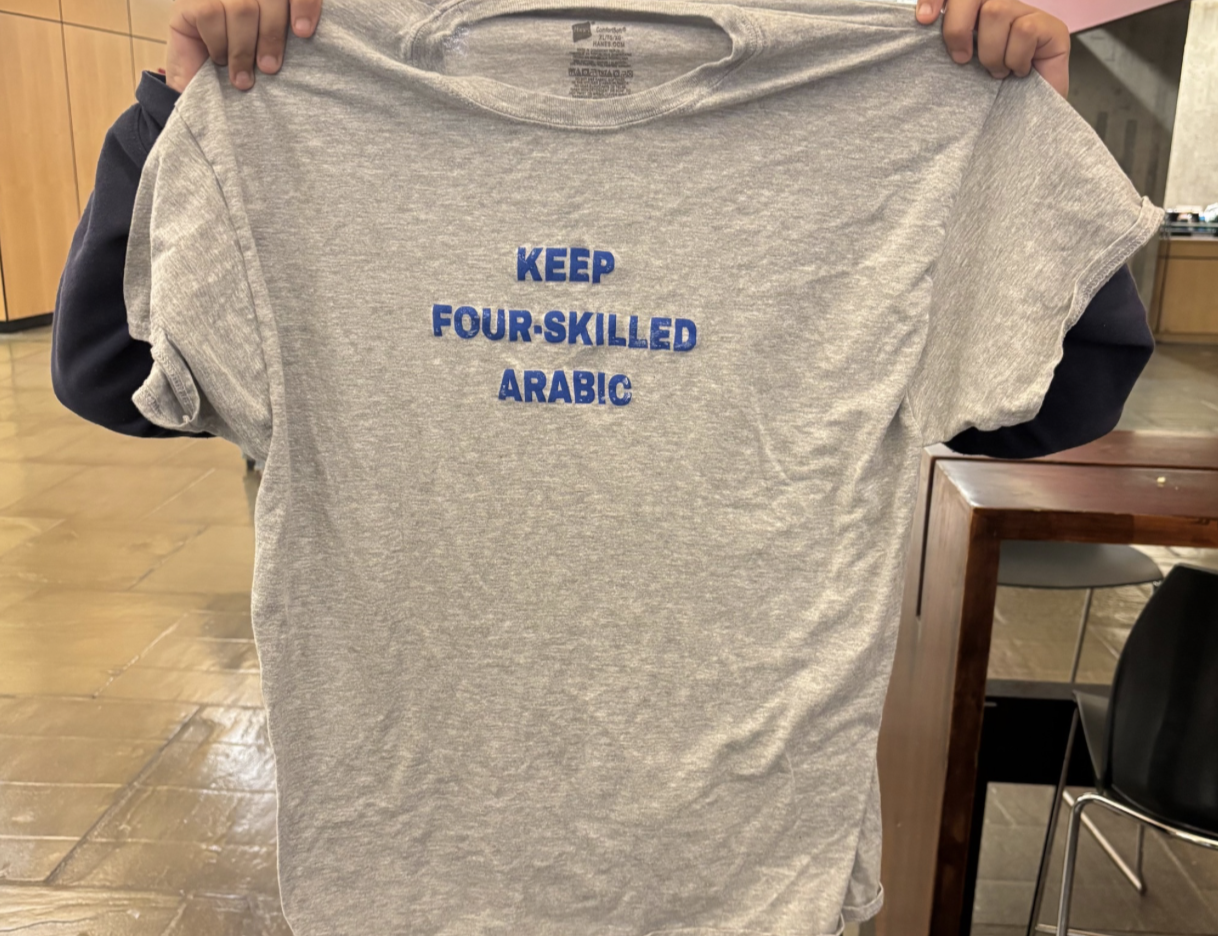
After months of administrative battles, the University of Massachusetts Amherst (UMass) decided to terminate its Languages, Literatures, and Cultures (LLC) Four-Skilled Arabic language program beginning in spring 2027.
The Five College Arabic Language Initiative was founded in 2011 to support the Four-Skilled Arabic Language instruction at Amherst College, Smith College, Mount Holyoke College, and the University of Massachusetts Amherst (Hampshire College did not have an in-house faculty member). This program sought to teach Arabic speaking, writing, listening, and reading skills in an environment where faculty from across the Five College consortium were able to collaborate and share curricula.
However, after 15 years of the program, Amherst and Mount Holyoke announced the termination of the program in the fall of 2025, which was enacted in the spring of 2026. Provost and Dean of the Faculty Martha Umphrey commented that this decision came from a unanimous vote among the Provosts across the Five College Consortium due to low enrollment within the program.
Shortly after, UMass also announced that it will be cutting the program, which currently enrolls 22 students, in spring 2027, leaving a year for the UMass community to consider the impacts of this decision, according to the Massachusetts Daily Collegian. Since then, students have attempted to challenge the University’s decision amidst what they perceive as a lack of administrative clarity.
Beatrix Worthington, a sophomore at UMass, first tried making contact with administrators, namely Dean of the College of Humanities and Fine Arts Maria del Guadalupe Davidson, in the fall of 2025 while writing an article about the Arabic cuts for the Massachusetts Daily Collegian. Since then, she and UMass junior Luc-Andre Sader have tried to contact more administrators, with Sader even writing a letter to Provost Fouad Abd-El-Khalick in fall 2026. However, getting a direct meeting with administrators “with jurisdiction” has proven to be a challenge.
“[Davidson] continued to direct me to other people who essentially would tell me that they didn’t have the jurisdiction to make any decisions and I had to meet with [Davidson],” Worthington said. “So it’s just this continual feedback that made me really exhausted and frustrated with the university.”
Nevertheless, concerned university students and faculty continued to push back to challenge administrative arguments for the program cuts, including underenrollment and budget constraints.
Worthington noted that, before the proposed cuts, the Four-Skilled program was worth six credits, while the other Arabic track offered through the Department of Judaic & Near Eastern Studies only offered four credits with two classes per week. Now, the Four-Skilled program courses are also only worth four credits, despite meeting four times a week.
Worthington then emphasized that “Students who don’t know the difference between these two programs and don't deliberately want to challenge themselves are not going to take the one with the same amount of credits that uses double the amount of time,” which would effectively lead to a decrease in enrollment in the Four-Skilled program.
Furthermore, on “Schedule Builder,” the platform UMass students use to register for courses, Four-Skilled Arabic is the last Arabic option that comes up if you type “Arabic” in the search bar, because it is in the Languages, Literatures, and Cultures tab of the courses and not Arabic language.
Students emphasized that despite being “hidden” on the platform, the program currently has 22 enrolled, highlighting its enduring popularity.
Additionally, various community members similarly challenged arguments that Four-Skilled Arabic must be cut because of budget constraints. In an email, a member of the Massachusetts Society of Professors (MSP), who elected to remain anonymous, said: “If 5C canceled the Arabic Language Initiative, but UMass helped fund the Initiative [across the colleges], can't UMass simply reallocate the money to Arabic language instruction on our campus?”
The member suggested that since the funds currently allocated to the program could be significantly less than what the university had originally invested into the Five College initiative, the university would still be saving money even by continuing the program.
Despite these challenges, after their meeting with the Interim Chair of Judaic & Near Eastern Studies Dr. Brian W. Ogilvie, Sader, Worthington, and other concerned students received an email stating that the reasons for terminating the program — previously described as issues with enrollment and budget — would no longer be discussed with students.
On Oct. 7, twenty concerned students co-signed an email to Davidson expressing concerns about the proposed cuts to the program and again asked for clarity. On Oct. 15, Davidson offered to meet with students on Nov. 16 to discuss their Arabic course options: switching into a less intensive Arabic track offered by the Department of Judaic and Near Eastern Studies or taking a Four-Skilled course at Smith. As of this weekend, this meeting is now set to change, though no set date has been given.
However, with class registration coming up on Nov. 9, students stress the importance of expeditious communication with university administrators. As Worthington argued, simply switching into the Arabic language program offered by the Department of Judaic and Near Eastern Studies is not a viable option for four-skilled students because the language instruction "[is] not a continuum by any means” and switching into a different language track “would seriously disrupt the education of 22 students here at UMass.”
She also explained that, though Smith continues to offer the Four-Skilled track and UMass administration allegedly cited Smith as a supposed alternative, it is not a practical substitution. “You're sending students on a … trek even though the program that they want and the school can afford is already offered at their home university.”
While the ongoing debates between university students and administration occur, it should not be understated that this is also an issue that directly affects Amherst students who wish to take Arabic, who will similarly be sent on a lengthy trip to Smith to pursue a rigorous Arabic education.
Sader asked, “You get rid of the most enthusiastic Arabic class that is offered — the most rigorous, the most accredited, with the most students who care and want to learn the language, and then what happens?”
The question of aftermath will weigh heavy in the coming weeks as students demand an expedited and targeted meeting with Davidson and continue to challenge the proposed cuts.
Editor’s note: The writer is currently enrolled in a Four-Skilled intermediate Arabic course.
Comments ()