

WAMH x The Student: Looking at “Head Over Heels”
In the first installment of a three-part series, Staff Writer Luke Deeble ’29 unveils the often-ignored emotional and structural complexity of Tears for Fears’ “Head Over Heels”.
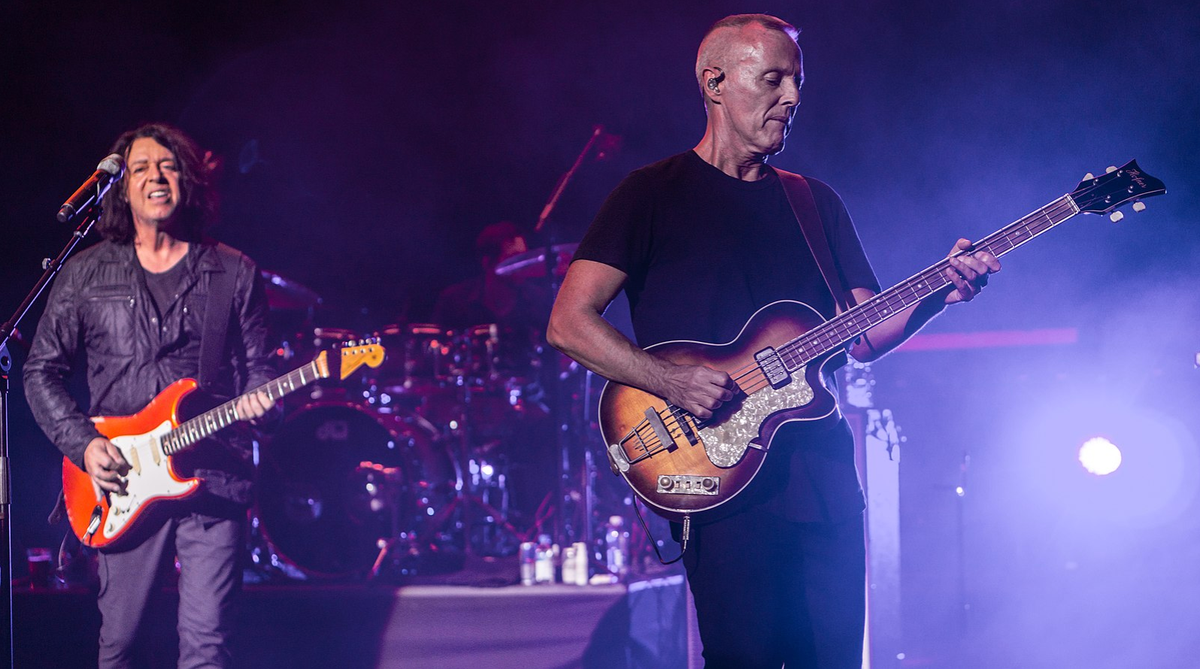
This is the first installment of a planned three-part series analyzing beloved ’80s pop love songs. Today’s subject is Tears for Fears’s “Head Over Heels.” Later installments will include The Cure’s “Just Like Heaven” and a-ha’s “Take On Me.” These songs have enjoyed persistent popularity for decades. Still, it seems that the most exciting artistic elements of each tend to go underappreciated: I admire how these songs’ lyrical complexity works in concert with their top-forty pop viability, but too often the latter aspect overshadows the former. While my interpretations are certainly not definitive, I hope that this series will encourage readers to look at these and other beloved songs a bit differently.
“Head Over Heels” — released in 1985, written by Curt Smith and Roland Orzabal — is grand yet brimming with uncertainty, at once celebratory and comically anxiety-ridden. It is as much a song about time and impermanence as it is a song about infatuation. This is all to say: It is worth considering as more than a fun pop hit.

The track grew out of Tears for Fears’s attempt to write a transition between what would have otherwise been the last two songs sequentially on the 1985 album “Songs From the Big Chair”: “Broken” and “Listen.” It is worth listening to the song within the context of the album, as “Broken” and “Head Over Heels” are companion pieces with melodic and lyrical throughlines.
In contrast to “Head Over Heels,” “Broken” is a frantic and mostly instrumental piece. Lyrically, it is succinct and abstract: “Between the searching and the need to work it out / I stop believing everything will be alright / broken, we are broken.” The sections that predict the melody of “Head Over Heels” are still frantic but slightly less so — a sort of respite and foreshadowing of the more hope-inflected song to follow.
When the first notes of “Head Over Heels” are played, their effect on the listener is highly shaped by context: Here is a melody that has already been played, but now it is slower, grander, more self-assured. Beautiful string swells soon accompany, then a powerful guitar line. The lines are still not monophonic, but contrast the preceding song by weaving in and out of each other logically. Such contrasts frame the entire song, as well as the following lines, which first appear as the last lines in “Broken”:
“In my mind’s eye
One little boy anger one little man
Funny how time flies.”
The last lyrics of “Head Over Heels” are these same lines, only with “anger” omitted. Hence, the song is a narrative bookended by a lamentation of time and a bird’s-eye view reflection on childhood and manhood. What’s more, “Head Over Heels” concludes with an instrumental coda of “Broken.” “Head Over Heels,” we shall see, is the eye of a storm: an exciting, temporal, and ever-unresolved feeling of limerence amid a torrent of existential despair.
The aforementioned analogy is further apt, considering the first words of the song:
“I wanted to be with you alone
And talk about the weather.”
How simple, but how many ways this second line may be interpreted! It is a letdown from the first. Would he not have the courage to talk about anything more amorous in nature? But also, it seems that he likes his love interest to the extent that a mundane conversation with her would make him happy. Then again, the Genius annotation (which one need not put too much stock into) considers it a comic euphemism. It is also conceivable that “weather” relates to the speaker’s helplessness at time’s hands. But most significantly, there is something about youthful infatuation that this line evokes so well. To me, it belongs in an elite class of incredibly effective but elegantly simple standalone lines (other examples: “I get the news I need from the weather report” — Simon and Garfunkel, “The Only Living Boy in New York”; “It’s no better to be safe than sorry” — a-ha, “Take On Me.”) It introduces the speaker’s infatuation perfectly.
The song’s lyrics as a whole are somewhat opaque. A line-by-line analysis would not be unfruitful. For our purposes, it will suffice to draw out several significant throughlines. The first verse — after the weather line — moves from consideration of the past, to that of the present, and then to the future. The speaker is constrained by something about the love interest’s past. In the present, she eludes connection — keeping distance “with a system of touch /and gentle persuasion.” She is stringing him along as he is “lost in admiration.” Hence the future-facing concern: “you’re wasting my time / just wasting my time.” But all of this is in the present tense, compressing his indecision into the open-ended present.
There is not too much to unearth in the chorus, brilliant as it is. Still, the speaker’s complaint, “I never find out till I’m head over heels,” is powerful, not least because it is borderline illogical — of course, one finds out that they are head over heels by being such; the only other way would be to see the future.
This may be precisely what the speaker is trying to do via pyromancy in the second verse:
“I made a fire, and watching it burn
I thought of your future.”
Fire thus becomes a symbol both of the future’s uncertainty and the past’s forever elusiveness (in “watching it burn”).
The second verse, read by itself, would not seem to be about romance. The speaker admonishes his subject for keeping “one foot in the past” — “Have you no ambition?” Seemingly, he echoes his family: “My mother and brother used to cleaning fresh air / and dreaming I’m a doctor.” Note the curious present tense in the second line, striking a dissonance with present reality instead of relaying an old wish. Simultaneously, background singers repeat the line “Nothing ever changes when you’re acting your age.” The speaker, in the moment of decision or indecision, gives voice to the numerous pressures acting on him; each line in this verse seems to come from a different place. In its final complete line, the verse metaphorically invokes the potential of violence: “It’s hard to be a man when there’s a gun in your hand.” The speaker feels gravely mismatched with his power. In a musically powerful moment, Orzabal ascends to a higher register to deliver the fragment “I feel so” before the second chorus. This is a perhaps trite expression of effability — in that he cannot not find words to complete the phrase — but wholly effective because of its musical delivery. At the end of the second verse — with its introduction of cryptic, evocative, and multivariate pressures — this emotional crescendo makes perfect sense.
The bridge returns to the opening riff, the one introduced in “Broken.” Here, finally, we get explicit hope:
“And this is my four-leaf clover
I’m on the line, one open mind
This is my four-leaf clover.”
At this, a chorus breaks out singing the main riff in “la la la”s. Their entrance is cathartic; it feels, when they come in, as if they have been waiting to and restrained from doing so only by some inhibition on the part of the speaker. The speaker has moved from indecision to action, no matter how uncertain the result, and we are led by music to find joy in that alone.
Over this, Orzabal sings the lines that concluded “Broken” (with a slight deviation):
“In my mind’s eye
One little boy, one little man
Funny how time flies.”
These lines now seem to have a slightly clearer meaning. The speaker is facing a coming-of-age dilemma, but there also seems to be some sort of relationship between the “boy” and the “man,” as if they are distinct characters, both with import to the present situation. They are no doubt versions of the speaker, but the speaker has some sort of disassociation with both.
I have tried not to resolve the countless ambiguities in this song into some linear, monologic story because I think of these ambiguities not as puzzles to be solved, but as effectable articulations of the speaker’s situation. And I have not given the music the treatment it deserves — I recommend Rick Beato’s great 10-minute video breaking down the song’s musical composition. It will suffice to say that “Head Over Heels” beautifully explores time, the importance of the past and the future, and the simultaneous power of the present, as well as the inextricable intertwining of these considerations with overwhelming human desire.


Comments ()