

Writing Worlds of Words — Alumni Profile, Lindsay Stern ’13
Exploring questions of reality, language, and time, author Lindsay Stern ’13 reflects on how her Amherst classes shaped her worldviews and literary pursuits.
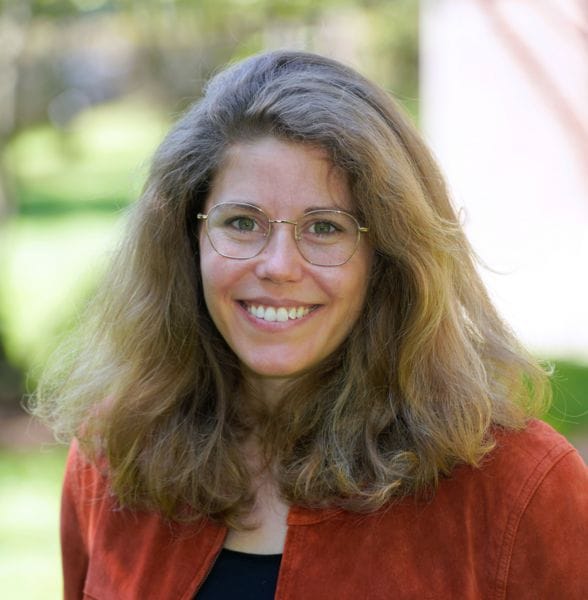
Johnson Chapel’s clock tower has been handless for weeks. Shockingly, life at Amherst College has not fallen into disarray — few seem to have even noticed the lack of (mostly) hourly bells. Lindsay Stern ’13 takes seriously the questions of time, reality, and the capacity of language to articulate both. Crafting characters like the horologist in her debut novella — published during her senior year at Amherst — and imagining a society that tells time by trees in her summa cum laude honors thesis, Stern continues to investigate the philosophical, linguistic, and literary inquiries awakened in her undergraduate years.
Learning to Love Literature
Out of a 13th-floor window in New York, Stern floated slips of paper down to pedestrians. Though admittedly littering, Stern would watch people down below notice — or not notice — the notes. “[They] were probably a little bit creepy,” she confessed, remembering writing ominous phrases like, “I see you.”
“[Flying notes] must have come from a desire, at some level, to use words to reach complete strangers. I guess I’m still doing that in a different way,” she said.
“It introduced an anonymity between neighbors because of the size of the city that I found quite freeing, because it made me feel like I was with people, but also protected in my solitude. And I also grew fascinated by the specters of other lives that were physically proximate but emotionally distant because of the size of the city.”
Stern was exposed to the world of words at an early age. Growing up, her parents read to her every night. They themselves were voracious readers. Stern remembers reading Roald Dahl, Beverly Cleary, Shel Silverstein, Jules Piper, and William Steig — authors she’s now beginning to envision revisiting with her own two-year-old child.
Around age six, Stern became enthralled with words themselves. One morning, on the way to school, she unlocked the ability to comprehend the letters on buildings as composite parts of words. “Unfortunately, it was the name of a bank. It wasn’t particularly inspiring,” she said.
Loving words and stories, Stern decided that she “wanted to live a life organized around literature.” In high school, she discovered her interrelated love of philosophy after her high school teacher, Ms. Susan Sagor, wrote the word epistemology on the blackboard. Stern recalled driving her family crazy after learning (and frequently practicing) the Socratic method of relentless questioning.
The Writer’s College
Stern heard about Amherst from Ms. Sagor, whose son attended the college. Seeing how Stern thrived in the small high school environment, Ms. Sagor recommended the college to her, and Stern was sold.
Val-sitting quickly became one of Stern’s frequent modes of experiencing Amherst. Stern loved staking out a table for hours, enjoying the sunlight and seeing many different friends pass by.
Escaping the people-centered dining hall, Stern also enjoyed immersing herself in Amherst’s nature, particularly the Rail Trail and Wildlife Sanctuary. “I always treasured how easy it was to be isolated in nature,” she said. “That was a big part of my time as a student, being able to go off and think about a paper, a story, my thesis, or a reading, and take a long run, and then come right back and be able to go see everyone easily. It was a wonderful thing.”
Stern’s favorite place to write: the second floor lounge of Cooper House, with a readily available supply of chocolate milk.
As an English and philosophy double major, Stern credits then-Writer-in-Residence Daniel Hall’s creative writing dinner program as instrumental in opening up a professional literary world. Hall and his husband hosted dinners where students mingled with visiting writers, including Sabina Murray, John Hennessy, and Amity Gaige.
“It became the heart of literary culture at Amherst, but it was so intimate and inclusive, and I, at the time, sort of took it for [granted]. It was only later that I realized how unique that was,” Stern said.
Stern was active in student-run literary initiatives as well. As the editor-in-chief of The Indicator, Amherst’s literary magazine, Stern added the art section to the preexisting fiction and poetry sections.
Stern’s favorite courses at Amherst investigated the questions of words, what they signify, how they interact, and the worldviews they construct. She took three classes with John E. Kirkpatrick, 1951 Professor in Law, Jurisprudence and Social Thought Adam Sitze, “who was incredibly impactful for me as a mentor,” she said. She recalled one class in particular, “Psychoanalysis and Law,” which met in the dark, windowless basement of Merrill Science Center. She still thinks about a key lesson from that class to this day: the ultimate challenge and gift of conscience is that the self must live with itself — the notion of back-and-forth internal dialogue embedded in Hannah Arendt’s two-in-one.
Her other most rewarding courses proved to be some of the most challenging. “Plato and the Poets” with Sitze, for example, “set the pattern for a lot of what I then wrote about in graduate school.” Rachel and Michael Deutch Professor of Philosophy Alexander George’s seminar on Ludwig Wittgenstein’s “The Blue Book” was likewise a deeply gratifying class. Despite the short sentences, Wittgenstein’s writing demanded deep analysis. Stern reflected that the course “planted a long-standing interest in his work.”
Taking advantage of Amherst’s open curriculum, Stern also explored courses outside of her philosophical comfort zone. One of these proved to be the most frustrating class Stern took at Amherst: “Evolutionary Biology.”
“I thought it was fascinating, but I kept getting Cs on my papers. I just couldn’t connect with it because I think I was approaching it from a humanist angle,” she said.
101 - Intro to Publishing
The “intellectual, but not self-serious” academic and social sphere of Amherst — that allowed for prolonged Val-sits juxtaposed with Wittgenstein — was fertile for cultivating creative projects; by the end of Stern’s sophomore year, she had secured a publisher.
One evening, out to dinner in Northampton with her parents who were visiting, an awning caught first-year Stern’s attention.
The awning, which no longer exists, announced: “Rug Doctor.”
“Somehow that stuck in my mind. So then I wrote a brief vignette about a character who mends carpets, but who ends up deteriorating physically, like losing his shadow and losing all this stuff,” she said.
After a magazine internship for the summer after her freshman year fell through, she dedicated the newly-empty three-month bucket of time to unfolding more elements of what would become her first published book.
“It was sort of my failure on the publishing front that opened the door to something that became much more lasting as a direction for my life,” Stern said.
After submitting the manuscript and matching with a publisher through poetsandwriters.org during her sophomore year, the publishing process would continue into her final year at Amherst: “Town of Shadows” was officially published in September 2012.
“Town of Shadows” is interspersed with de-familiarizing definitions, like time as “the illusion of change,” self as “a hidden crowd,” and future as “the memory of now.” Stern continued to grapple with the definitions, categorizations, and authority of words in her senior English honors thesis, “LÜZ,” which was later published in 2017.
The creation myth tells the story of language, exploring its limits and expansiveness, truths and lies embedded in an agreed-upon list of signs. From a decree that bans the use of vowels, to an abolition of synonyms, words become vessels for the unsayable. The inquiry she set out to grapple with, as posed in the thesis’ introduction: “What would it mean to treat the natural world as a language?”
It was from thesis advisor Hall’s philosophy classes that she “imported” questions of the philosophy of language into the form of fiction. “I found those questions so stimulating that I found that I wanted to keep pursuing them beyond the genre constraints of the way you approach them in philosophy,” she said. “It was language and the relationship between language and reality, but also increasingly the source of the reason that you know for the dyad in the first place … to think about a gap between language and reality. That was the fascination that drove both of those creative projects.”
Stern in Cambodia
Stern’s passion for writing was — and still is — coupled with a love of teaching. While at Amherst, Stern created a creative writing program, WordBox, for students in Holyoke, providing free tutoring and mentorship.
Stern applied to the Thomas J. Watson Fellowship (Watson), hoping to provide a modified version of the WordBox program and work with students on their creative writing in Cambodia. Watson is a prestigious grant that funds a year of “purposeful, independent exploration outside of the United States.”
While in Cambodia, Stern routinely took her lunch break at a coffee shop just down the way from the school. She recalled striking a friendship with a police officer who was regularly posted there.
By 2014, then-Prime Minister Hun Sen, President of the Cambodian People’s Party who initially rose to power with the Khmer Rouge, had served nearly 30 years as Head of Government. In Jan. 2015, Human Rights Watch published a 68-page report outlining Hun Sen’s decades of extrajudicial killings, torture, unauthorized arrests, corruption, and general disregard for the Cambodian constitution. The police officer was an agent of Sen.
One day, the officer started crying.
“I just work. This is my job, but this is terrible. I hate this guy,” Stern recalled him saying to her.
Having taken Sitze’s seminar on Hannah Arendt at Amherst, Stern was struck by the relevance of “Eichmann in Jerusalem: A Report on the Banality of Evil.”
At the time, Cambodia was in a 13-year process of holding trials to reckon with the genocide of nearly two million people from 1975 to 1979 as part of the Khmer Rouge’s mission to create a “classless agrarian utopia,” per the United States Holocaust Memorial Museum. The trials were a performance complete with red curtains and a stage, a “soothing fiction,” Stern called it, “that there’s a leader that can be scapegoated and if they are purged the harms of the community are healed.”
Stern reached out to a Dutch lawyer of a high-ranking Khmer Rouge officer, hoping to get insight on the crisis.
“I wrote to the guy defending the second-hand man of Pol Pot … and he immediately responded and he agreed to meet with me,” she told me.
Being a writer, she found, is a great way to get people to talk to you about themselves.
The lawyer had previously defended war criminals in Sierra Leone, “that was his job,” she said. “His name, ironically, was Victor; he never won a case.”
The trials were a form of “guilt therapy” for the United States in a Barack Obama-era peak of U.S. soft power, according to Stern.
The trials mattered to people, though. One of Stern’s friends was a firm dissident.
The day of trials she watched was a linguistic debate analyzing the diction of a specific verb in a command issued to soldiers. The discourse over lethal words was juxtaposed by the imprisoned leader whispering to his guard, and coming back with a white jacket for him. He had gotten cold.
“There was something so haunting, but so human about listening to the bloodshed created as a result of these orders,” she said, “and then of course he’s a human being.”
Stern had her students read the chilling epilogue to Hannah Arendt’s “Eichmann in Jerusalem”; Stern, her students, and Arendt alike grappled with the question of how a human could commit such atrocities. Stern created an activity where her students crafted a creative confessional in the voice of a guard.
“They wanted to talk about it,” she said.
Expanding Education
After a year of novelty abroad, Stern returned home to New York for a year and taught fifth-grade creative writing at her middle school. Having already written a first draft of a new novel while in Cambodia, Stern was then ready to plunge back into the world of literature. In the fall of 2015, Stern enrolled at the highly selective Iowa Writers’ Workshop, joining some of the biggest names in writing.
“It was a great place in which to hone and forge and concentrate on projects that are hard to insulate when you’re not surrounded by people who are doing the same kind of thing,” she said. Talking about projects in the program felt like attempting to talk about a dream, she said. “It’s so raw and personal that it can become a little bit harder to have it be the basis of an intellectual community in some way.”
After Iowa, Stern earned a Ph.D. in comparative literature at Yale University. Through her studies, she grappled with the culture of analytic philosophy. “You could also look at the form and the content of what was being written, as opposed to the content alone, and so that enabled me to expand my curiosity around the lives of philosophers and things they wrote beyond just philosophy,” Stern explained.
The Study of Animal Languages
An investigation of the inner lives of philosophers animates Stern’s first novel, “The Study of Animal Languages,” which was published in 2019.
Capturing the complicated relationship of two professors who study different forms of communication, the novel grapples with questions of knowing, sanity, and action. Despite the fact that it takes place at a New England elite college, according to Stern, the novel is not a fictionalized account of Amherst or its people.
The characters also contend with the implications that these ideas may not be confined to humans — that other animals may also have the capacity for reason and language.
Stern said these ideas were less original than she thought at the time. “I think it’s a provocative perspective if you’re coming from a[n] insular Judeo-Christian point of view,” she said. “But so many traditions, like the Dharmic traditions … don’t think of the soul as a species-defined thing.”
Now
In the spring of 2022, Stern returned to Amherst as a visiting lecturer in law, jurisprudence, and social thought while finishing her Ph.D. Piloting two new seminars in the department, Stern reflected that “it was a joy to teach in a department that understands literary study and practice as part and parcel of the pursuit of knowledge.”
Now, Stern is an assistant professor at Texas State University’s MFA program. The pursuit of literature, she said, is a “truth-seeking activity.”
“We use the term ‘fiction’ to refer to lies sometimes,” Stern explained. “But actually that’s probably just an accident of grammar because a lie is completely different from a fictional narrative, which is more like a creative activity that engages — if a writer is lucky and successful — the emotions of a complete stranger.”
One of the courses she particularly loves teaching is “Form and Theory,” a course that asks the question, “what is fictional narration” through a journey across literary time from Sophocles to Toni Morrison.
“I love teaching that class because I feel like I’m tapping into the Amherst classes too [by] thinking about the relationship between language and reality,” she said.
These themes make their way into her current novel project as well.
The novel is about “an extremely scrupulous, lost and found clerk [at a museum] who is also overcommitted,” she said. “It's about a disaster that arises from his vigilance around lost and found, and the items that get left in his museum.”
Exploring themes of “conscience on overdrive” and “guilt,” Stern is exploring the genre of the tragic comedy. “I’m still working with that affinity that Amherst classes introduced me to around the tragic and comic forms as having a kinship.”
As a writer committed to the questions of the human condition, Stern worries about the current state of the world and the threatened state of the humanities. But at the same time, she thinks there is something freeing and exciting about the uncertainty.
Invoking Hume, Stern reminded that even the belief that the sun will rise tomorrow is a leap of faith.
“In the end, we really can never predict the future, and now we all kind of have to admit it, and so I think there are positive aspects to that in terms of for young people and people who are going to enter the economy,” she said. “It’s really a chance to actually do what you would have done if you didn’t have to have some stable job that you fantasize [exists].”



Comments ()