

A Look into Amherst’s Athletic Admissions Process
Senior Managing Editor Lauren Siegel ’27 and Managing Features Editor Emma Burd ’26 investigate Amherst’s athletic recruitment process, detailing how it operates and the role it plays in the college’s diversity efforts.
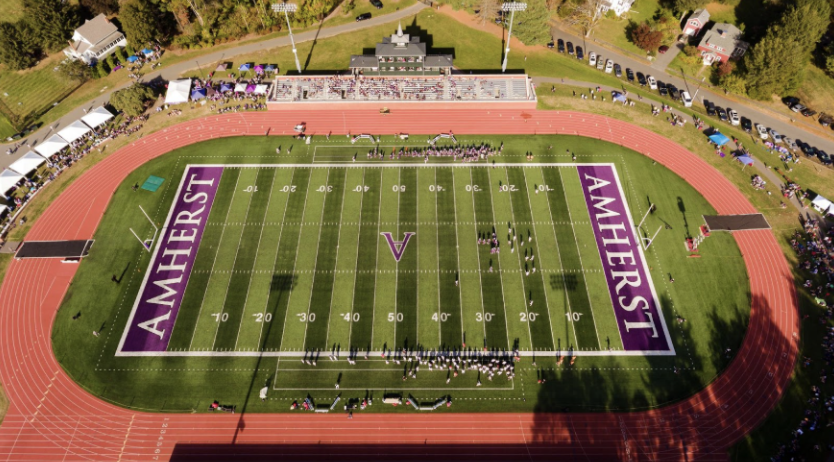
Athletics is undoubtedly an important part of Amherst’s culture and campus life, with over 30% of Amherst College’s student body participating in varsity sports. However, for the nearly two-thirds of the student body that aren’t on a varsity team, the process by which athletes come to play a sport at Amherst largely remains a mystery.
Over the past few decades, many have criticized Amherst’s athletic recruitment process for its seeming prioritization of white, wealthy recruits, and its potential to undermine the college’s goal of creating a diverse student body. These discussions culminated in the publication of the Diver II report in 2016, which revealed that only 23 to 24% of varsity athletes were students of color and 2 to 6% were from low-income backgrounds, and urged Athletics to diversify team rosters.
While coaches and administrators responded — and Amherst even received an NCAA Division III Diversity Spotlight Award in 2023 for its efforts — the Supreme Court’s 2023 decision to overturn affirmative action in college admissions has rendered discussions about the racial diversity of admitted classes challenging to navigate. The college has since taken initiatives to maintain a diverse student body, namely expanding rural student outreach through joining the Small Town and Rural Students (STARS) Network in 2024, but it is unclear how the decision has impacted athletic recruitment.
How the Athletic Recruitment Process Works
As a member of the New England Small College Athletic Conference (NESCAC), Amherst coaches can begin direct contact with an athlete the summer before their junior year of high school. According to Director of Athletics Don Faulstick, students often introduce themselves to coaches by sending an email containing their athletic competition videos and academic information, and coaches then travel to observe athletes at their clinics or tournaments. However, Faulstick noted that “every sport’s a little different time-wise, it’s not like [communicating with athletes and commitment decisions] all happen and end at one time.”
Sometimes, Amherst coaches will also reach out to students directly. “Schools that seriously recruited me found me and reached out to me either through my coach or just through being at a tournament or watching game film,” Chris Hammond ’26, a member of the men’s basketball team, said. “Amherst reached out to me first, and then they would check in and call [me] every other day … it’s an intense process, our assistant coaches are fully in it — whenever [the basketball team is] not in season, their full-time job is recruiting.”
Once coaches identify an athlete that they are interested in recruiting, they send the athlete’s information to the admissions office to gauge their admission prospects — a process known as a “pre-read.”
Vice President and Dean of Admission & Financial Aid Matthew McGann explained that the college does not complete pre-reads until the summer before an athlete’s senior year. By contrast, many Division I schools review recruits and extend verbal commitment offers as early as June 15 after an athlete’s sophomore year. “For Amherst and for our fellow schools in the NESCAC, that kind of process would not work for us,” McGann said. “For Amherst, our admission — whether you're a recruited student-athlete, a talented artist or musician, or whoever you might be — is going to primarily be an academic evaluation, and to do that, you need to have mostly done your high school career.”
As a part of the pre-read process, students will typically provide their standardized test scores, high school transcripts, and a writing supplement. Many coaches will also write a statement for admissions officers, which not only discusses how a prospective athlete would contribute to their team, but also how they would fit into the broader Amherst community.
“It’s not the full application, but it’s enough for us to get a sense of where they might fall in our rubric rating system, and then we’ll use that and provide that [information] to the coaches,” McGann said.
Following the Supreme Court’s decision in Students for Fair Admissions v. Harvard (SFFA), which overturned affirmative action, the college has revised its system for ranking potential recruits. According to President Michael Elliott, the college used to categorize athletes by A-band, B-band, and C-band, with the most academically qualified applicants being in the A-band. Each team had a cap on the number of B-band and C-band applicants it could support.
Now, athletic candidates are evaluated during pre-reads using the same 15-point holistic system utilized to assess non-athletes in the general admissions process, a move that McGann said aims “to ensure that our recruited student athletes are indeed reflective, academically and otherwise, of the rest of the student body.”
According to McGann, “[Admissions officers] don’t admit [applicants] by rating, but those rubric ratings inform the holistic admission process that we have.”
During the pre-read process, admissions officers give coaches an early estimate of the points potential recruits would receive during the standard admissions cycle.
According to McGann, the pre-read process for athletes is very similar to the process used to review and select prospective students for Access to Amherst (A2A), the college’s fall fly-in program for students who may not be able to visit campus independently. “In each of these cases, athletic pre-reads and A2A, it’s not an offer of admission, it’s some kind of feedback, and the ability to continue a conversation,” McGann explained. “We find that students in both categories, should they choose to apply after getting some good feedback from us, are more likely to be admitted and end up in the class.”
After the admissions officers complete a pre-read of a prospective student-athlete, coaches communicate their feedback to the athlete and indicate their likelihood of being admitted to Amherst. If an athlete “passes” their pre-read, coaches can guarantee students a spot on the team, given that they are later admitted to the college. If athletes accept the offer, they commit to apply Early Decision at Amherst.
However, McGann stressed that this commitment does not constitute acceptance to Amherst. “No one is admitted until they get a letter from the Office of Admissions saying that they’re admitted,” McGann said. “It is true that oftentimes — especially with not just Amherst, but many of our peers who have early programs which might be to some degree restrictive — that [athletes] do have to make some choices, and so maybe want to announce that choice, that they’re looking to Amherst. But no one is admitted until they come through admission.”
Student Experiences with Athletic Recruiting
Some student-athletes noted that, although they were not officially accepted to Amherst, they were extremely confident that they would be admitted after committing to the admissions process. “I think a lot of times people think that they can be easily rejected, but my coach told us no one they’ve ever supported has been rejected,” Daphne Witherell ’27, a former member of the women’s cross country team, said.
However, other student-athletes still felt unsure about their Amherst acceptances. “My coach told me, ‘Don't get any Cs and you'll probably be fine’ … but I just remember opening [my decision] and being nervous, even though I had already committed,” Caroline Reichert ’28, a member of the women’s lacrosse team, said.
Many student-athletes affirmed that, despite feeling more confident in their ability to attend Amherst due to the recruitment process, the process itself was generally extremely difficult.
“The recruiting process was probably one of the worst experiences of my life,” Ella Johnson ’26, a member of the women’s soccer team, said. “I don’t think it’s an easy feat by any means, because if you’re trying to go to a [Division III] school, you still have to do the work academically … You’re still doing everything you would for a college application — you’re just doing it a little earlier.”
Johnson also noted that communicating with coaches was extremely stressful in and of itself. “You’re 17 years old, and you’re putting all your eggs in a basket, and sometimes a coach will be like, ‘Just kidding, we gave your spot away,’” she said. “Just the emotional turmoil that is on top of everything else, I think, is something that not a lot of people know.”
Diversity and Athletic Recruitment Today
When evaluating student-athletes, McGann explained that admissions officers take the college’s mission into close consideration. He said that admissions officers often host training sessions with coaches to help them understand what kind of students they are looking to admit to Amherst. “We’re trying to find those students who are really going to thrive in the classroom, in the lab, be great community members in the dorm and Val,” McGann said. As a part of this training, admissions officers explain Amherst’s holistic admission policy and that it “can mean [looking for students from] rural or small towns, it can mean trying to be more socio-economically diverse, [looking] in areas with [fewer] forms of privilege.”
While Faulstick noted that the overturning of affirmative action has made this work more difficult, he affirmed that Amherst Athletics is still committed to cultivating diversity among its teams. However, he explained that, because collegiate sports have become increasingly competitive, standing out as a qualified recruit typically requires significant money and resources, resulting in a wealthier and whiter athlete pool.
Reichert also noted that more affluent high school teams have resources built in to make the recruiting process easier. For example, her club team had a staff member whose entire job was to support the athlete’s recruitment process.
It is also more difficult for low-income athletes to get recruited at Amherst due to the expenses associated with campus visits. “There [are] definitely challenges posed by the fact that Amherst can’t always fund your visit as a recruited athlete,” Witherell said. She noted how, given that current team members can often put in a good word for potential recruits after face-to-face interaction, in-person visits are an advantage in the process.
Alongside resource barriers, Faulstick also explained how recruiting athletes from diverse backgrounds can be difficult because they are less likely to have heard of Amherst.
K.J. Neville ’29, a member of the basketball team from Memphis, Tennessee, experienced this initial difficulty when being recruited by Amherst coaches. “[Head Coach] Blake [Waldron] reached out to me, and I was like, ‘What is this school? Why would I even be interested in coming to you?”’ Neville explained. He only began to seriously consider Amherst after his high school principal and teachers spoke highly of the college: “I was like, ‘Do you know something about Amherst College?’ And my teacher just lit up. She was like ‘Yeah, isn’t [that] where the Emily Dickinson Museum is?”’
The Campus Debate Surrounding Athletics
For Willard Long Thorp Professor of Economics Jessica Reyes, the idea that there are separate processes by which athletes and non-athletes come to Amherst is inherently problematic. “We should not be preferencing a particular pursuit that is very expensive and that results in recruiting, through an earlier and easier process, a group of students who are much more white and privileged,” she said. In her opinion, the school’s approach is “separate — and unequal.”
According to Reyes, “the [college’s] mission is about education, thriving, personal growth, community, doing good in the world. And diversity, equity, and inclusion (DEI) are crucial to that, but one of the things that is crucial [is to not] amplify privilege. I think there are lots of ways forward, but I don’t think that any equitable future for Amherst involves a massive set aside that benefits rich white men.”
Laura Daniels ’28, a member of the softball team, agreed that the athletic recruitment process felt unfair. “You really don’t hear about [athletes] not getting in very often. I think it should be harder; if that means we have worse teams, then we have worse teams,” she said.
However, some students believe the athletic recruitment process has a unique potential to help ensure the diversity of Amherst’s student body. “I think athletics has been a really great tool for diversity on this campus,” Johnson said. “I do think it’s a great resource that coaches can, when they’re recruiting student athletes, know what they look like, and that is something that the admissions officers don’t have access to.”
Considering Athletics’ diversity efforts, Johnson spoke about her experiences as the president of the Council of Amherst College Student Athletes of Color (CACSAC), a Registered Student Organization for athletes of color on campus.
“[CACSAC] was first created … because a bunch of student-athletes of color felt like they couldn’t really fit into the affinity groups that existed on campus. They didn’t feel super welcome at [Black Student Union], or La Causa, or clubs like that,” Johnson explained.
According to Johnson, CASAC’s mission is to ensure that all students feel supported and heard, even if they are on less diverse teams. Although CASAC is student-led, the organization receives support from the Athletics staff and has helped ensure the effectiveness of the administration’s diversity initiatives. In addition to CASAC, every athletic team has DEI representatives to facilitate conversations about diversity and belonging within the team.
Thompson Lau ’26, a captain and DEI representative for the men’s lacrosse team, described how the team created an initiative to expand access to lacrosse for urban high school students, as well as implementing DEI educational programming for the team. “Even if we’re not the most diverse team … we’re at least getting the education,” he said.
Many student-athletes noted that the diversity among Amherst’s athletic teams encouraged them to commit to the college. “The reason why I chose Amherst is because of [the] diversity on the team,” Kaya Tray ’28, a member of the women’s swim team, said. “At the other NESCAC schools I went to, I met maybe one other Asian person on the entire team … I knew I wanted to be somewhere that at least had more than just one Asian person.”
Many student-athletes also noted that Athletics has recently begun initiatives to encourage socioeconomic diversity among recruited athletes, such as providing more free equipment and workout clothing.
Where Do We Go From Here?
With the benefits and drawbacks of Amherst’s athletic admissions landscape in mind, the questions remain: Where do we go from here? What should be the ideal role of athletics and athletic recruitment in our campus culture?
Reyes said that she believed the only way the college can uphold its mission and improve its culture is by eradicating the early recruitment timeline to ensure that athletes and non-athletes both commit to Amherst using the same process. She also urged the college to be more transparent about its interactions with athletic recruits and to release more demographic data.
Many student-athletes share a similar desire for transparency; however, their call involves greater clarity between coaches and athletes during the recruitment process. “I had these dream schools, and I’d be talking to these coaches, and they’d be like, ‘We want you. We’re just gonna come to one more game,’” Johnson said. “And then they would essentially be lying to me … I get that for them, it’s like a business deal. But for students, that’s really difficult. I think just having transparency in general would help the process.”
For others, such as Professor of American Studies Robert Hayashi, dismantling the stereotypes associated with athletics is crucial to addressing its issues. In the past, Hayashi noted that discussions have felt divisive and accusatory, rather than constructive. “What’s been disappointing to me is that a lot of this has been framed as athletics versus academics, professors versus the coaches. That’s a false narrative that I would push [back] on,” he said.
In light of its efforts to uphold the college’s mission post-SFFA, Amherst athletic admissions, perhaps now more than ever, plays a central role in shaping campus culture. For Hayashi, the best way to reckon with this reality is through open conversation across campus: “My hope is that we have that discussion, that information is made accessible to people, that we can have dialogues that are focused on examining issues, and [come] to some sort of action plan.”

Comments ()