

Alum Offers Insight on Supreme Court Appeasements
Stephen Vladeck ’01 returned to his alma mater to discuss fears surrounding the erosion of the balance of power sparked by recent Supreme Court decisions under Trump. Vladeck attempted to appease student concerns, citing “guarded optimism” and trust in democratic safeguards.
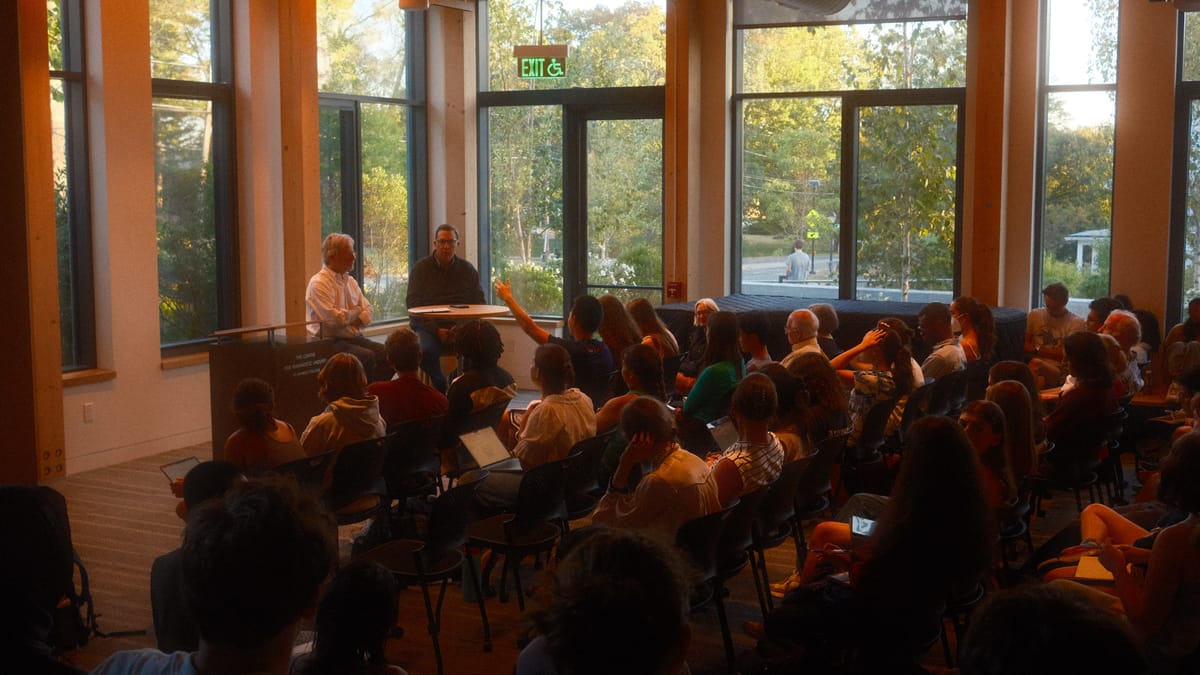
This past Thursday, CNN Supreme Court Analyst and Agnes Williams Sesquicentennial Professor of Federal Courts at Georgetown University Law Center, Stephen Vladeck ’01, spoke in the Center for Humanistic Inquiry (CHI) Think Tank. He implored students to grasp his message: The state of the nation is not as bad as we think.
Vladeck returned to his undergraduate alma mater this past week, this time as the newest member of the Board of Trustees. The event titled “Are We Still a Constitutional Democracy?” was hosted by the Law, Jurisprudence, and Social Thought (LJST) department. Vladeck aimed to provide a space for students to better understand the question the LJST department posed as the underlying theme of this discussion: “Do the constraints [of the Constitution] still exist?” and “Are we still a constitutional democracy in [Vladeck’s] mind?”
Moderated by James J. Grosfeld Professor of Law, Jurisprudence and Social Thought, Lawrence Douglas, students had the opportunity to listen to Vladeck’s responses to Douglas while also posing their own questions during the Q&A segment.
The opening question posed by Douglas reflected the name of the talk, or as Douglas put it more colloquially: “Are we screwed?” Vladeck tackled this question by first addressing the unfortunate fact that the so-called balance of power in government has begun to erode, which he referred to as “the guard rails failing.”
Most notably, Vladeck answered multiple questions regarding the Supreme Court’s “appeasement” of President Donald Trump and Justices Amy Coney Barrett and Brett Kavanaugh’s “desire for the path of least resistance” when dealing with the White House. Specifically, he touched on the “shadow docket,” or the unprecedented number of emergency applications that the Court is agreeing to hear in recent terms.
In these cases, the Supreme Court of the United States (SCOTUS) issues a quick judgment without providing any written line of its reasoning. Vladeck hypothesizes that perhaps this is to temporarily delay giving merit-based verdicts, which could butt heads with the administration's agenda. Here, a merit-based judgment refers to when a verdict is reached based empirically on the legal question or issue formed on a later date.
“[If] the Court continues to surrender power, I don’t know if we will get it back,” Vladeck said.
Despite the troubling nature of SCOTUS, Vladeck continued to emphasize the importance of maintaining guarded optimism in the judicial branch, despite the overpowering headlines constantly pushing the negative outcomes. As an example, he suggested that news coverage and the media have been disproportionately highlighting examples of these guardrails failing, when in truth, there are multiple examples of American legal institutions holding strongly.
He noted numerous accounts of the lower district courts pushing back against SCOTUS rulings and their refusal to reach a verdict, such as both cases regarding the International Emergency Economic Powers Act (IEEPA), V.O.S. Selections, Inc. v. Trump and Learning Resources, Inc. v. Trump. These cases came to fruition following Congress’s decision to yield power to Trump to impose tariffs on imported goods after he declared an “economic emergency.”
It is the responsibility of SCOTUS to regulate the limitations on this transfer of power, and the lower courts can also check its power.
“[SCOTUS] is not usually explaining itself … lower courts are looking at these orders and saying, well, WTF … [and lower courts are saying] you didn’t write anything, therefore we’re not bound by anything,” Vladeck said.
Additionally, in a challenge to Executive Order 14160, a birthright citizenship case known as Trump v. Casa, the lower courts have been utilizing the same resistance tactic outlined by Vladeck by moving to block SCOTUS from overturning their interim ruling without any oral reasoning behind their claims.
“We’re seeing more public objections from lower court judges, not about Supreme Court rulings — that’s always going to happen — but about the Supreme Court’s behavior,” he said.
He later added, “The lower courts … have been really, in some respects, the most effective check … on what the Trump administration is doing.”
Students who attended the discussion resonated with Vladeck’s call for optimism.
“When we see decisions come down that do not seem favorable, it is easy to get distracted, but Vladeck urges us to consider the discourse surrounding these issues, and more importantly, the lower court implementation of such decisions,” Kate Becker ’26, who is also an assistant sports editor for The Student, said.
As Vladeck noted in response to Douglas’ initial question, “I think we are in a more vulnerable place constitutionally than we have been … probably since the Civil War, but I also think that there are reasons to be cautiously optimistic that at least some of the safeguards are still working.”
Correction, Sept. 24, 2025: A previous version of this article stated that Stephen Vladeck was a CNN Supreme Court Correspondent. Stephen Vladeck is a CNN Supreme Court Analyst.
Comments ()