

Amherst to Raise Tuition for Bobsled Track
Assistant Sports Editor Ethan Niewoehner ‘29 covers a recent Board of Trustees decision to build a bobsled track on campus, set to be completed by 2035.
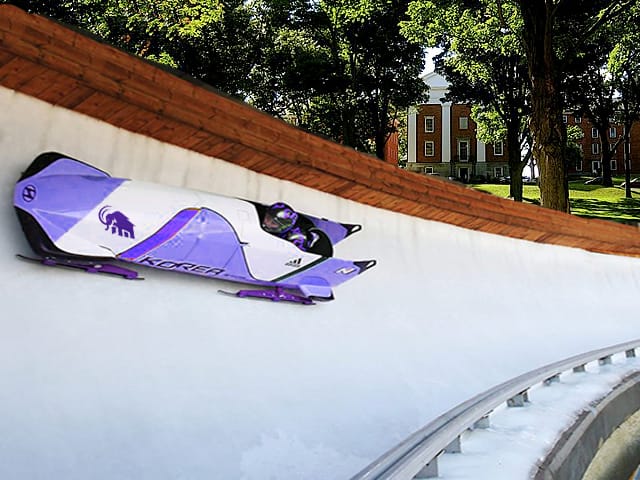
Last Thursday, the Board of Trustees voted to re-raise Amherst tuition as part of the College’s commitment to erecting a state-of-the-art bobsled track on campus by the year 2035.
As communicated to the student body through an email from President Michael Elliot, the Board determined a reorientation of institutional priorities was called for: “Amherst has always relentlessly pursued providing a stellar academic and student experience for its attendees. The time has now come to focus on our winter sports facilities as well.”
Coming less than a month after an earlier tuition hike, the decision quickly fell under scrutiny. One anonymous student questioned the plan: “Obviously, Amherst is nothing without its bobsled tradition. But can students really be expected to cough up $115,000 a year just to fund the new track? Why not cut a department or fire some more staff instead?” Apparently, in the wake of pushback to previously announced staff cuts, the Board of Trustees determined it better to place the financial burden on its student body, noting: “Our students have proven incredibly resilient to a number of challenging situations in years past; we are optimistic that they will meet this new moment of change with the same flexibility, perseverance, and optimism which has defined their character for decades.”
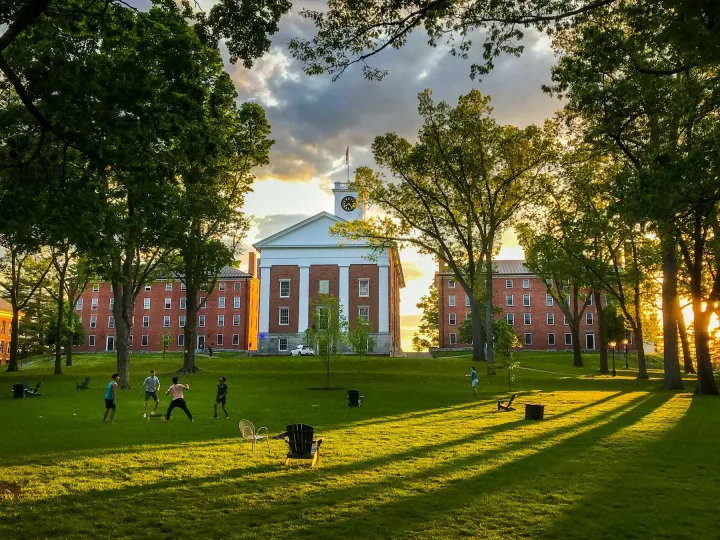
Beyond monetary concerns, some also raised issues with the plan’s disruptive nature. The approved bobsled track is set to run from Johnson Chapel down to the tennis courts. Models depict it weaving through the first-year quad before bisecting the new Student Center and plunging across Hitchcock Field to reach its end. The Board outlined a “four-stage, 13-step, 19-bit” plan to unobtrusively construct the $450 million track over ten years of construction. However, given that the track would traverse 23% of the Amherst campus, the unobtrusiveness of its construction remains open to speculation.
Furthermore, designers plan to add massive, industrial-scale fans at multiple straightaway points on the course to compensate for anticipated lower speeds. Traditional bobsled tracks wind down 450 to 500 feet of elevation, while the elevation change from Johnson Chapel to the tennis courts is only around 150 feet. That’s where the fans come in. Acting as “speed boosts,” according to designers, they would elevate Amherst’s course to the level of its domestic and international peers: “We [the Board of Trustees] hope to offset any natural-terrain-based limitations with these fans in order to erect a course possessing the quality to host global bobsled competitions.”
When pushed on how obtrusive these fans would be, planners held their ground: “They really won’t be a big deal. Just picture a couple of semi-trucks, or, you know what, better yet, a small building sitting on top of the ice that the racers sled under — the fans won’t even be that noticeable when they aren’t running.” Designers have acknowledged that the new race-day fans, which can generate up to 110 decibels during operation, may produce a soundscape some would consider less than tranquil. However, they remain confident that anticipated crowds will effectively mask any ambient noise of mechanical operation.
For too long, Amherst has lagged behind its peers in bobsled performance. Not once in our proud history has a team from the College qualified for the Olympics, nor have we even sent a bobsledder to the U.S.A. Bobsled-Skeleton Hall of Fame. At last, the Board of Trustees is taking the appropriate steps to ensure that future Mammoths won’t suffer the embarrassment of lackluster bobsled infrastructure as past classes have. A steep cost and a disturbed campus simply aren’t prices too high to pay for this noble mission: When returning to campus years after graduating, we will all finally have something to be proud of here when the bobsled track is finished.

Comments ()