

Capturing the Now — Alumni Profile, Bill Wasik ’96
From singing for the Zumbyes to being the editorial director of The New York Times Magazine, Bill Wasik ’96 is committed to comedy and community.
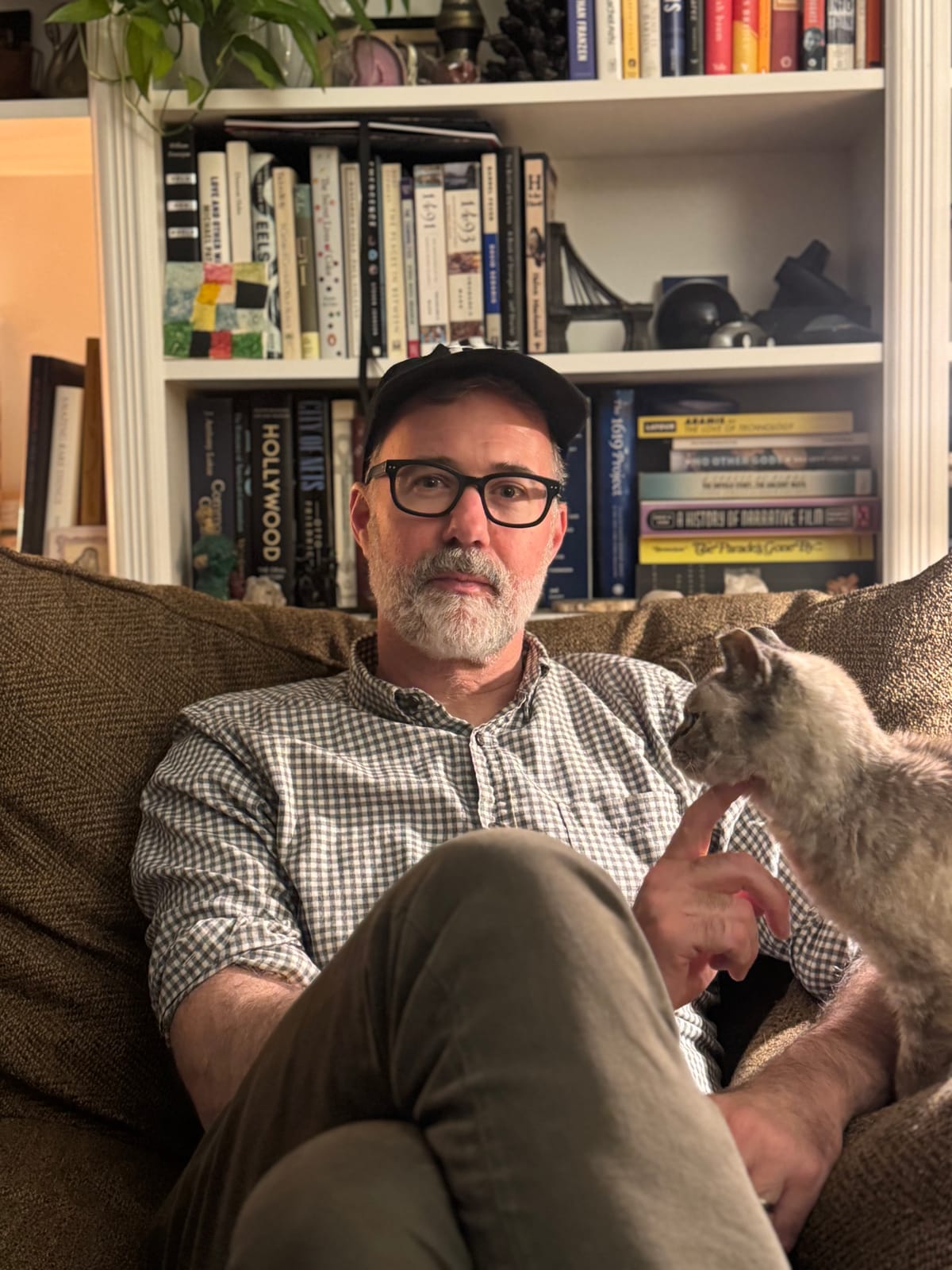
From inciting Manhattan flash mobs and crafting humorous articles to commenting on politics, Bill Wasik ’96 has an undeniable talent for reflecting on the current moment while bringing individuals together in the process. With an eye toward comedy and a career curating salient political pieces, Wasik worked his way from his high school newspaper to his current role as editorial director at The New York Times Magazine.
I spoke to Wasik from the Amherst Student newsroom, the basement corner decorated with clippings and bound books of articles from the paper’s past. Notably absent: any writing by Wasik. Despite Wasik’s journalistic inclinations pre-dating his time at Amherst College and his impressive career in the industry since, he never felt drawn to write for The Student — too newspaper-y.
Childhood Magazines
Wasik’s fascination with capturing “now” began when he was a child. He recalls flipping through the magazines that arrived in his mailbox each week and being enthralled by the covers of Newsweek, which provocatively and visually commented on the state of the world.
Wasik grew up in Laytonsville, Maryland — a suburb of Washington, D.C. — child of a math teacher and defense contractor. This meant that aside from Newsweek, he was also fond of the puzzle magazine Games (now Games World of Puzzles) — a subscription that provided him with seemingly endless pages of math games and logic puzzles. Wasik even credits Games with influencing his decision to major in math at Amherst.
By high school, Wasik was on the other side of the print microcosm. As a writer for the school’s newspaper, The Falcon, Wasik enjoyed being able to reflect the school community back to itself. “What really seemed cool about [The Falcon] was the kind of role … it played in the community,” he said. The paper highlighted events at the school, documented clubs and trends, and was known to have “ruffled some feathers” on occasion. It was this sense of community writing that later guided Wasik’s passion for magazine journalism.
A Note on Amherst
Before enrolling at Amherst, Wasik got a glimpse into all Amherst had to offer during his brief, but transformative overnight stay during his senior year of high school.
It was a cold Amherst winter and teenage Wasik arrived on campus to get a better sense of life at the college. His upperclassman host shepherded Wasik to his dorm, showed him the spot on the floor where he would be sleeping, and left. Abandoned, Wasik decided to wander around the wintry campus. “It was snowing a little bit, which was just very magical. I remember walking into Buckley Recital Hall … and finding my way to the Steinway pianos ... and realizing that I could sit and just play a Steinway with just incredible sound.” After this musical interlude, Wasik meandered through the falling snow back to the dorm and fell asleep.
“Around midnight, the guy I was staying with came back and immediately remembered that he had totally forgotten about me and felt bad, and so he roused a friend, and they drove me out to this … late night restaurant on Route 9 … for a late night breakfast, and talked to me about the school, and [they] were just like, really cool guys.”
Sold by the cinematic sequence of events, Wasik decided, “‘Okay, this is where I have to go to college.’”
Acclimating to Amherst
Stepping back onto campus as a student, Wasik developed close friendships with his Valentine Hall dormmates during his first year. “I wound up feeling like I had a really great intellectual community, and was really pushed to follow intellectual pathways that went even beyond what I was taking classes in,” he said. Upon further reflection, some of the conversations he had with his peers 20 years ago about leftist policies (such as defunding the police or raising housework wages) and questions about truth and misinformation that “incubated in the [liberal arts] academy,” have resurfaced in journalistic vernacular in the last five years.
“I feel like when I used the word, ‘epistemology,’ 20 years ago in the professional media, question[s] of ‘wait, you have to think in this meta way about how we know what we know?’ … [But] it feels very vital now at a time when everything is so contested,” Wasik said.
When he wasn’t deep in philosophical discussion, Wasik was — and continues to be — a proud Zumbye; he even returned to campus last year for the acapella group’s 75th anniversary. Wasik described the Zumbyes as “the kind of experience that I feel like you can only really have in college.” Wasik enjoyed traveling to other college campuses and singing with other acapella groups. “I learned a lot about confidence in performing and public speaking with Zumbyes,” Wasik said.
The group, renowned for opening their performances by frantically running to the stage, jumping around, and wearing a banana costume, provided an important comedic space for him throughout his college career.
“I always was really interested in comedy and comedy writing, and the Zumbyes were an outlet for that when I was at Amherst.”
Humorous to Serious
After graduating from Amherst, comedy continued to be a driving force in Wasik’s life. He soon reconnected with some friends from Hampshire College who had made a name for themselves in the Boston comedy scene. Some of them had established a humor magazine, which he later wrote and edited for, and his friend, Eugene Mirman, the voice of Gene Belcher on Bob’s Burgers, had started a comedy show in Cambridge.
“Comedy was really my passion when I first got out of college,” Wasik said.
Fittingly, his postgrad career in journalism began with writing for the humor magazine, the Weekly Week, of which he quickly became an editor. An article he wrote in the fall of 1998 called “Rock Prophets,” a humor piece about the band Journey’s lyrical love advice, caught the attention of Harper’s Magazine and was subsequently published in the magazine the following spring. As a 24 year old, fresh out of college, “[This] was obviously a huge thing for me,” Wasik said.
Without fully realizing it at the time, Wasik’s later acceptance to Harper’s internship program catalyzed his career, and slowly began a drift away from his roots in comedy.
“Even after I got that internship … I really was thinking of my interest in it as mostly comedic, and still imagined that I might change gears and go to L.A., try to become a comedy writer,” he said. “And it just happened, very slowly, where I was working on serious pieces, and found that really gratifying.”
The words of a colleague at Harper’s shifted Wasik’s perspective on the strict binary of “comedy” and “serious.”
“[I] could sublimate [the things I love about comedy] into the work of being a serious editor by … looking for the kind of the surprising turn of phrase, the quote that’s a little absurd, like the headline that has a little wink to it,” Wasik said. “To sort of take that love of surprise and absurdity and perversity and juxtaposition and even some of the angry parts of comedy, of powerful people who say stuff that’s just ridiculous or isn’t true … this kind of comedic instinct can be part of the mental toolkit of a serious journalist and a serious editor.”
Five, Six, Seven, Eight!
Most of the Boston comedy crew made their way to New York. This shift to more serious pieces did not impede Wasik’s engagement with absurdity. Flash mobs, the trend that took the world by storm in the early 2000s, were a product of Wasik’s creative genius.
Epitomizing its early internet time, the chain-email-based flash mob: Individuals participated in planned performance in public space that erupts spontaneously and subverts social expectation for space-use. The mob was an “arty attempt to take thoughts about comedy and try to impose them on the physical world in a sort of anarchic way,” he said.
In setting out to understand what gets people to show up to a comedy show, Wasik had the thought: “What if there was no show, what if the viral email creating a crowd was the whole point of the email, and kind of created the possibility of … performance art.”
Curiosity was the driving force of getting people to participate in a flash mob. “You get this email forwarded to you, and you would think like, I wonder what’s going to happen. I guess I’m going to go and see what’s going to happen,” he explained.
In the era of the cultural fixation on email: The concept of a real person sitting, typing, pushing send on an email which then would miraculously make its way to another real person, also sitting somewhere.
The flash mob’s inciting email prompted “a physical correlate to this digital world.” Wasik orchestrated eight flash mobs in total, all in 2003. “When the crowds were big enough, it was a real testimony to the fact that you could take these digital connections and … marshall huge numbers, and there was a lot of excitement associated with that,” Wasik said.
In 2010, Wasik moved across the country to San Francisco for an opportunity to pursue his fascination at the intersection of technology, writing, and society as senior editor of Wired Magazine.
“I had always been really interested in the internet and technology, and [the flash mob] experience got me even more interested in that.”
Technology Today
While the chain-email fad used to instrumentalize actions like this is largely now out of fashion, the rise of group chats and of digital spaces like Discord prompt similar feelings of curiosity for Wasik.
“A lot of older people, I think, misunderstand or over pathologize what’s happening in those spaces,” Wasik said. “The promise of the internet to connect people anywhere in the world, and now increasingly across languages with automatic translation … still just does make a lot of interpersonal magic happen.”
His recent personal writing includes a focus on artificial intelligence (AI) and its relation to humanity and the humanities, particularly AI’s ability to rewrite history.
In Wasik’s mind, there is a preliminary question of whether AI has the capacity to change the world and a secondary question on whether that change will be positive. While Wasik is a self-proclaimed believer in its ability to change the world, he is also confident that certain kinds of distinctly human practices, like reading, cannot be offloaded to AI.
“To me as an editor and a writer, thinking about AI … is the great work right now,” Wasik said.
Creatures and Culture
In addition to writing articles on the social side of technology, Wasik’s first of three books investigated this relationship in 2009, including reflections on his experimentation with the flash mob a few years earlier. In “And Then There’s This: How Stories Live and Die in Viral Culture,” he analyzes early 2000s internet culture and its relation to shaping perceptions of both the individual and the collective.
Wasik also cowrote two books with his wife, Monica Murphy, a veterinary expert.
Together, they’ve written about the intersection of sociopolitics and animals — a blend of their two worlds: Murphy as a veterinarian and Wasik as a journalist.
Their first book, published in 2012, “Rabid: A Cultural History of the World’s Most Diabolical Virus,” combined their political and scientific perspectives on rabies. And most recently, in 2024, they cowrote, “Our Kindred Creatures: How Americans Came to Feel the Way They Do About Animals.”
While in the first book, they primarily stuck to their respective realms of expertise when divvying up the writing, they wove their perspectives in the latter. “She became really obsessed with P. T. Barnum and circuses, and I took the lead on the chapters about animal research,” Wasik said.
A Beginning
After four years at Wired, Wasik received an offer that enticed his return to the East Coast: to serve as an editor of The New York Times Magazine: the publication he now directs.
“Jake Silverstein [the current editor-in-chief of The New York Times Magazine], had been a writer for Harper’s. His wife was somebody who had been an editor at Harper’s, and she and I knew each other," he explained. “And so when he was offered the job to be the editor of The New York Times Magazine, he and I started talking, and he offered me a job to come as one of the deputy editors at The New York Times Magazine, which was very exciting.”
Wasik now tries to recreate his childhood awe he had of the magazine covers for millions of magazine subscribers, refreshingly mirroring reality back through the pages of a magazine.
“I just was in a meeting where we were talking about cover illustrations for future issues, and kind of how the illustration would interplay with the language,” Wasik said. “And I think we’re still trying to give people ... that feeling every week of having the cover kind of say something about the world that they weren’t expecting, and just kind of on its own as a sort of … cultural statement.”
This role includes more direct engagement with political writings than he initially imagined he would find himself doing as a young college graduate. While Wasik still loves comedy, he said finding it in this political moment is “pretty limited.”
Still holding appreciation for a good punny headline or infusing irony, he’s come to realize the delicate balance between comedic enjoyment and “having fun at somebody’s expense.”
“I still enjoy watching a good stand up comedy show, and I like watching funny shows on television. [But] I feel like … my sense of comedy as one of my great preoccupations is in the past.”
Writing and Community
As a lifelong writer of an impressive (and increasing) range, Wasik offers optimism for others seeking to engage with the world through word.
“There is still a community of people who are writing and reading great, thoughtful pieces of nonfiction writing … I do think that it’s a very, very vital community… [and] I have faith that that community is going to survive,” Wasik said.
He hopes we can find more ways to better support the breadth of nonfiction writing, acknowledging the current lack, and that the difficulty of finding paid jobs in the field “doesn’t dissuade people who are drawn to that kind of writing to not participate.”
Wasik’s wisdom imbued with passion, curiosity, and an openness to opportunity are not only indicative of who he is as a person, but also speaks to values of community Amherst has sought to foster.
“Amherst was the size that you could have that feeling of community, and that feeling of exciting connection, of everybody mattering to each other that I think is harder to find in a grown up life,” Wasik said. “There is something about a community of that size, that just allows for a certain collective awareness and conversation.”

Comments ()