

Class of 2030 Statistics Leaked on Fizz
The leaked information revealed a record percentage of female-identifying students in the admitted class. The Admission Office also shared expectations of a higher yield rate due to the increased relevance of a Liberal Arts education in the age of AI.
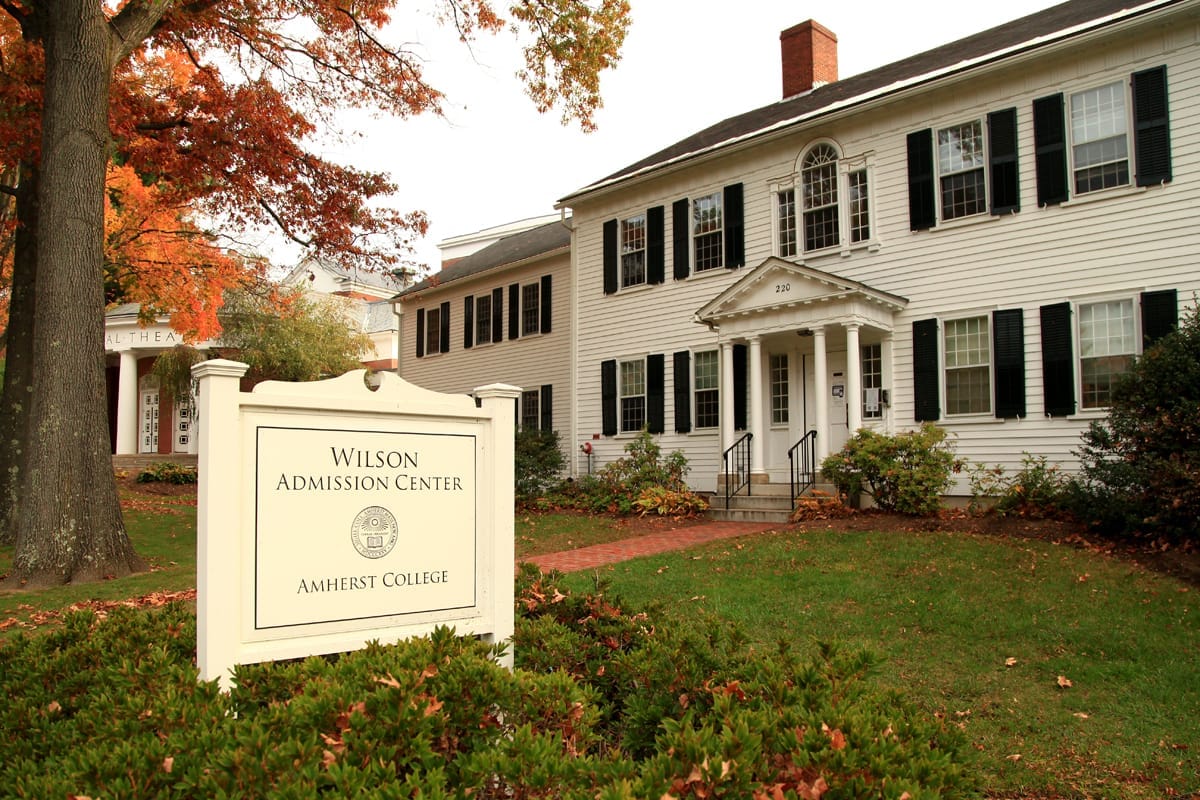
On Friday, confidential admissions data for the admitted class of 2030 was leaked on the widely used online platform Fizz. The post, which has since been deleted, was originally shared by an account with the username @totallydefintelyrealmichalelliott.
Although the Office of Admissions intended to release the official data only after National College Decision Day on May 1, they agreed to grant The Student an interview to explain some of the leaked information.
The original released data showed that 72% of the admitted class identifies as female. The Office of Admissions confirmed the information to The Student, adding that the statistic is “the culmination of a decade-long effort.”
“The high number of admitted students who identify as females isn’t a coincidence. As 2026 marks the celebration of 50 years of coeducation at Amherst, this is part of a broader commitment to decreasing the number of male students at the school, addressing our historical debt to gender inequality,” an admissions officer explained.
This year, however, the office’s internal note acknowledged that the ratio has reached the point of being “noticeable at social events.”
Despite open curriculum and interdisciplinary studies remaining the biggest appeals of the college, data show that students remain largely concentrated in just three majors: economics, political science, and mathematics. The data also included a rise in “create your own” majors, where proposals included “Applied Networking”, “Intellectual Curiosity, Its Development and Performance,” and “Digital Intimacy in College Online Platforms.”
“Although the option to ‘create your own major’ is not a new initiative, we have never observed such a large number of admitted students demonstrating the interest to follow this track,” Associate Dean of Admission Avery Holistica said. “It is hard to confirm this now, but we believe that this increase has to do with the fact that students are seeking new ways to stand out to employers in the age of artificial intelligence (AI), and having a unique major might be a very effective way to do that.”
Admission officers reported that the use of AI was particularly important in this admissions cycle. They highlighted that the rapid changes in the job market and academic environments across the country have required the office to adapt its recruitment process. “We didn’t bother to consider anyone whose personal essay GPTZero didn’t flag with at least 80% certainty,” Holistica said. “We value students who know how to leverage their resources, and right now, ChatGPT is the most underutilized tool.”
She also added that “AI literacy is probably the most essential skill someone can have today, and freshman students coming into Amherst must be knowledgeable of how to effectively engage with these tools.” “It is a fact that entirely humanly written essays are a thing of the past, and we wanted our admission process to reflect that,” she said.
A student contacted by The Student, who wished to remain anonymous, was one of the violators of the new guideline. Their essay was entirely human-written. “I understand my mistake, and I am deeply sorry,” the student said. “I recognize my belief in self-expression was stupid and selfish … Unfortunately, this has cost me admission to my dream school. I really thought I had a shot at getting into Amherst.”
According to the Office of Admissions, another advantage for the college in light of AI development has been an expected increase in yield rates, as liberal arts colleges were named the best places to develop intellectual curiosity in the age of technology.
“My father went to Harvard, my grandfather went to Harvard, my great-grandfather went to Harvard. Yet, I chose to be different. At Amherst, I will get more attention to my intellectualism, develop actual inter-personal skills in a small classroom, and get to make eye contact with my professor outside of office hours,” Jane Kennedy ’30 said. “And the best part is, now when I say I go to a small college in Massachusetts, I can actually mean it.”

Comments ()