

College Commemorates 10th Anniversary of Amherst Uprising
Students, alumni, and professors gathered in Frost Library on Friday to celebrate the 10-year anniversary of the Amherst Uprising, the student sit-in that led the college to adopt a new mascot — the mammoth.
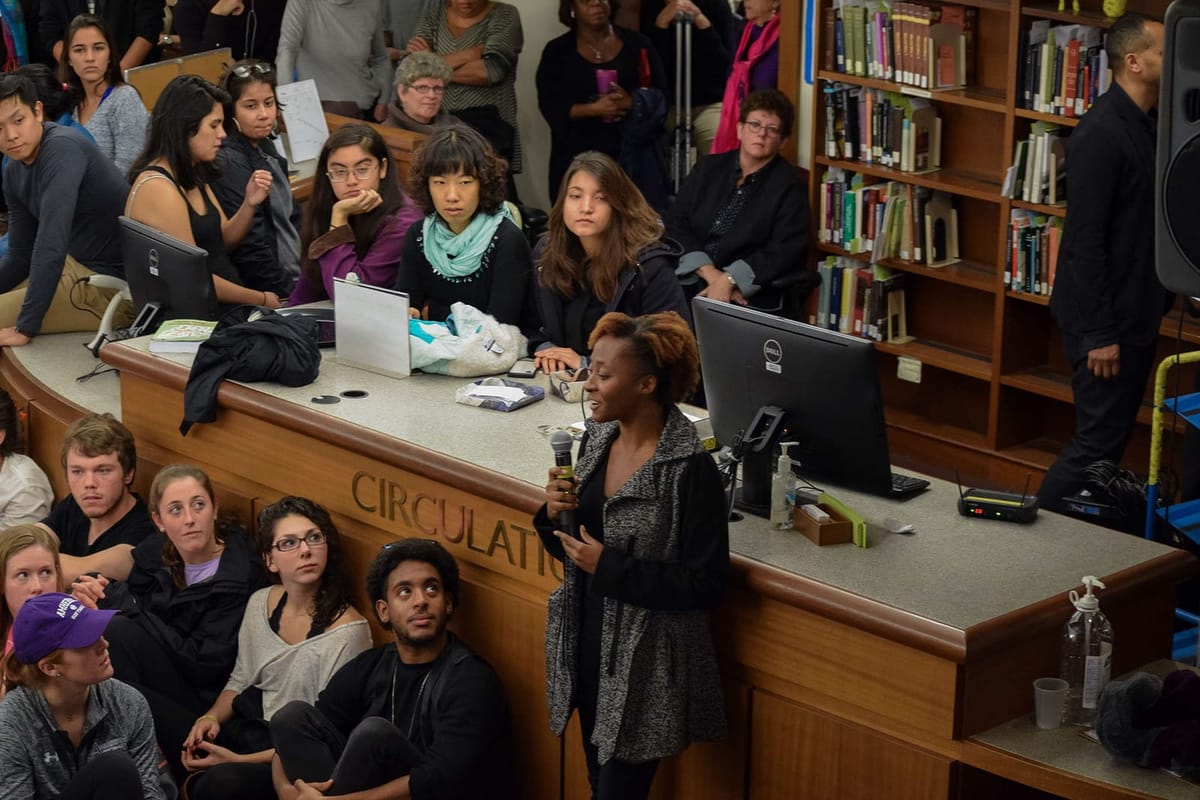
Today marks the 10-year anniversary of the Amherst Uprising, which the college commemorated on Friday through a series of talks and the opening of an exhibit at Frost Library. The uprising was a student-led sit-in in Frost that sparked the college’s mascot change from the Lord Jeffs, named after colonial-era military hero Lord Jeffery Amherst, to the Mammoths and led to broader awareness of racial injustices on campus. A series of panels was held during Homecoming and Black Alumni Weekend, and was attended by alumni, faculty, and current students.
The first panel was titled “The Uprising Remembered,” with panelists Mercedes MacAlpine ’16, Matthew Randolph ’16, Sanyu Takirambudde ’18, and former Amherst College President Biddy Martin. The panel was moderated by Dean of Students Angie Tissi-Gassoway. Panelists reflected on their experiences during the Uprising 10 years ago and how it impacted the rest of their college experience.
Panelists explained how the Uprising was where a sense of community among students of color was first fostered outside of groups such as the Black Student Union. They stated that they began to feel support for the first time from the whole college, with departments and organizations joining together for the sit-in.
Alumni and faculty members recalled how professors voluntarily canceled classes to allow their students to attend the sit-in without repercussions. Similarly, staff members at Frost worked long hours to support the sit-in.
“We wanted to make sure we gave due justice to what it was, and what were the frustrations that were behind it and the changes to the college since then,” Vice President for Equity and Inclusion Pawan Dhingra said.
A second panel, titled “Campus Then & Now,” focused on the changes the college has made since the Uprising and the gaps in equality that remain. Panelists consisted of Professor of Chemistry and Department Chair Sheila Jaswal, Emily C. Jordan Folger Professor of Black Studies and English Emerita Rhonda Cobham-Sander, Senior Associate Dean of Students Charri Boykin-East, and Arts & Humanities Librarian Sara Smith, and the panel was moderated byAnson D. Morse 1871 Professor of History and Professor of Environmental Science Rick Lopez. As faculty and staff who have worked at the college since the Uprising, they discussed changes they have seen and what should follow.
Panelists explained that the Uprising marked the beginning of discussions about negative experiences with race and discrimination at Amherst. Before the Uprising, it seemed that students were afraid of the consequences of sharing their personal experiences.
Additionally, several major equity-related changes have resulted from the Uprising, including the establishment of the Latinx and Latin American Studies major, the creation of the Office of Diversity, Equity, and Inclusion, and the launch of the Being Human in STEM Program. The Uprising shifted the way many viewed the environment at Amherst, and panelists hoped the college could continue growing in that direction.
“It’s not as retrospective. We want to also be forward-looking,” Dhingra said. The third and final panel, “Still Rising,” was a conversation between current students Ayres Warren ’26, Suntali Donahue ’27, Jadyn Newby ’27, and President Michael Elliott aimed at discussing how the college can meet today’s challenges while looking ahead to build a stronger, more inclusive Amherst community.
Another major theme of the event was building community at Amherst. Panelists in the first panel discussed the importance of collaboration between departments, faculty, and students during the Uprising in successfully changing the college mascot to what it is today: the mammoth. The shift from the Lord Jeffs to the Mammoths signified a much larger shift in the college’s culture towards inclusion.
For Tissi-Gassoway, the events were intended to inspire community members to consider these pertinent questions: ”What are the opportunities for us to be in community with each other? What does it mean to recognize how much work we still have to do, but [to know] that we’re building on the work of all the people who have come before us?”
The program concluded with a reception, where attendees socialized and reflected on the day’s events. “It’s truly meaningful to have an event where alumni, faculty, staff, and students are all sitting in the room talking to each other about what kind of community we want to create,” Elliott said while reflecting on the event.
Editor’s Note, Nov. 13, 2025: The article was updated to correct who the moderator of the second panel was.
Comments ()