

College Receives National Attention, Controversy Over “Voices of the Class” Performance
The Washington Free Beacon recently published an article by Jeb Allen ’27 criticizing the annual “Voices of the Class” performance and other “school-sanctioned sex events”. Students reported experiencing online harassment and doxing as more organizations published similar articles.
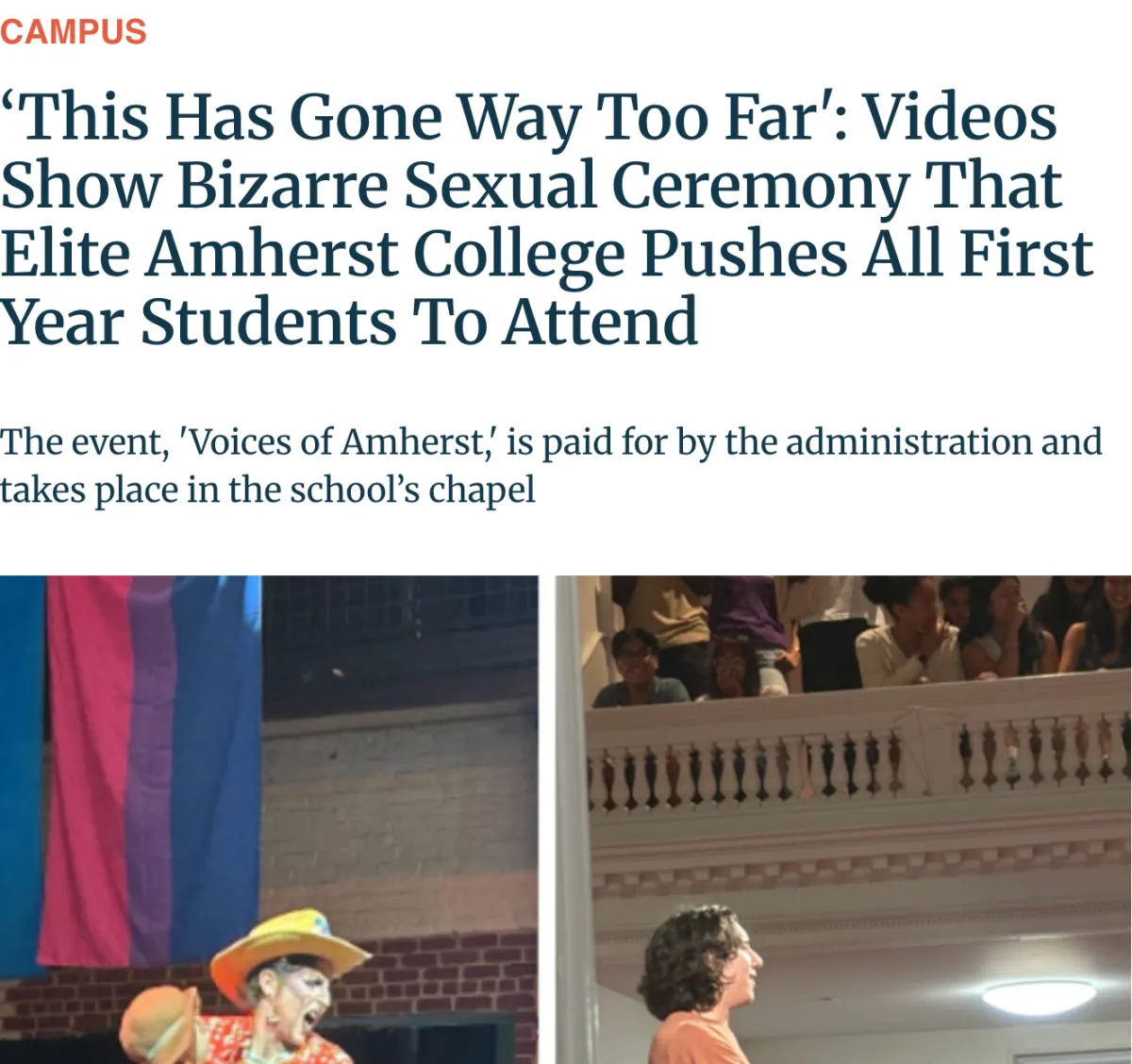
On Friday, The Washington Free Beacon published an article titled “‘This Has Gone Way Too Far’,” criticizing “Voices of the Class” — an annual Orientation performance using out-of-context material from incoming students’ application essays — as a “bizarre sexual ceremony”. Written by Jeb Allen ’27, the article included photos and videos of student performers, as well as student interviews critical of the performance and other college-sponsored events designed to promote sexual respect, such as the “Wellbeing Skits” and “Sex in the Dark.”
“Amherst College was founded over two centuries ago to prepare young Christian men for the ministry,” Allen wrote. “Today, however, the prestigious college has become a hotbed of administratively sanctioned sex performances and ‘sexual skills’ programs, with a focus on ‘queer’ and transgender students and on free-sex practices such as polyamory.”
The article also included screenshots of posts on anonymous social media app Fizz, where a student shared that “[s]eeing the Voices’ actors around campus is giving me involuntary flashbacks to the scarring experience that was the Voices of the Class of 2029.”
On the same day, the New York Post used footage from The Beacon in its own article titled “Elite liberal arts school Amherst College held ‘disgusting’ orientation performance — where students mimicked sex acts. Several other newspapers, such as the International Business Times UK and The U.S. Sun, also published similar articles on the same day, claiming that “Voices of the Class” is a “vile performance” that made students “absolutely horrified”.
This uptick in reporting prompted a multitude of responses from both the college and the student body. In an email from the President’s Office on the same day, President Michael Elliott and Dean of Students Angie Tissi-Gassoway explained that the college is “exploring possible responses to the article in the context of [the college’s] educational mission,” and had contacted students “who were named or appear[ed] in the videos to ensure they are supported during this time.”
In an email to the community on Saturday, the Office of Student Affairs confirmed that several Amherst students had “experienced harassment and doxing” due to the reporting. The email explained that the college is “seeking the removal of photos, videos, and alarming photos where possible” and requesting for corrections in articles that “misreported the events in question”. The email also stated that the college is “exploring other actions that [it] might take” to protect the student community and that it has “zero tolerance for harassment and doxing at Amherst College.”
The Association of Amherst Students (AAS) also responded to the articles with a letter to the administration claiming that “the [c]ollege’s public posture has not yet matched what students are experiencing” and requesting that the college describe guidelines for affected students as well as establish preventative measures. AAS explained that while it “vehemently support[s] every students’ right” to disagree, the deliberate “spread of misinformation does not contribute to the purpose of free speech.”
Other student organizations such as The Muckrake, Amherst College Democrats, the Disabled and Neurodivergent Alliance, the Southeast Asian Student Association, and the South Asian Student Association (SASA), expressed solidarity with affected students and called on the college to take further action.
“We’d like to express our support for and solidarity with students who have been negatively affected by this article and stand firmly by them,” SASA wrote in an Instagram post. “While we support free speech and the right to publicly disagree with the college’s programs, that speech should never directly enable harassment, doxing, or threats to students’ safety and lives.”
Several students have also reported feeling concerned about their safety. On Fizz, one student wondered whether the college’s recent negative attention “could result in violence against [the students]” in light of the recent shooting at Brown University. Another student commented that Allen should have gone to “The Student or [administration],” or at least published his article without student performers’ faces.
“We will continue to defend the rights of our students to participate fully in campus life,” the Office of Student Affairs wrote in their campus-wide email.

Comments ()