

Efficiency or Education? Frost Confronts Generative AI
As the College rolls out institutional access to generative AI tools, Managing Features Editor Talia Ehrenberg ’28 examines what the change means for research, learning, and campus resources.

As artificial intelligence (AI) continues to dominate national discourse — from class syllabi to Super Bowl ads — Amherst has further fueled on-campus discussion with the rollout of premium access to three new generative AI tools. As of Jan. 22, Amherst students, staff, and faculty can activate free subscriptions to NotebookLM, ZoomAI Companion, and Gemini.
With NotebookLM positioned as a “research and thinking partner,” ZoomAI Companion promising to “capture context [and] uncover insights,” and Gemini claiming to “supercharge creativity and productivity,” these tools raise critical questions about the evolving role of academic institutions in relation to the people and resources that constitute them.
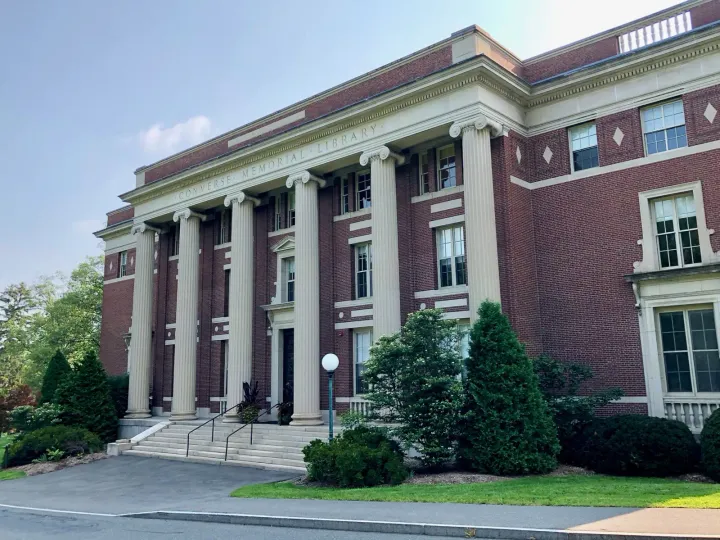
With campus-wide access to these tools, attention has turned to Amherst’s more analog research spaces — most notably, Frost Library and its related resource centers — and to a broader question: where do we go from here?
In an announcement from Vice President for Information Technology and Chief Information Officer David Hamilton and Provost and Dean of the Faculty Martha Umphrey, the college clarified that “making these tools available is not an endorsement of any single or uniform use, nor an expectation that every individual adopt them.”
The decision was largely driven by the reality that many students already use generative AI tools through personal accounts. Task forces composed of Amherst staff and faculty determined that providing institutional access would both level the playing field for students and enhance user security through additional safeguards.
According to Hamilton, in an interview with The Student over email, evaluative committees decided to enable access to these three tools after tracking a range of factors over the past year and a half, including use at peer institutions, budget impact, community needs, licences, and contract terms.
Although the email announcing the availability of new AI tools arrived just before the spring semester, the news did not come as a surprise to Jessica Kem, director of the Writing Center. Describing the development as a “logical next step” for the college’s approach to data security and equity, Kem explained that she had anticipated the change through informal communication amongst colleagues. “I didn't know when it was going to come, or exactly what the rollout would look like,” she said. “But I was aware that it was coming.”
This is not the first time new technology has introduced looming epistemological questions of knowledge, information, and digital reliance. In Feb. 2022, the Association of Amherst Students (AAS) granted students access to Grammarly Premium. But even before that, search engines and platforms like Wikipedia raised alarms for what critics saw as shortcuts to the research process and concerns about reliability.
Director of the Library Martin Garnar recalled his early days as a librarian, when Wikipedia was still in its infancy and similar questions about authority and credibility were emerging. Over time, Wikipedia has gained broader trust as a fact-checked, crowd-sourced encyclopedia, but even so, Garnar emphasized that it should serve as a starting point rather than an end point.
“If you want to start with Wikipedia to get an overall understanding, it's the same move as going to one of our print or online encyclopedias. And in both cases, I would then tell you to go to the sources to learn more,” Garnar said.
As reliance on the internet for research grew, Garnar noted that a more existential question began to surface: “Why do we even need libraries?”
Similar concerns arose when students first gained access to Grammarly, with some fearing that increased reliance on digital feedback would lead to a reduction in use of campus writing centers. Kem noted that this has happened to some extent across other institutions but was surprisingly not the case at Amherst.
“We haven't seen that,” Kem said. “Our [student participation] numbers have crept up over the last couple of years, which is interesting, and I can't point to a specific causation for that, but we haven’t seen that drop off.”
The library affirmed that it will hold to its mission as technological circumstances evolve.
The Amherst College’s Library Mission, adopted in 2023, states that “the Amherst College Library partners in teaching, learning, and research by providing and advocating for equitable access to information, promoting free expression, and building community. We aim to provide inclusive and responsive services, resources, and spaces that reflect these commitments.”
In realizing this mission, the library created a guide to responsibly using generative AI, including navigating ethical costs, appropriate research uses, relationship to copyrighted work, and self-reflective questions.
With the goal of ensuring students are competent navigators of curated library resources, Garnar wants students to “have the ability to think about your information needs and then fulfill [them] so that when you leave Amherst, wherever you go, if someone asks you a question, … [you’ve] got the ability to … know how to navigate that world of information in an effective way.”
While the campus-wide AI availability is still in the first weeks of the rollout, librarians have noticed some shifts in student engagement with the library after a general increase in AI use. Garnar said the library has seen students “requesting materials that don’t exist” because of fabricated citations or inaccurate descriptions of sources.
“In some respects, [students have been] tricked by AI thinking,” Garnar said.
Both Garnar and Kem affirmed that these technologies have useful features that may be a time-saver in certain circumstances: for experts in a field who already know the questions they need to ask, Garnar noted, or for transcribing pages of handwritten notes, Kem added.
But Kem believes that efficiency is not always the goal. Without slowing down to pay attention to purpose and process, something might get lost.
“One of the things that we’re really invested in [at] the Writing Center is supporting students in developing close reading skills,” Kem said. “And listening to a NotebookLM podcast of a reading is not the same as sitting with the reading on paper in front of you … Sometimes we need to take in information quickly, and sometimes we need to take in information slowly. But without attention, what are you trying to get out of this activity?”
As pressure for hedonic efficiency continues, the larger question of “why” remains unanswered when it comes to AI’s exact purpose.
“Does that open up more space for us to use our time for things that are deeper, more creative? Maybe.” Kem said.
Garnar added that if AI is used solely as a shortcut, “the educational experience is diminished.”
There is still no consensus on a single, overarching policy. “There is a range of opinions [among] the faculty … some who can see great uses for it, some who can see similar uses for it, and some who don't want to use it at all,” Garnar said. “And we have to support everybody.”
Kem emphasized that using AI does not have to come at the expense of interpersonal engagement.
“We have [a] strong belief in human-to-human interaction and dialogue as a way of learning,” Kem said. “You can use the tools and be in dialogue with people at the same time … Sometimes getting feedback from a human and from AI can just give you more information.”
Still, Garnar wanted to establish a clear boundary.
“We are going to be pretty firm about making sure that [AI] doesn't become a substitute for your own thinking,” Garnar said.
When advising students on how to proceed with using these tools for research, Garnar said that if students have a question about how to approach a research topic, they should start where they’ve always started in the past — talking to human resources on campus so they can “provide the guidance that [they]are here to give.”
Hamilton echoed that sentiment, pointing to institutional support structures. “The college is making training opportunities widely available, and I encourage everyone to consider those options. Engaging with faculty in courses and with academic advisors who may have advice specific to majors and disciplines is another good way to begin exploring,” he said.
Garnar noted that a liberal arts environment is particularly well-suited to developing the skills to thoughtfully engage with AI.
“This is your opportunity here at this place to build those skills so that you can use your own judgment as to when to do the time savers, but you can't save time if you don't know how to do it in the first place,” Garnar said.
A recurring thread that emerged from both Garnar and Kem was simple: Ask questions.
“Ask questions of the tools. If you're going to use these tools, you can use them to investigate the tools themselves in terms of what they might be useful for or not as good at,” Kem said. “But perhaps more importantly, ask your professors, talk to your friends, talk to us, librarians, and writing center associates. [AI tools] present a whole new menu of choices, and none of us can figure all those things out by ourselves.”

Comments ()