

Exhibitions Celebrate Mead’s 75th Anniversary
For its 75th anniversary, the Mead Art Museum is redefining what gallery experiences can be. From immersive textiles to art created under state censorship, Staff Writer Amaya Ranatunge ’28 captures how the Mead has challenged how we engage with art, and how it is set to inspire for years to come.
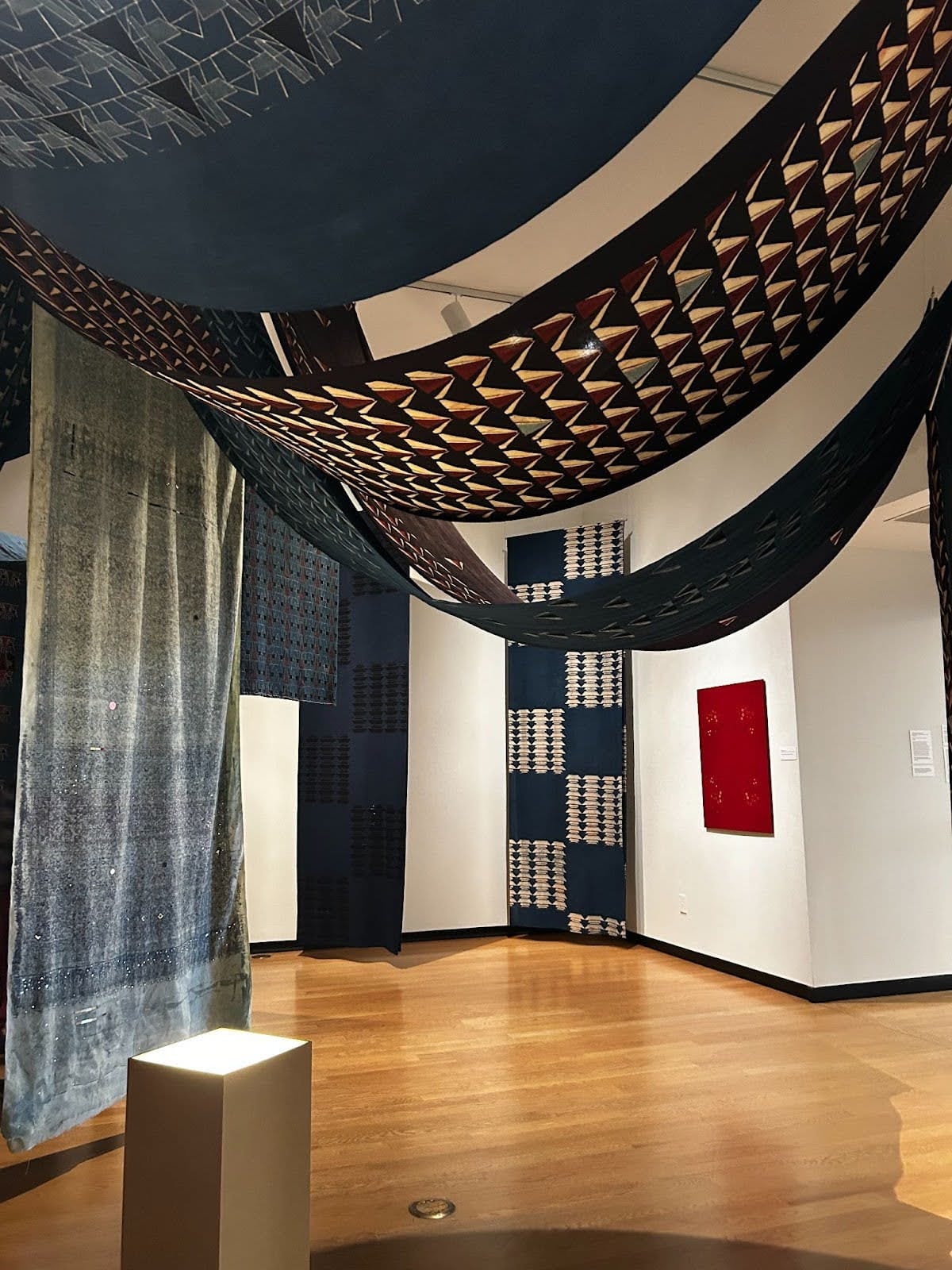
Walking into the Mead Art Museum on Friday for its 75th anniversary exhibition, I expected the usual — paintings on the walls, people standing around with drinks in hand, polite conversation about brushstrokes and light. But this time, I was surprised. The 2025 Mead Fall installation has three main sections: Swapnaa Tamhane’s “Spaces That Hold,” “A Contentious Legacy: Paintings from Soviet Ukraine,” and “Re/Presenting: An Activity Gallery.”
The first thing that caught my eye was “Spaces That Hold” by Swapnaa Tamhane. Instead of canvases, the room was filled with textiles, elegantly hanging from the ceiling. Above, strips of cotton hung like banners, dyed in deep reds and indigos, their surfaces patterned with block-printed shapes and lines. This was “Mobile Palace” (2020–2021), a collaboration between Tamhane and artisans Salemamad Khatri and Mukesh Prajapati. Beading and appliqué added texture; the marks of the hand were everywhere, with labor, collaboration, tradition, and innovation stitched together.
The motif for “Mobile Palace” is a building by Le Corbusier, the Mill Owners’ Association building in Ahmedabad, India. Growing up around block printing with an architect dad, Tamhane felt as though she had always been passionate about ornamentalizing architectural spaces: “It is a modernist piece of architecture and I wanted to turn it into an ornament.”
What struck me most was how immersive it felt. When I asked Tamhane what inspired her to create more accessible art, she mentioned that she “wanted to make a beautiful ornamental space for everybody because some people don’t feel comfortable going to museums.” It felt less like walking into a gallery and more like stepping into another world. The space had been completely transformed, and I could tell I wasn’t the only one taken aback: People stood under the hanging cloth, looking up, letting the colors fall around them. The exhibition’s theme, making art more accessible, suddenly felt alive in that moment. Tamhane’s art pushes out of its frame and into the room, insisting you enter and notice it.
Siddhartha Shah, the museum’s director, said making museums and art accessible to everyone was one of his priorities. “I learned about Swapna’s work a few years ago, but have never seen it in person. What drew me the most to it is [how it] completely chang[es] the way people experience art museums. When you go to museums, you are just used to standing and staring at paintings and looking at labels. I wanted to create a space where you can [lie] down, you can sit, you can sing, you are looking in all different directions, and your body is moving in totally different ways in the space, so you can feel almost at home.”
When you walk into most Western art museums, it’s pretty unusual to see much South Asian representation. Maybe there’s a token piece tucked away, but European painters or American modernists often dominate the walls. That’s why stepping into the Mead and seeing Swapnaa Tamhane’s block-printed textiles suspended from the ceiling feels so refreshing. As Shah said, “there are so many gorgeous South Asian art forms that need to demand more space.”
The second exhibition, “A Contentious Legacy: Paintings from Soviet Ukraine,” was a complete shift in mood. Instead of textiles, the room was filled with paintings from Soviet Ukraine, made between the 1960s and 1980s when art was caught in a strange space between propaganda and creative expression. These pieces raised the question: How much freedom did these artists really have under the state system that dictated what could and couldn’t be shown?
The works come from the Maniichuk-Brady Collection, which has an incredible backstory. After the Soviet Union collapsed, Ukrainian American lawyer Jurii Maniichuk began collecting these paintings in Kyiv to save them from being lost or destroyed. What makes this exhibit even more urgent is its connection to the present. It encourages comparison between the complicated legacy of Soviet rule and Russia’s current invasion of its former territories, showing how art, even decades later, still holds those complicated histories. Many of the featured artists came from cities now devastated by Russia’s invasion, like Kharkiv, Zaporizhzhia, Luhansk, and Donetsk.
The Mead has also introduced different colored tinted glass lenses through which you can look at these paintings, and I found myself peering through them. A cool tint softened the scene, while a warm one sharpened and intensified it. It was such a simple idea, but it made me pause and think about how easily perspective shifts and how art isn’t just about what’s on the canvas, but about how we look at it.
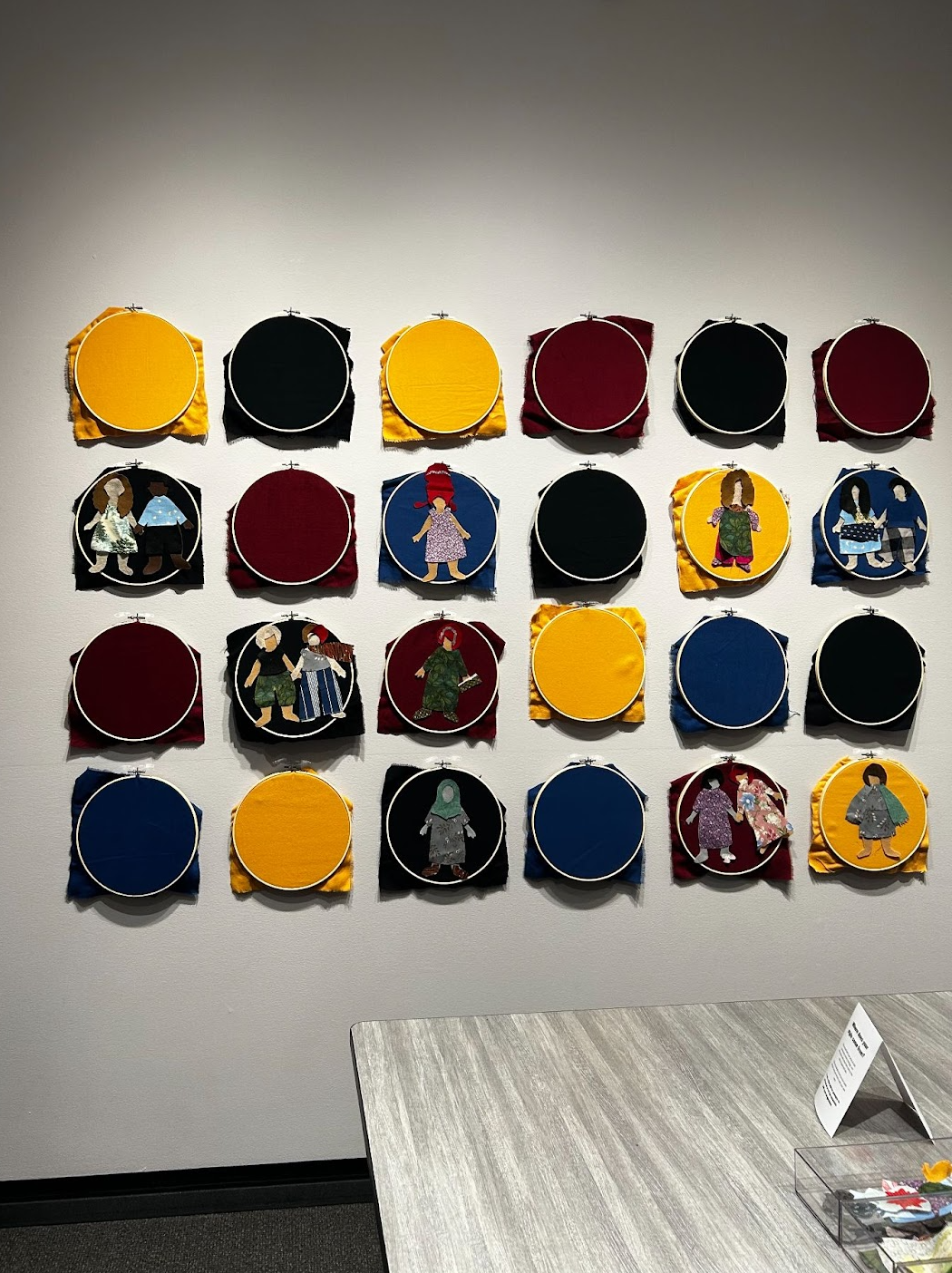
The last stop was “Re/Presenting: An Activity Gallery,” which felt unlike any museum space I’d been in before. Instead of looking at portraits on the walls, I was invited to sit down, pick up some materials, and start creating. What I loved most was the way the gallery encouraged the audience to think about how we see one another: how skin tones, hair textures, and facial features are represented in art, and how those choices carry weight. “Re/Presenting” was asking questions about visibility, beauty, and value. Who gets to be shown in museums whose stories are told, and who gets left out? Inspired by work from EmbraceRace, an Amherst-based organization that supports healthy racial learning in early childhood, the gallery made those questions approachable without watering them down. It was the kind of space that reminded me that museums don’t just preserve the past; they can also challenge us to reimagine the present.
Compared to other Mead exhibit openings, the turnout for this exhibition was significantly larger, and definitely more enthusiastic. “I think that the new exhibits are fascinating and I love that I get the opportunity to go to the Mead on its 75th anniversary,” Harry Finnegan ’28 said.
Walking out of the Mead that evening, I realized the anniversary wasn’t just about celebrating the museum’s past 75 years but also about imagining what the next 75 years could look like. From South Asian textiles that redefine what a gallery space could be, to Soviet Ukrainian paintings that complicate ideas of art and propaganda, to an activity gallery that turns visitors into creators, each exhibition presents ways to see art and museums differently. The exhibitions will continue to remain open until early January next year. The Mead opened doors, shifted perspectives, and invited us in. If this celebration was any sign of what’s to come, the future of the Mead feels as bold and accessible as the art it holds.
Comments ()