

First-Year Senators Share New Campus Ideas
In interviews with The Student, recently elected first-year senators shared ideas they hope to bring to AAS this coming year. Projects included improving social engagement on the First-Year Quad, encouraging more events in the Powerhouse, and a “student ambassador program.”
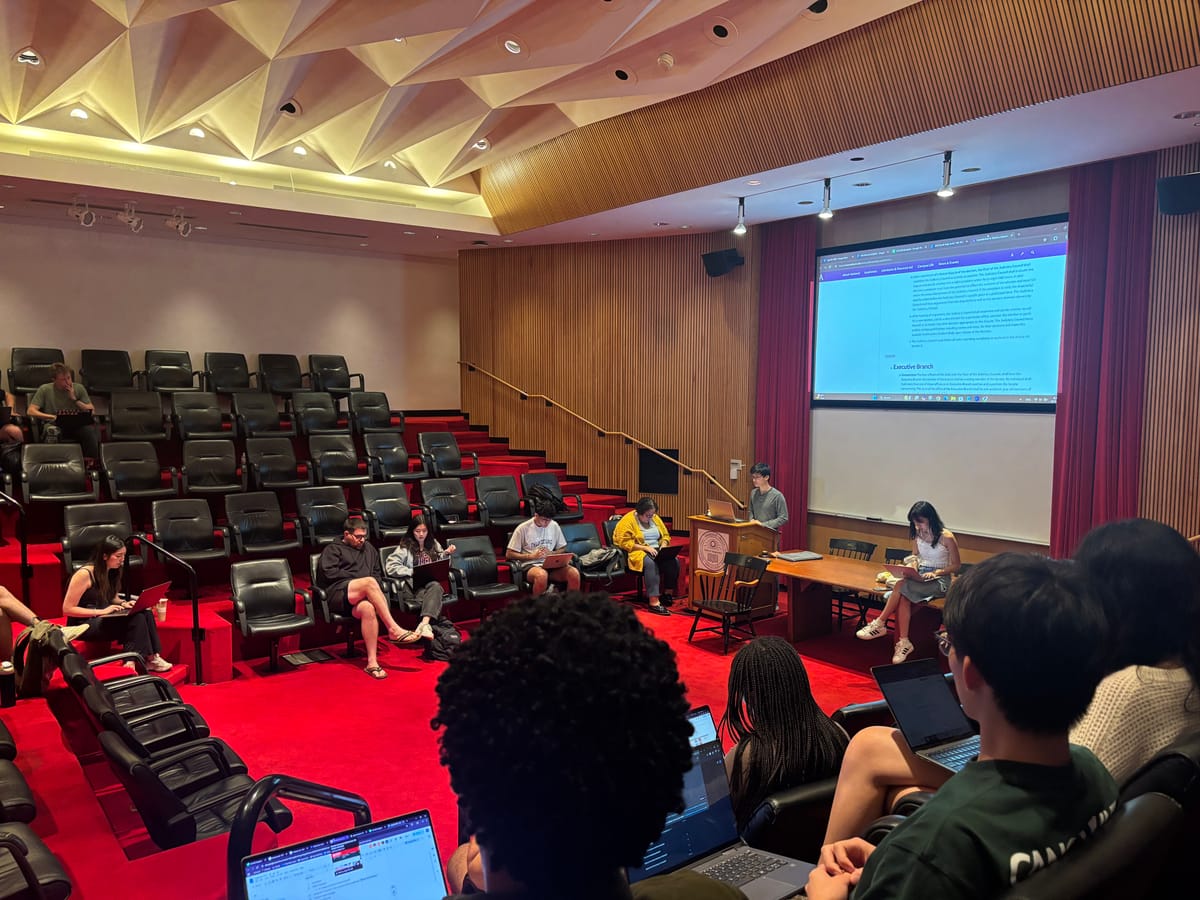
Following the results of last week’s first-year senator elections, eight fresh faces have joined the Association of Amherst Students (AAS) Senate for the 2025–2026 academic year. This year’s first-year senators were officially sworn in during their first AAS meeting in the Red Room on Sept. 29.
In interviews with The Student, new senators discussed their goals and priorities as they begin their first term. Many were motivated to run for the position by their previous leadership experiences in high school and their desire to ensure that their classmates’ voices are heard.
“I just have a passion for being a leader and making an impact in my community, so I knew that was something I wanted to do here,” Amir Ali ’29 said. “I’m also first-generation, and I didn’t want my background to make me feel like I wasn’t good enough to run for something.”
Mayen Thorsen ’29 emphasized that the transition from high school to college can be challenging for many students and hopes, as a senator, she can help ease that process and improve the freshman experience.
“If I do a good job at being a senator, I think I can implement policy that creates the best student experience and can really bring a lot of those concerns and things that are on people’s minds to light,” Thorsen said.
Most of the senators already have ideas for changes they hope to bring. A common theme among them is improving social engagement and expanding opportunities for students to connect through events and shared spaces.
Ali is especially excited to bring back the Powerhouse Committee on AAS, which oversaw events, activities, and programming at the Powerhouse. He noticed that many of his classmates were unfamiliar with the space or even unaware of its location.
Ali is also interested in creating a shared playlist in Valentine Dining Hall, accessible through QR codes, that would allow students to add songs directly to the playlist. “That way, we can hear more about different cultures, traditions, and walks of life, and start conversations based on those songs,” he said.
Thorsen hopes to promote more events in the First-Year Quad. She believes that competitions or collaborative events among the residence halls could help students meet new friends and step outside of their comfort zone.
“I think that after orientation, we really don’t have many of those opportunities to interact with people who aren’t in immediate proximity to us,” Thorsen said.
Ally Spino ’29 also hopes to enhance the student experience within the First-Year Quad. She sees potential in improving common spaces in freshman dorms and advocating for additions like ping-pong tables and bean bags in buildings that lack them.
“I feel like even spending more time in our common rooms has allowed me to make a lot of new friends and connect with new people. So I feel like expanding that into more dorms is definitely a priority,” Spino said. “I also want to do social events to connect our class, maybe like formals for everyone.”
Micah Scott ’29 emphasized the importance of celebrating multicultural perspectives within the freshman class. He believes that food-centered events in residence halls could help bridge diverse groups and foster stronger connections on campus.
Tony Wang ’29 hopes to improve the laundry facilities in the freshman dorms by adding features, like laundry baskets or storage cabinets, to make the spaces more organized. He is also advocating for ice cream as a late-night option, a proposal he believes helped him win his election.
Like his fellow senators, Beckett Lawrence-Apfelbaum ’29 aims to enhance the freshman social experience. In particular, he hopes to advocate for a driver’s education program on campus.
“I think the process for getting [a license] while on campus is quite difficult because you don’t know which agencies to trust, and you also have to travel there in the first place,” Lawrence-Apfelbaum said. “I think there’s an opportunity, considering the [number] of people who don't have their license, for Amherst to possibly … get discounts to make it more affordable and accessible for people.”
Tim Churchill ’29, who was inspired to run for Senate after winning the Performative Male Competition, wants to use his platform to promote more engaging, similar-style activities for students.
“I realized that it would be fun to have the opportunity to do more things like that. I think everyone takes themselves a little bit too seriously, so creating events that can help people just relax and just have fun … is something that appeals to me,” he said.
Parker Alleman ’29 is enthusiastic about creating a “student ambassador program” to encourage Amherst students to return to their local high schools and promote the college to a more diverse audience.
“I think Amherst is in a situation where that really could happen, because I think there are a lot of people who do not know Amherst is an option, or do not know Amherst is an affordable option,” Alleman said. Looking ahead, the senators expressed a shared desire to leave a positive and lasting impact on their class.
“I think that the kind of impact I want to have is a class of 2029 that is really interconnected, [one where] you can walk around and know that you’re part of a campus where your identities can be shared freely,” Scott said.
Wang echoed a similar sentiment. “I want to stay connected to the rest of my class. And I want to make sure that their ideas get implemented into actual actions, and future classes can enjoy those amenities as well,” he said.
Comments ()