

Former Secretary Pete Buttigieg Speaks At LitFest
From this year's annual LitFest, Senior Managing Editor Mira Wilde ’28 writes about the highly-anticipated talk given by the former U.S. Secretary of Transportation, Pete Buttigieg, who shared his relationship with literature and how it shapes his work in politics.
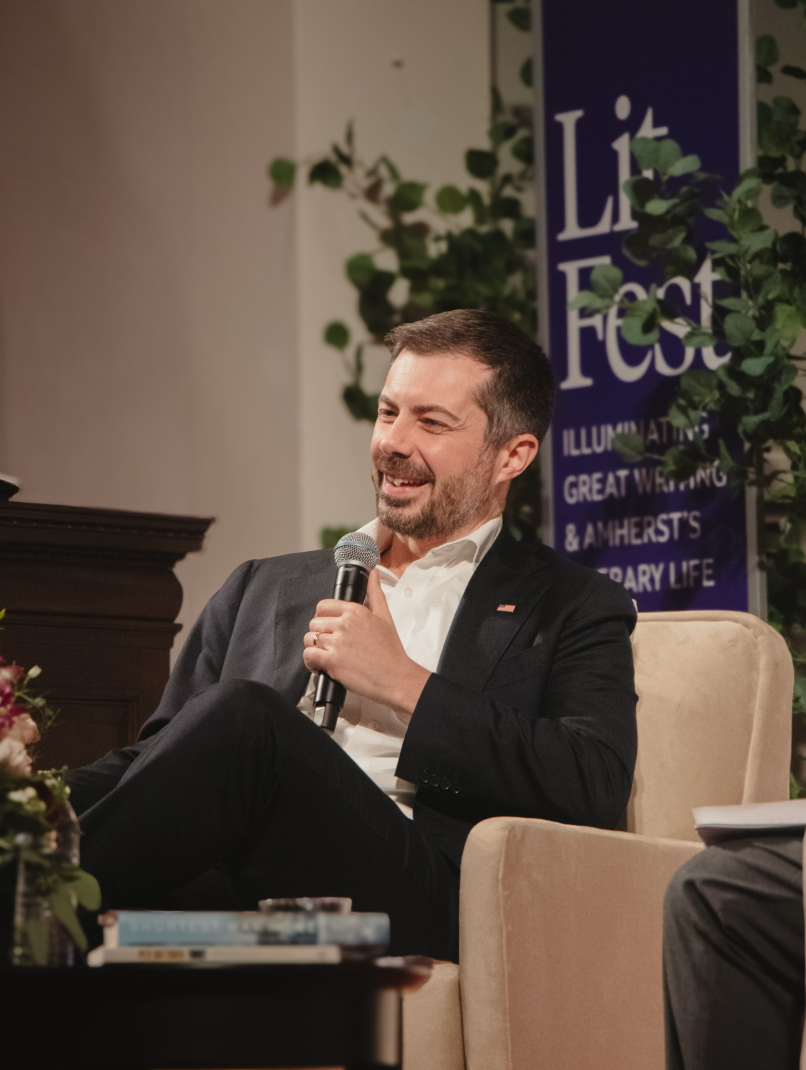
At first glance, Pete Buttigieg — the United States Secretary of Transportation from 2021-25 and former Mayor of South Bend, IN — might not have been the most obvious choice for a festival celebrating Amherst’s history of literary tradition and creative writing. But in his conversation on Friday with writer, journalist, and editor Cullen Murphy ’74, H’19, firmly cemented the influence that books and explorative reading had on the politician, but also the potentials that innovative information sharing have on the future of democracy, public service, and a liberal arts education.
Buttigieg — an avid reader, writer, and book-lover — urged readers to engage with literature, both as a mode of personal enrichment and as relational nourishment, “buy a book as a gift for someone else, not only to boost the book economy, but also to stretch the bonds of literature beyond the self, so that books may feed us as a community and inspire us to be stronger together.”
Bookish Beginnings
Buttigieg began his discussion with an insight into his early bookishness: “I grew up in a world of books. Some people are said to have been raised by wolves. I was raised by faculty.” Buttigieg reflected on growing up, subconsciously absorbing the sophisticated dinner-table conversations between his professor parents, citing this passive information absorption as an early cause of his interest in the world around him.
Beyond this, Buttigieg reflected on the influence that his father’s literary interests had on shaping his own understandings: “I probably, in spite of myself, soaked up my father’s affinity for James Joyce, and I think in many ways that has framed my understanding of politics.” Buttigieg — who used multiple quotes from Joyce as epigraphs in his first book, “Shortest Way Home” — talked about how the Joyceian focus on daily life was a major catalyst for his current approach to government.
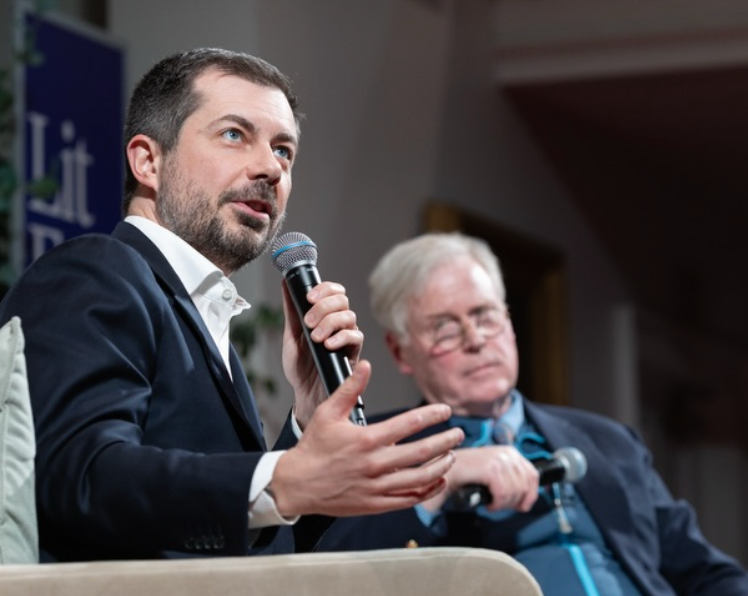
To Buttigieg, what is great about Joyce’s writing, and art more generally, “is its capability to put us in somebody else’s shoes, to make us regard somebody else the way we might ourselves, and then to see ourselves a little bit differently.” Buttigieg relied on this thinking to shape his understanding of politics at its best as a process of encounter and persuasion with the goal of bettering the everyday lives of normal people.
Creating Connections
During the conversation, Buttigieg reflected deeply on what it meant to connect with people, both within a political context and the current tension-filled social environment. Buttigieg began this discussion by describing the developments of his college years and their revolutionary effects. Buttigieg entered college at Harvard University in a time when smartphones and webmail did not exist. But, within a few years, everything had changed — a revolution that Buttigieg’s classmates were partially responsible for. “While we were there, some students in the next dorm over in Kirkland House cooked up this thing called thefacebook.com,” he said. With this proximity, Buttigieg was the “200th-something user of Facebook.”
Despite living doors down from the genesis of what would eventually shape a world-wide social revolution, Buttigieg shared a feeling of naivety about what this technology was capable of, “I don’t think any of us really grasped, including the people who created it, the power, the capability, the wealth and the destruction that, what would come to be known as, social media was going to create.”
The influence of social media on politics, knowledge sharing, and government responsibility has become an especially relevant issue in Buttigieg’s life. In an era of push notifications, social media algorithms, and declining literacy levels, the information American constituents receive is heavily tailored to their political interests and concerns. Buttigieg distinguished the effect of social media on who people get their news from as something distinct from the past: People used to rely on television or an editorial process to get their news, and now get out information through a screen. To prove his point, Buttigieg had all Amherst students put a hand up before instructing “keep your hand up if you get a significant percentage of your news by watching television on a television.” Nearly every hand dropped.
Buttigieg pointed out that engagement with news through social media will show you two things: One, a person you already like doing something that makes them look good, and two, a person you already don’t like doing something that reminds you why you don’t like them. To Buttigieg, these two filters corrode the democratic necessity of thoughtful discussion and an informed electorate.
While Buttigieg is well aware of the abilities and necessity of social media for campaign outreach and political education, he instead focused his part of the discussion on the importance of face-to-face connections as a necessary goal and core tenet of politics.
Buttigieg first ran for office in 2010, attempting to secure the position of Indiana State Treasurer. Despite losing the race, Buttigieg learned a valuable lesson from the campaign and a reorientation in his politics, leading him to see running for office as a craft that requires repeated practice. For Buttigieg, this practice required new approaches to campaigning: “In my case, what it required was to go to every chicken dinner being hosted by a Democratic party organization in each of the 92 counties of the state of Indiana, and go table to table and stick out your hand to a total stranger and introduce yourself and explain why you’re running and ask for their support.”
Talking to strangers became the crux of Buttigieg’s political philosophy. Describing the politically transformative effect of engaging with fellow Americans, Buttigieg shared, “And then something incredible happens, because if you take them seriously, you begin taking on board all of the aspirations and all of the anxieties and all of the worries and all the potential all of these people who, for very different reasons, want the attention of the government.”
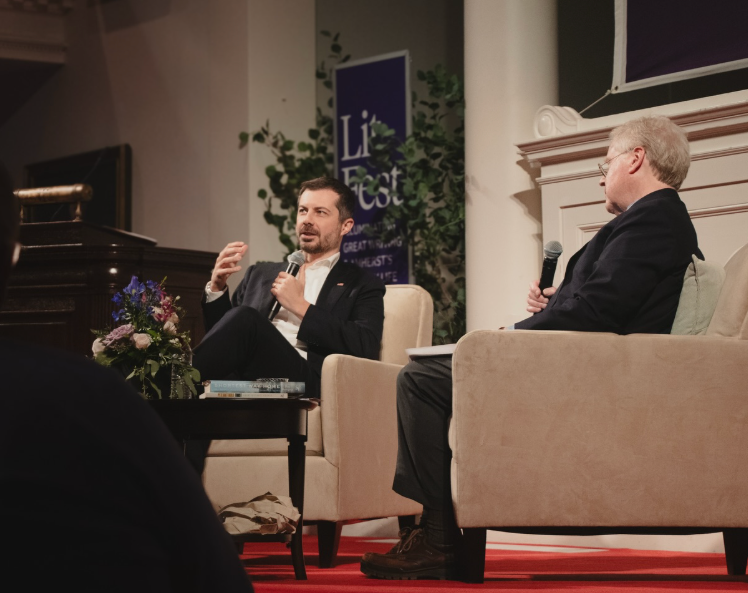
Conversations with strangers have taken on a new level of political importance since the years of Buttigieg’s initial entrance into politics. The last ten years in American politics have witnessed unprecedented levels of polarization, partisan policymaking, and a decline in the posture towards compromise that is a core tenet of democracy. In response to this, Buttigieg has adopted a role as someone who will engage with all people, especially those with differing political beliefs. “I developed this very unexpected specialty I have going on Fox News,” Buttigieg said.
Buttigieg credits this ability and tendency to his upbringing in Indiana, a state that has voted for a Republican president every year since 1969, except 2008, when it narrowly voted for President Barack Obama. For Buttigieg, coming of age in a predominantly conservative environment had a profound impact on his engagement in political disagreements. “Growing up a little bit at odds with my surroundings, being a more left-leaning kid growing up in a place like Indiana … just in order to get by, was to talk about what I believed with people who believe something else,” he said.
While Buttigieg participates in these discussions on a much larger scale, he emphasized to the audience the importance of in-person conversations with people you disagree with as important on all scales. Whether it is on national television or over beers in the dorms, Buttigieg wants young people to view these conversations as both personally enriching, and necessary for the preservation of our democratic principles: “The idea of encounter, the idea of persuasion, the idea of expanding the way we think … the way that talking to somebody who you disagree with in ways that sometimes make you change your mind, and other times make you feel what you’ve already felt with more sophistication.”
Buttigieg articulated clearly the promise and incentive of these discussions: “It might make you change your mind. It might make you dig in. That's the point.”
Along with this encouragement, Buttigieg also recognized that the spaces that foster these types of dialogue are increasingly rare and difficult to find. With this in mind, he reflected on his own role in breaking down this division. “I think the job of somebody like me is to penetrate as many of those bubbles as possible, going into conservative media, going into non-political digital media,” he said.
Buttigieg’s trip down memory lane to a time before social media and the polarity that seems so engrained in our present lives reminded us that encounter and outreach are “at the very core of what politics ought to be about, but [are] less and less part of what politics consists of in our time.”
Looking to the Future
Murphy drew the conversion’s attention to the upcoming November midterm elections, asking Buttigieg for his perspective on what the Democratic Party needs to prioritize in order to win. Buttigieg began his response by noting that, if you look at the ten most important policy problems for American voters, two-thirds of Americans agree with the democratic position on each. With this knowledge, Buttigieg posed the question: “If I’m right, and two-thirds of Americans agree with [the Democratic Party] on most of the big issues … how the hell are we not getting 50% in so many elections?”
To answer this question, Buttigieg cited a communication and instructional concern with the Democratic Party’s outreach strategy. Buttigieg encouraged the party not to focus solely on “preaching to the choir” on MS NOW, but to engage critically with people in places where they may believe in Democratic party positions but haven’t heard those stances articulated directly to them.
While this communication concern was one part of the equation to Buttigieg, what the Democratic party is actually saying might pose the bigger problem. Buttigieg warned the party from, either explicitly or implicitly, letting their message amount to: “Put us in charge. We'll end the nightmare of Trump. We’ll reverse all the damage, and then we’ll find all the shards of all the things that he smashed to bits, and we’ll tape them back together, and we’ll give you the world just like it looked in 2023.”
Buttigieg described this promise as a dangerous one: It not only establishes the Democratic Party as the party of the status quo, but it also allows Americans to believe that everything was going fine before Trump, and that Trump’s presidency was an anomaly to the otherwise progressive and rights-increasing arc of American history. Buttigieg points out that, “if our political, social, and economic institutions were going along just fine, a guy like Donald Trump wouldn't be getting anywhere … proto-authoritarian nationalist movements don’t just find fertile ground on their own anywhere when things are going along just fine, right?”
To Buttigieg, this past-oriented approach to the 2026 midterm elections is simply not good enough. “We have to be able to make clear that what we’re offering is not just better than now, but better than before,” he said.
Closing Remarks
Buttigieg returned to what he described as the “fundamentally democratic” nature of James Joyce’s writing as a root for his vision on the future of politics. When taken to heart, Joyce’s focus on daily life is an inspiration for reconfiguring the American political mission to center on constituents’ everyday lives.
To Buttigieg, the message of the Democratic party should be simple, effective, and it should be delivered on: “Here’s how your day is going to go differently and better … You’re going to have clean water when you get up in the morning and a road that actually works to get you to your job. And then when you get to that job, that one job is enough to live on, and you’re going to come home to a home that you can actually afford, and you can actually aspire to own before you’re in your 40s.” Buttigieg wants his constituents to know that these concerns are not too much to ask for and, in fact, should represent the purpose of politics at its core.
While inspiration for public service and political care comes from all aspects of life, literature will always be one of Buttigieg’s biggest motivators. “Great politics, well done politics, just like good literature, takes just what it is like to be a person as the point of departure and revolves around that,” he said.


Comments ()