

Fresh Faculty: Daniel Amir
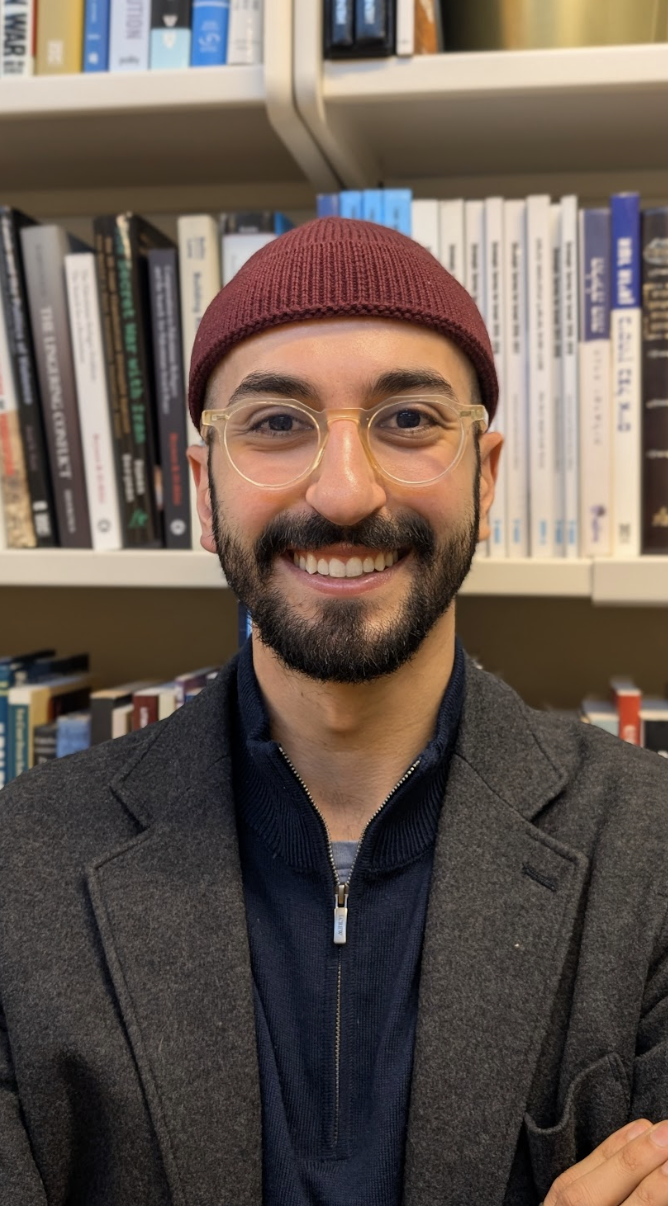
Daniel Amir is a visiting assistant professor of history. Managing Features Editor Mira Wilde ’28 sat down to speak with him about his path from journalism to academia, his love of language and passion for Jewish studies, and what it has been like adjusting to rural life at Amherst College.
Q: Can you share where you’re coming from and what brought you here to Amherst?
A: I finished my Ph.D. at Oxford [University] back in 2023, and I hadn’t yet fully finished my dissertation when, out of the blue, I got an invitation to move to Boston to do two years of research at Brandeis [University]. I had to kind of finish everything really quickly, get the dissertation done, move to America — fresh start.
I was there for two years. I wasn’t teaching — I was working full-time on my book, which is out next year. I was determined to go back to the [United Kingdom], where my family is, and my life is. I said, “I’ll apply for one job in America, and if it’s going to be one job, it’s going to be somewhere that I really, really want to work.” This job came up in Jewish studies at Amherst, and I couldn’t resist.
Q: Congratulations on the book! Had you heard of Amherst before coming here?
A: I had heard of Amherst before coming here for a number of reasons. I knew it because I knew David Foster Wallace had come here and that he’d written his first novel, I think partly at the end of his degree; if I’m not wrong [David Foster Wallace wrote “The Broom of the System” as one of two of his undergraduate theses at Amherst]. And I’ve met people here and there who had come here to do undergrad, and thought that — as somebody who had done a degree in the British system that was much more focused — the ability to kind of do anything and be interested in anything, to have that at your fingertips, seemed incredibly special. Getting to see it up close was definitely something that I was interested in as a teacher. But also, I came at it with a sense of bright-eyed joy that people were able to do this and engage in this experience.
Q: It’s your first semester in the area and at the school. How are you settling in? I can imagine it’s a little different than where you’re from.
A: It is, in some sense, a little different. But I’ve really loved it … I asked somebody, I was like, “When does everyone get grouchy? At what point do people start grumbling in the semester?” And here we are, one semester in, and it’s been incredibly uplifting. Everyone is super positive.
In terms of adjusting to the area, I will say I’ve had to make some big life adjustments, first and foremost, of which is the fact that, despite being a lifelong urbanite, I finally was forced at the age of 30 to get a driving license and to buy the world’s smallest car, which I drive around and feel very glamorous in. I think the really big adjustment was living a little rurally, learning to drive. I kind of feel like I’ve grown up a little bit in the process of it. You know, getting your driving license is something every American teenager does. I just waited till I was double that age. But, it was, [and] it has been, a treat.
Q: What was your path to becoming a professor and specifically a history professor? Were you always interested in academia, or was it something you sort of found yourself doing?
A: I did a degree in Persian and Urdu at Oxford. That was my undergrad, and I always loved working with languages. I did French, Spanish, and German at school. I speak Hebrew at home, my grandparents and great grandparents’ generation come from five [or] six different countries. That sense of variety of human experience — of migration, and of difference — is something that I was always interested in, whatever I was doing.
Basically, the big conversation in my life always has been to do with the Middle East, to do with Jewishness, to do with Israel/Palestine, [so] studying the Middle East was really important to me. That’s part of the reason why I went into university to do it, but I was interested in kind of everything in a way. I got into Persian because I was really into — I mean, this gives you a sense of why I had no friends as a teenager — mystical Persian poetry. As a 16-year-old, I loved Iranian films and thinking about this place that I knew I had family from, but couldn’t really go to. As a result of this sort of sense of family background — my own interest — I gravitated towards studying the Middle East, whatever that means.
But I didn’t always know I wanted to be a historian. When I graduated, I did a ton of different jobs. I always worked on this region, but from various different angles. I started out working for a think tank for a while. I did a master’s degree at the London School of Economics, but during that time, I was working as a music and food journalist [and] I was writing articles for newspapers and magazines on Middle East politics. I was trying to have my cake and eat it all the while doing a master’s degree — which I both recommend and don’t recommend. It was sort of like this burst of energy in any direction. Out of that experience, I got a job just after my master’s, working for the BBC. I spent two years there, mainly writing news about Iran, writing news about Israeli politics, [working] 10-hour shifts four or five times a week, watching Iranian news, watching Israeli news, reading Twitter … Not only did my language skills go through the roof, but I got an amazing insight into the day-to-day function of two countries and two spaces that people consider really complex and kind of difficult to penetrate … I had to package that up for an audience that didn't know as much [and] to try and explain these quite difficult, complicated places to people.
Doing that on the TV, doing that on the radio, doing that in print, gave me an appreciation for why it’s important to communicate about these places. After two years there, my inner nerd got the better of me, and I was like, “I need to go deeper. I would love to do some work of my own on this — something that felt connected to me personally, but something that was also significant in the way that people understand the experience of Iran, of Israel/Palestine, of Jewishness.” I kind of landed on the topic of Iranian Jews. I applied to two universities, and ended up going back to Oxford — something that, as an undergraduate, I swore I would never, ever do — to do the Ph.D. That was kind of my winding path to it.
Q: You mentioned a little bit about your family. How did your family impact these interests?
A: I was the kind of kid [who] spent time while the adults were at the dinner table looking through my grandparents’ cupboards, and I found passports and photos and school reports and cuttings from all sorts of different letters and postcards. I think that even as a child, that experience of pulling things out of a cupboard, not knowing what you were going to find, and asking questions on the basis of it was really fun. I was eight, nine, 10, 11 years old, and that was already kind of my first archival experience.
Realizing that I could get to do that as a job later down the line allows me to be professionally nosy. I will also say that seeing my family — which is kind of pretty spread out, divided between various places in Eastern Europe, speaking …several languages whether it’s Yiddish or Hebrew or Polish or Aramaic or Persian — that there was this sense of multiplicity, this sense [of] “Here are all the different ways there are of existing in the world that I wanted to understand.” That kind of family influence, rather than any particular pressure from them, was what has always maintained and sparked my interest … I feel not only a personal stake in a lot of the work that I do, but I think it goes back to a much earlier curiosity about all these different ways of being in all these different places. I think that's something that I try [to] bring into the work that we do in the classroom.
Q: You touched on this previously, but would you elaborate on your study of Jewish languages and translation? What does that study look like for you, and where do you draw meaning from the discipline both historically and in the present day?
A: I mean, that’s a really big question. I think the reason that language and translation have always fascinated me is because I’m interested in how people communicate about identity across different boundaries. I think that when you’re trying to address different audiences, when you’re trying to think across different geographical spaces, the moment at which you’re translating your ideas is often a really telling moment, because you’re forced to somehow funnel it into a new shape.
I think that one of the really interesting things about Jewish culture — about minority cultures, more generally — is that often these languages are a meeting place for lots and lots of different intellectual streams … I think what [I’m] doing is a very well established pattern of trying to work out how we think about the world by thinking about the languages that we speak. That was something that I’ve, as a person [who] enjoys communicating with different groups of people, always wanted to do.
When I was at Oxford, they started [the] Oxford School of Rare Jewish Languages, which was awesome, and it was free [to enroll in]. There is a very embarrassing, geeky, blog by me just going on about how much I loved it — I did three languages. I was like, “I have to drink this in as much as I [can].” It’s helped connect me to so many things in ways that I feel are really important. I think that once you look at these minority perspectives, once you look at these sorts of sometimes niche spaces, in comparison … you realize that there’s a lot of richness to be had in places that you might not ordinarily connect together. That’s what I try to do in my work and in class as well.
Q: What courses are you teaching this semester, and what are you planning on teaching in the spring?
A: This semester, I’ve taught two classes — and it’s just coming to an end, which I’m heartbroken about, honestly. I taught “Jewish History Through Language.” We begin with the myth of the Tower of Babel, and this sort of scattering of the world into 70 languages, and all this confusion of language and creation at the very beginning of Genesis in the Hebrew Bible. We move through different multilingual societies in which Jews have lived and look at how Jews relate to their identity through debates about language.
The second course has been “Modern Jews in the Middle East.” We look at the Middle East from the perspective of regular people — how the changes of modernity in the Middle East, whether that’s ideological, technological, financial — have influenced what it meant to be Jewish in those spaces. It was really important to me that we grounded that in the perspectives of real people: We read about Jewish traders from Baghdad who [were] based in Shanghai, Jewish communists in Morocco, women and women’s etiquette manuals in the Ottoman Empire. Looking at the experiences of real people from the ground up is a really great way of trying to understand these tensions of identity.
Next semester, I’m teaching two classes. I’m teaching “Jewish History in the Modern Age” with Professor [of History Adi] Gordon. I’m very excited for that. That’s a broader survey of Jewish history from around 1500 to the present, going through pirates [and] false messiahs, right through to the Zionist movement, and into contemporary debates about Jewish identity.
My other course is from another subject that’s pretty close to my heart and my research, which is called “Iran: Revolution and Beyond.” We look at the run-up to the Iranian Revolution [and] at different ways of doing politics in contemporary Iran, something that I think is really quite mysterious at times to a lot of people. A lot of people look at it as sort of radical clerics and never-ending protests. But what I really wanted to do was to give a sense of: What does society [and politics] look like? What are the debates going on between these clerics that we might not always see the differences between from [the] outside? We look at politics, and then we move into society, where we look at women, art, queer activism, film, and culture, to try and really see how people experience and how they’re pushing back against a frequently limiting political environment.
Q: You mentioned you’re writing a book. Can you tell me a little bit about that and any other research you’re doing at the moment?
A: My first book, [Jewish Iran], hopefully not my last, is coming out in July. It’s basically an exploration of how Jews in Iran relate to different political movements in the course of the 20th century, and it does [that] primarily by looking at newspapers.
In the course of the 20th century, we have all kinds of Jewish involvement in different ideological streams. Jews are communists, they’re nationalists, they’re poets, they’re pro-revolution, they are Zionist, they are anti-Zionist. They run, really, the whole spectrum of political mobilization in Iran, but they all meet in the pages of the press. My question was: If there are all these different political movements trying to appeal to Jews, or that Jews are trying to be a part of, how do they blend different ways of thinking? By meeting on the page, how does communicating through newspapers and through the press reflect outwards towards Jewish communities abroad, towards Zionist organizations and political movements in Israel/Palestine, and to their Iranian countrymen more generally? I think it’s this project of connecting different ideological streams, connecting different geographical spaces.
[The book] runs right through from the period after Iran’s first constitutional revolution at the beginning of the 20th century … right through to the years after the revolution in the early 1980s when we have Jews speaking about and fighting on the front lines of the Iran-Iraq War. It’s this sort of sweeping history, but one thing that we see throughout it is of a Jewish community wanting to always be involved in as many national, regional, global conversations. The question is, how do they do it through the press? There's lots of other research in the bank, but I think I have spilled on enough about this book.
Q: That’s fascinating. How did you go about doing that archival research? Where are you finding these newspapers?
A: That was exactly the question that I asked myself. I had to use archives from four or five different countries, which was really challenging during Covid. Part of it I did through travel, part of it I did through begging favors from generous archivists and librarians around the world, whom I am super grateful for.
Along the way, I spoke to a lot of interesting people. I spoke to a lot of people who had a personal stake in these things but rarely knew how to put them into a conversation with other resources. People who sort of said, “Oh, my father worked for a newspaper, or my mom was involved in this. But I don’t really know what to do with this. Here, have some pictures” … It was investigative work, a lot of it was sort of random chance … it puts you into conversation with the community. As somebody who was doing a lot of this from my kitchen table during Covid while I was unable to leave the house in the early 2020s, it made me feel a little bit like I was traveling through time and space. And for that, I am always grateful to historical research.
Q: What has been the most exciting thing about your first year teaching at Amherst?
A: Honestly — this is cliche — but it is the students. When I came for my interview, I had lunch with a panel of students, and I came away from it feeling like the rules of the game had changed completely. The students had a part in kind of pushing for my role to be created, so I’m basically indebt[ed]. I remember asking [them], “What do you want out of this position? What can I do for you?” And somebody saying, “Well, I feel like I want to do more to become a Jewish intellectual.” And I was like, “Wow, what an ambition to have at this stage in your college career, and how can I make it happen?”
Essentially, what I’ve tried to bring — even in the small classes that I’ve had — is that openness to giving people a space in which to explore that in themselves … I have Jewish students, I have non-Jewish students [and] the extent to which people have always come up with interesting, innovative, thought-provoking ideas in class … fires me up every class I have, and I teach back to back. Every class I have, I come out with a renewed sense of energy, not just for my own work, but to keep teaching. I’m grateful to you guys for giving me that opportunity, because it powers me through to every kind of new adventure and class that we have, and I look forward to them immensely.
Q: Outside of Amherst, do you have any hobbies or activities that you like to do?
A: Would you believe that I have a life beyond this space? … In spite of my slightly introverted persona, people are sometimes surprised to learn that I used to front a salsa band, that I like to do improv comedy … I like to run outside when it’s not completely freezing and to play music… Keeping healthy, keeping outdoors, and trying to be creative in as many ways as possible … These are the things that keep me happy.
Q: Do you have any advice for Amherst students?
A: I think the advice that I would have is not to compromise on your curiosity. I think that elite environments can have this effect on you that pushes you to focus on your grades and your attainment … I would sooner have a class full of imperfect grades where everyone felt like they were fully in the grip of the ideas, than a class where people were pursuing perfection at the expense of enjoyment. I think that’s something that takes conscious focus, and that would be my best advice. I think it’s the most valuable thing to leave college with.
Q: Is there anything else that you want to share as we wrap up this interview?
A: The only thing that I want to add, really, is that this is my first year [and] I am here for three years. My desire is for Jewish studies at Amherst to be something that is meaningful to as many people as possible. I think Jewish studies is a great way, whether you’re Jewish or not Jewish, to think about so many issues: to think about gender and queerness, the body, contemporary politics. I want as many people as possible to share in that conversation. Particularly now [in] what feels like a fraught time. And so, my concluding message would be [to] treat me as a moldable professor. I’m planning on running some listening sessions early next semester, to try and talk to as many students as possible, see what interest there is. Because I think that this is a field and an idea that has so much to say, and I would love to see how, between faculty and students, we can hopefully create something that is meaningful and generative on this campus.

Comments ()