

From London to D.C.: A Perspective on Leading the Folger Shakespeare Library
What do Shakespeare, public humanities, and children’s books about the Bard have in common? Editor-in-Chief Edwyn Choi ’27 spoke with Dr. Farah Karim-Cooper, director of the Folger Shakespeare Library, about her journey to institutional leadership and relationship between Folger and the College.
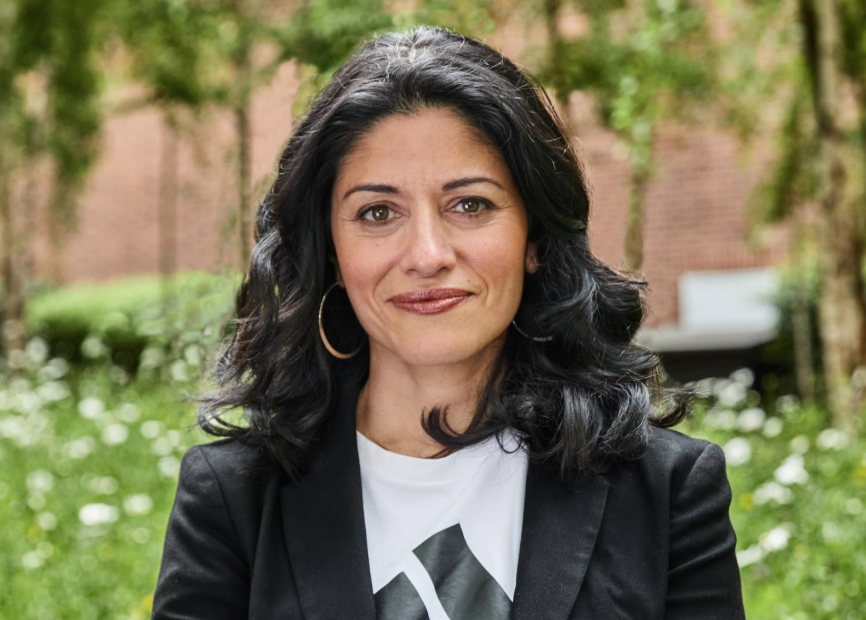
Visiting campus on Monday, Dr. Farah Karim-Cooper, director of the Folger Shakespeare Library, ventured from Washington, D.C. to Amherst, MA to visit the Library’s affiliated college. The Folger was established in 1932 by Henry Clay Folger, and his wife, Emily Jordan Folger to share their globally-renowned Shakespearean archive. Henry Clay Folger, Amherst class of 1879, placed the Library in the hands of Amherst Trustees upon his death and established an undergraduate fellowship through the Folger for Amherst students.
Karim-Cooper became the eighth director of the Folger library in 2024. Having written over 40 published chapters, a recent children’s book “All the World’s Your Stage: Shakespeare for Today,” and several academic texts Karim-Cooper was met with warm greetings from students and faculty. As a Folger Fellow this past winter, I had the opportunity to meet Karim-Cooper when she came to campus to learn a bit more about her experience leading the library, her journey into academia, and her interests outside of Shakespeare.
Q: Thank you for agreeing to be interviewed today. What has brought you to Amherst?
A: Well, I am the eighth director of the Folger Shakespeare Library — I was appointed in 2024, and I started in [Oct.] 2024. Because of the relationship between Amherst and the Folger, I thought, “I need to go and visit and see the president in person and meet members of the faculty and the undergraduates” … It's just because this time of year was the most convenient for calendars on both sides. I could have come any time of year, but I’m really glad I came when it snowed, because it’s very pretty.
Q: Now that you’ve been here for two days, how are you liking Amherst?
A: I love it. I think the campus is beautiful. I love the spirit of inquiry that you get at most universities. But I have been on university campuses where the students feel a little bit downtrodden, and here I see, and maybe it’s due to the open curriculum, but students feel free to ask questions and inquire, and the faculty are so responsive to that. This is just what I’ve picked up in my conversations in the last couple of days. There’s a real culture of empathy and curiosity here, and that's a wonderful accomplishment on the part of this college.
Q: Could you share a little bit about your history before you became the Folger director?
Prior to coming to the Folger, I was the Director of Education and Research at Shakespeare’s Globe in London and also a Professor of Shakespeare studies at King’s College London. The two organizations had a relationship: We ran the Center for Shakespeare Studies in London together, and we also shared Ph.D. students. So, Ph.D. students I was supervising would also do their research at the Globe in addition to other things. I was a professor, and I published. I was teaching, but I was also running public engagement work and looking after a team that ran higher education, research, and collections.
Q: Where did you study for undergraduate and graduate education?
A: I studied at California State University, Fullerton, and I went on to do a master’s [on John] Milton at Royal Holloway, which is part of the University of London.
Q: Why Milton?
A: I think it was because I knew I wanted to do Elizabethan and Jacobean literature, but there was no Shakespeare M.A. program at the time in 1994, so I chose a program that was Shakespeare adjacent, and I happened to really like Milton a lot. I had taken a Milton course at university and just loved it.
Q: So then you were interested in Shakespeare from the very start?
A: Yeah, when I was an undergraduate, I knew that I wanted to do poetry, but I was very interested as well in ancient novels, American literature and poetry; I was obsessed with Walt Whitman. I had a Shakespeare professor in my sophomore year, and she was dynamic — she made Shakespeare really sing off the page. I realized that’s really what I wanted to do, so I started focusing on Elizabethan and Jacobean drama, Shakespeare, and Elizabethan poetry, and that’s kind of how I got into it. Sometimes it’s all about the professor, I guess.
Q: How has the transition been moving from a more education-focused space to your current role, which I assume is more administrative?
A: It is a big difference. I think the role of the director of the Folger is more akin to a CEO position, where you have to manage a leadership team and make sure that they’re all aligned in their purpose and vision. It’s about ensuring the institution's financial health, it's fundraising, managing different stakeholders — people who love the Folger, are invested in the Folger — and ensuring that everybody feels loved and paid attention to, so there’s a lot of that kind of work. But because I’m a scholar, and because I love Shakespeare, I want to keep a foot in that world. I recently published a children’s book in November, and I still give talks on Shakespeare, and we’ll do guest lectures and classroom visits from time to time. So it's a nice balance.
Q: Do you miss teaching?
A: Sometimes. I was a school teacher before I finished my Ph.D., so I had been teaching for quite a long time, and it is incredibly rewarding to be a teacher. It’s fabulous to keep a dialogue with the rising generations, so that you’re always kept on your toes, you don’t become stale, and you don’t rest on your laurels believing the same things you always believed. I always found that my students would push me to challenge my own assumptions, and I really enjoyed that part of teaching.
Q: What was the transition like going from teaching in schools to being a professor in higher education or graduate school?
A: I didn’t get funding to attend graduate school, so I needed to make money to pay my mortgage. I was a school teacher while I was working on a Ph.D. part-time, and then, eventually, my Ph.D. supervisor said to me, “One day, do you want to have a career in school teaching or in university teaching?” And I said, “university.” And he said, “then you need to quit your job and focus on your Ph.D. full-time.” So that’s what I did.
Q: I wanted to go back to the children’s book you mentioned. That book and the lecture you presented on Tuesday at Amherst, “The Great White Bard,” seem to be focused on catering more to a non-academic audience. What is it like to transition between audience types, and why have you started writing for a broader consumption ?
A: Having spent 20 years working at the Globe — where there was a lot of public programming — I used to write program notes for the productions for a general readership. I really liked being able to share the research I was doing with a wider group of people. I published academic books, for sure — and that was important — but aside from the students assigned my essays and books, there were probably only about 12 people who would read them.
An important part of academic training and academic discourse is to write those books, and I certainly wouldn’t want to discourage that, but I've really enjoyed that the publication of “The Great White Bard” has meant that a lot more people know about the relationship between Shakespeare and race, which is something that was well hidden from the general public.
I do think that my work on the books has enabled me to think more about how research into Shakespeare, and the humanities more broadly, can have a real impact on people’s daily lives.
Q: At the Folger or otherwise, do you have any projects you are working on?
A: The Folger is kind of positioning itself to advance the idea that Shakespeare and the humanities can be great tools for problem solving, rather than safe places to retreat to from the world, so we’re going to do a range of projects that are rooted in that vision. We have to build a plan to do that, so we have theater productions; a festival for new playwrights that really encourages new playwrights to engage with the classics and think about being impactful in their writing; we have a scholarly institute that is interested in public humanities and the way the idea of generating problem solving methods from the humanities is something that we can share with a wider group of people.
[For] personal projects, I am hoping to write another book. It’s going to take me a few years to do bits and pieces of research in between the administration, but it will be another trade book. It’s probably going to be about the relationship that we need to have to the arts and humanities as a general public that has so much information thrown at them every day — how do we become more discerning when we interpret that information?
Q: What was the process of breaking into the Shakespeare trade book market?
A: It depends on where you are. In England, it was harder, because I think the British press [is] much more protective of Shakespeare. I’m a Pakistani American woman daring to tell the British public about their national playwright, so I think there was less receptiveness to that in some circles. In other ways, it was really well received there.
I think I did make a name as a public intellectual in the U.S. The reception of my book was really great, and I think it’s because, in America, there isn’t the same sense of ownership of Shakespeare.
Q: On that note, do you feel like there are any major differences in how organizations are run in the U.S. versus in England, culturally speaking?
A: England is a different place, and, although we share the same language, we don’t have the same history. Our histories are interconnected, but we don’t share the same histories or even the same rules governing how you run an institution.
Philanthropy works very differently in the U.K. than it does in the U.S., and so I’ve had to learn a lot in my just year and a half of being in the Folger — it’s been a big learning curve. I think it's easier to get funding in the U.S. when it comes to private donors and foundations. I think in the U.K. there are government bodies that regularly award funding to the arts and culture, not indiscriminately. So, for example, in the U.S., when a government changes from Democrat to Republican, funding models and criteria might change, whereas in the U.K., it usually stays pretty consistent.
Q: Are there plans to develop or change the relationship between Amherst and Folger right now?
A: I think there are plans to deepen the relationship in different ways, programmatically. Maybe [through] faculty exchanges, there are all sorts of things that we’ve talked about. In the past, there may have been some caution about the relationship, because the Folger has only been self-governing since 2005, and the Folger is a 92-year-old institution. Prior to that, the Amherst board of trustees served as the governors of the Folger. Now, we have pretty much established our independence. I think it’s okay to lean into Amherst more than we have in the past.
Q: Do you have any advice for students who are looking to do future research?
A: I have so much advice. The main thing is, and I used to say this to my own Ph.D. students, you could be as organized as possible, as disciplined and as smart as the next person, but if you don’t love the topic you’re researching, and you’re not endlessly curious about it, you won't finish your Ph.D. You have to have that self-driven impulse that gets you into the library every day and gets you in front of your laptop writing out your thesis. It’s a very, very difficult task to do a Ph.D., but it is so worth it if you’re fueled by curiosity.
Q: Do you have any objects during your research or other cultures that helped you continue your journey during your Ph.D.?
A: When I was at the Globe, I did quite a bit of research into early modern theater history. I had a reconstructive theater that I got to play with, watch actors work on, and interview them to ask what they were learning. That taught me a lot about the experience of acting in Shakespeare’'s time and the experience of being an audience member in Shakespeare’s time. And so I built a lot of work around visiting the theater’s physical object and the actors’ experience, and related things I could find.
Q: Do you have a favorite Shakespeare play?
A: People are always surprised by this answer, but it’s “Titus Andronicus.”
Q: Why is that your favorite?
A: There are two reasons why. One is that I had to study it while researching my book “The Hand on a Shakespearean Stage,” and “Titus Andronicus” includes some amputations. It's one of Shakespeare's gory plays, but it also comes from this rich tradition of Senecan revenge tragedy, and what Shakespeare did with it was really unique. It's also the play that introduces the first-ever Black character in Shakespeare, and this villainous character has a child with the Empress. This is a mixed-race child whom he protects and loves, and actually turns out to be the best parent in the play. I just think there’s something really interesting that merits further inquiry than this play has received in the past.
The second reason is that there was a really fantastic production of it at the Globe that was electrifying. It was a production that was really viscerally staged to the extent that people fainted almost every evening. So that was cool to see.
Q: Do you have a favorite work of literature in general, Shakespeare or not?
A: Yes, I have a couple. One of them is Walt Whitman’s “Leaves of Grass” which I adore … the other is [Michel de] Montaigne’s — the French 17th-century French philosopher who is fabulous and really influential on Shakespeare — “Essays.” Probably my favorite novel of all time is Alice Walker’s “The Color Purple.” I know that sounds like a cliché because everyone loves that novel, but it moved me beyond words — it’s just profound.
Q: What hobbies do you have, or what do you like to do in your free time?
A: In my free time, I like to play with my cat. Her name is Miss Moneypenny, and she’s a very special fur baby. I love hiking. My husband and I used to go hiking a lot when we lived in England. It’s harder to do that in the city, but we try to get away to do things like that. We love walking — one of my favorite things — and reading novels, but also watching really bad TV. I love stupid TV, and that’s because I’m paid to think for a living and, because I was a literature professor, I was paid to read for a living, so sometimes, in order to relax, I just want to watch something really stupid and fun.
Q: And what’s the best-worst thing you’ve seen?
A: There’s so much vacuous programming that I love. I think maybe “Bridgerton,” but I don’t even think it’s bad. I think it’s okay in terms of [the fact that] there is some intellect going on there. “Emily in Paris” is terrible. It’s a terrible show, and the people in it are cardboard cutouts. They’re not actual people. But, for some reason, it’s a great escape, because you get to look at Paris or Venice or wherever they are. That’s a shameful confession.
Q: I’m gonna ask this question for students: If I were visiting the Folger and D.C. for the first time, what should I expect?
A: That’s a great question. If you go to the Folger, you will automatically see the Supreme Court. You will then look west of East Capitol Street, and you will see the Capitol dome. And if you walk further down Pennsylvania [Avenue], you’ll get to the White House. So the Folger is well-positioned to speak truth to power. It’s a very exciting position at the Folger; you’ll find a fantastic suite of exhibition halls: You’ll see the Shakespeare exhibition hall, where 82 of Shakespeare’s first folios are on permanent display; you’ll see a reconstructed printing press, so you can have a go at printing your own folio pages; then you’ll see temporary exhibitions — we’ve got a really wonderful temporary exhibition coming up in October.
Then you can go to the theater and see theater productions. We produce three shows a year, host poetry readings, and present concerts of early Baroque music. There's a lot going on at the Folger, and there’s a great cafe there called Quill & Crumb. We get a lot of people from the Hill who come to Quill & Crumb, and then we have an amazing collection and reference staff who are such great companions to the collection and researchers. There’s a lot to do.

Comments ()