

Israeli Activist Noa Tishby Visits Campus
Noa Tishby, who formerly served as the Israeli government’s special envoy for combating antisemitism and delegitimization, gave a talk on Monday titled “Israel and Antisemitism: Setting the Facts Straight.” Tishby discussed Zionism, antisemitism, and the violence in Gaza.
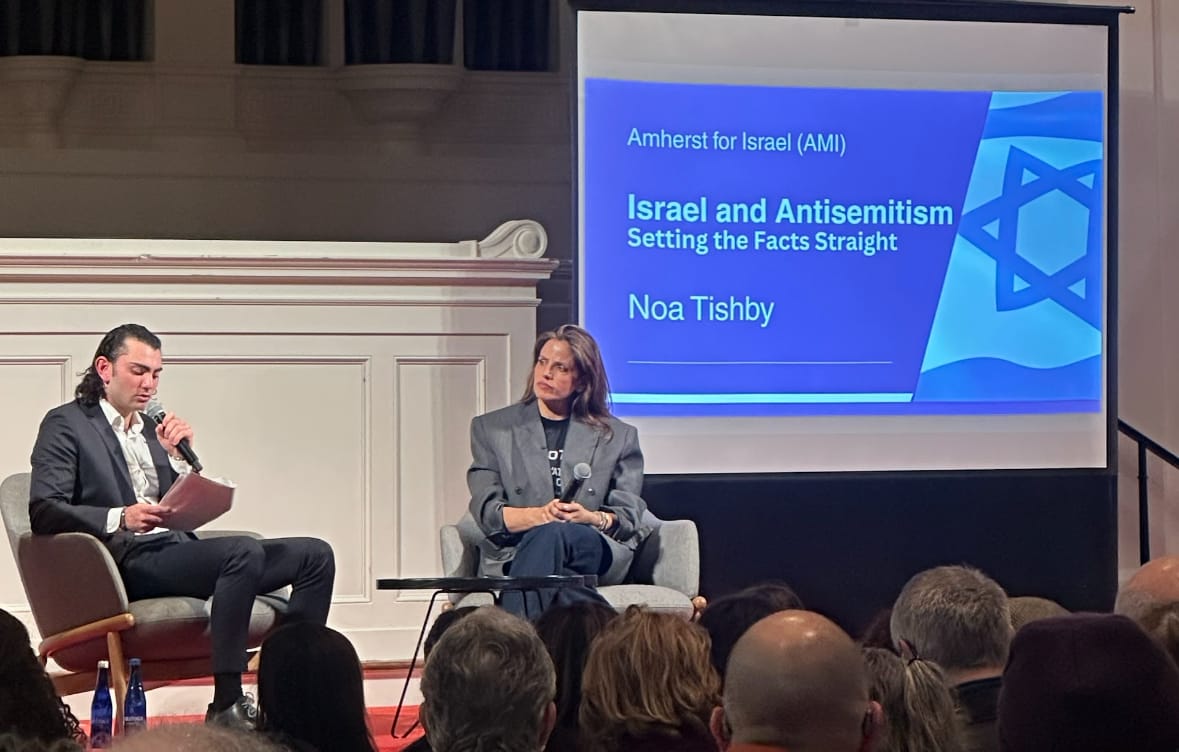
On Monday, a crowd of community members and students gathered in Johnson Chapel for a conversation between Israeli activist Noa Tishby and cofounder of Amherst for Israel (AMI) Cal Wider ’28 for a talk titled “Israel and Antisemitism: Setting the Facts Straight.” Tishby is the author of the New York Times Bestseller “Israel: A Simple Guide to the Most Misunderstood Country in the World,” was a singer for the Israel Defense Forces (IDF), and is a prominent pro-Israel figure on social media.
Associate Dean of Students for Equity and Engagement Crystal Norwood prefaced the conversation by stating that the college aims to foster dialogue that respects differences, saying “that principle has inspired our community’s collective response to the events of October 7 and the Israel-Gaza war.”
AMI member Galle Blaustein ’28 opened the talk by summarizing Tishby’s career and activist efforts, before presenting an introductory video which displayed clips of Israeli civilians being attacked on Oct. 7. “If you hear that slogan ‘From the river to the sea, Palestine will be free,’ what that’s calling for is a genocide to kill every single Jew in Israel,” the voiceover said. Tishby was featured in the video speaking against “violent protests” across American college campuses.
Throughout the conversation, Tishby argued that the IDF is more interested in Palestinian people’s lives than Hamas and that Gaza is not facing a genocide. She also argued that Hamas started the war in Gaza.
To Tishby, anti-Zionism is synonymous with antisemitism. “Zionism is the Jewish people’s right to self-governance and self-determination in some parts of their ancestral land,” she said. Tishby further argued that any desire to dismantle Israel is inherently antisemitic. “If people say to me, ‘I’m not antisemitic, I’m just an anti-Zionist,’ my question to them is: which other country would you like to dismantle? Do you hate Denmark? … You only deny one country in the world … and that country happens to be Jewish,” she said.
During the conversation, Wider’s question about how the “lack of education regarding Israeli conflicts and Jews” led to an uprising of “Jew hatred” on college campuses and other school systems prompted Tishby to define antisemitism as “a shapeshifting conspiracy theory.” She explained that antisemites both look down upon Jewish people and create prejudice against them because of their allegedly “oversized powers.”
“It’s like, the Jews are the vermin of the earth … they’re so disgusting. But also, the Jews control America … the banks … entertainment … the media,” she said.
Tishby listed the ways she believes antisemitism has taken shape throughout history — in the forms of racial, religious, and ethnic bias — and as a prejudice against one’s nationality and status as a Zionist today.
She argued that, today, antisemitism is opposition to Jewish self-determination, where people say Jewish people can be Jewish privately, “but can’t have self-governance and self-determination in parts of [their] ancestral homeland.”
Tishby stated that this form of antisemitism is a product of a lack of education on the historical context of Israel’s founding, “When you don’t educate the population about how Israel was formed … what you get as a result is a bunch of sweet, misguided kids standing outside chanting against me,” Tishby said, referring to the student protest outside of Johnson Chapel, held just before the talk.
Tishby also responded to a statement made by Mayor-Elect of New York City Zohran Mamdani’s statement during a June 5 interview on Fox News. Affirming his support for Israel’s right to exist as a state with equal rights, not as a Jewish state, Mamdani had said, “I’m not comfortable supporting any state that has a hierarchy of citizenship on the basis of religion or anything else, I think that in the way that we have in this country, equality should be enshrined in every country in the world.”
Tishby claimed that Mamdani’s view is antisemitic because it exclusively concentrates on a Jewish state. “How many Muslim states exist? And that’s okay? What’s the ethnic versatility of China? It’s one group of people,” she said.
Commenting on the past and present state of what Wider called “rampant antisemitism and persecution from both right-wing and left-wing governments,” in contexts such as Nazi Germany and the Soviet Union, Tishby used an old phrase — “Jews are the canary in the coal mine” — to explain that rising antisemitism is an indicator of societal unraveling. “It’s been happening for thousands of years, so obviously it’ll happen again,” she said.
Tishby also stated that opponents of Israel will force Israel to pay a “heavy price,” which she argued is unjustified. “The hard left … think they’re doing the best thing for humanity,” even though, she argued, Israel is “the greatest Land Back project.”
Sharing her account of the creation of the state of Palestine, Tishby claimed that it “emerged with the help of the KGB” in 1964 as a counter to Zionism, but also that “there has never been a Palestine.” She also said 10 minutes into the events of Oct. 7, she knew that Gaza was going to suffer. However, Tishby argued that calling her a genocide supporter is incorrect.
“What’s happening in Gaza is heartbreaking. We need to make sure that Hamas is removed from power, disarmed, dismantled, buried, gone,” she said. “If you want to actually protest for something, protest for that … instead of your invented genocide white colonialist creature.”
After stating that Israel has attempted to reach agreements on a Palestinian state before, but was met with their refusal, Tishby said “if they want everything from the river to the sea, we’re going to keep having this problem.”
The conversation ended with Tishby sharing her wishes for Israel’s future, emphasizing that she wants peace. “My hope for the future of Israel and the Palestinian people is peace,” she said, “we need to weed out the extremists from that region and calm everything down. That is the only way out,” she said.
The conversation was not followed by a Q&A session. “For a talk meant to contribute a perspective to the campus dialogue on Israel-Palestine, I found it quite disappointing that there was no opportunity for the audience to ask questions beyond those that were prescreened by the moderators,” Avi Helft ’26 said.
This lack of multiple perspectives, Helft added, made it feel “more like a rally than a substantive exchange of ideas with the Amherst community.”

Comments ()