

Justice Advocate Steven Donziger Discusses His Legal Career
On Thursday, environmental justice advocate and human rights attorney Steven Donziger delivered a talk titled “Donziger v. Chevron: Weaponizing the Bench for Corporate Retaliation.” He discussed his legal battle against Chevron Corporation and its oil contamination of the Ecuadorian Amazon.
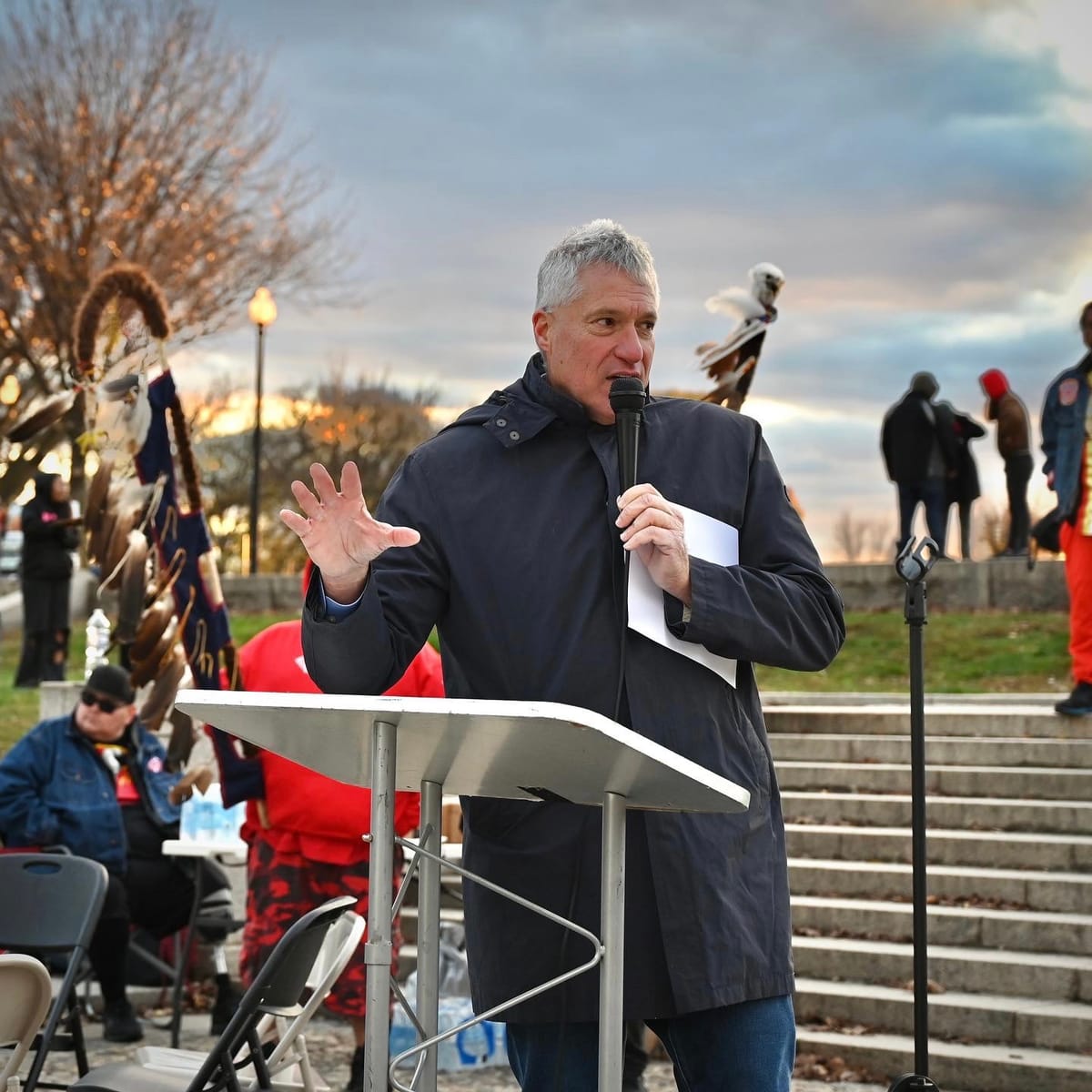
On Thursday, environmental justice advocate, human rights attorney and writer Steven Donziger spoke to students and staff alongside trial attorney Marty Garbus in a talk titled “Donziger v. Chevron: Weaponizing the Bench for Corporate Retaliation.” Donziger recounted the decades-long legal battle against the multinational energy organization, Chevron Corporation — then operating under the name Texaco — that has defined and derailed his legal career.
Garbus introduced Donziger, praising him for his courage and stating he should not only be viewed as a victim but a “beacon and lesson for law students across the country.”
In Donziger’s final year at Harvard Law School, he learned of the widespread oil contamination in the Ecuadorian Amazon from a classmate. In April of 1993, he helped organize a small team to investigate the event. What he encountered, he said, could only be described as “deliberate mass industrial poisoning.”
“There were literally hundreds of open-air waste pits cut out of the jungle floor to dump oil waste in. Texaco then built pipes into the sides of the pits to run off the waste into rivers and streams that indigenous peoples and farmer communities drank from,” Donziger said. Unlike most oil disasters, which result from negligence or recklessness, Donziger argued Texaco’s system was deliberate. “They didn’t see indigenous people as existing,” he said, describing a corporate logic that treats the rainforest as empty land.
Donziger’s team initially filed suit against Texaco in New York, where it took nearly a decade to get the case inside a U.S. courthouse. When Chevron acquired Texaco in 2001, they began pushing to get the case heard in Ecuador, rather than the U.S., as soon as possible. Donziger described this as a familiar play out of a corporate playbook: “If someone from another country, victimized by a U.S. corporation, sues in the United States, the company tries to send it back to their home country, where the legal systems are generally weaker,” he said.
Donziger explained that fighting for a fair trial was an uphill battle. “Everything is structured in a way to disfavor those who are not powerful,” he said. “It is very hard to find a legal system that truly treats everyone equally, despite the high-mindedness of the phrases they use.”
Chevron won the battle to send the case back to Ecuador, wrongly assuming the case would quietly dissipate. After a decade of litigation in the U.S., Donziger’s team had to start from scratch. “Chevron tried to block it every step of the way, filing hundreds of motions to stall proceedings,” he said. Finally, in 2011, Ecuadorian courts ruled in favor of the plaintiffs, penalizing Chevron for roughly $19 billion in damages. Though this number was later reduced by Educador’s Supreme Court to $9.5 billion, the case still represents the largest sum ever awarded in an environmental lawsuit.
Two weeks before the ruling was announced, Chevron launched a sweeping counterattack, not on the merits of the case, but on Donziger himself. Chevron accused Donziger of fraud and sued him personally for $60 billion. Donziger characterized the move as a Strategic Lawsuit Against Public Participation (SLAPP) lawsuit, which is a legal tactic “used by corporations to silence someone’s advocacy” through costly, prolonged litigation. “These are illegal lawsuits that violate the First Amendment,” Dongizer said.
What followed was a sustained legal campaign against Donziger. Chevron enlisted at least 60 law firms against him, got him disbarred, and convinced banks to freeze his accounts. Donziger argued, “the point was to get me off the case, to shut me up, and to sort of win by might, where they could not win by merit.” Donziger also recounted that Chevron paid an Ecuadorian witness $2 million, moved his entire family from Ecuador to the United States, and coached him for over 50 days to give false testimony. “But since they denied me a jury, I had no real check on my ability to fight that,” he said. After U.S. Attorney Geoffrey Berman declined to pursue criminal contempt charges, the presiding judge took an unusual step of appointing a private law firm — one that had previously represented Chevron — to prosecute the case.
Officially charged with a misdemeanor, Donziger expected the punishment to be relatively light, as such offences commonly carry a maximum sentence of one year. Instead, Donziger ended up spending nearly 1000 days detained, including six weeks in federal prison in Danbury, Conn. “I went home, and in my head, I was thinking this won’t last more than a week,” he said. He was released because of a Covid-19-era law allowing prisoners over 60 who had served at least 25% of their sentence to return home. Donziger stressed that “freedom is a precious thing.”
Reflecting on his decades-long fight, Donziger emphasized the importance of solidarity. “If you’re going to take on powerful interests that will stop at nothing to prevent your clients or your campaign from winning, you have to have a team and build attention,” he said. Donziger also urged aspiring lawyers to study opponents strategically. He argued that when challenging a corporation, it’s essential to map out its vulnerabilities. “We can’t match corporate resources, so you have to look for the weaknesses. Look for the gaps,” he said.
Despite the ruling in Ecuador, Chevron has yet to pay the damages, utilizing a legal loophole by stripping its assets from the country. Given that there are no statute of limitations on the enforcement of foreign judgments, Donziger expressed hope that other layers would take up the cause and pursue Chevron’s assets across the roughly 80 countries where the company operates.
Donziger concluded by pushing back against the narrative Chevron worked so hard to construct to keep the public’s attention on him. “This case is actually about the people of Ecuador,” he said, whose health has suffered immeasurably from the environmental destruction Chevron left behind. “So it’s tricky for me, right? I have to defend the case and myself, but it is very distracting to keep talking about myself when what also matters is what they did to these people.”
Looking forward, Donziger’s advocacy attention is turned toward what he sees as another SLAPP lawsuit, "Energy Transfer v. Greenpeace," which he described as “another example of how the law can be weaponized to try to intimidate people.” Energy Transfer faced significant backlash from the Standing Rock Sioux Tribe over the Dakota Access Pipeline, prompting mass protests involving thousands of participants. After unsuccessful legal action against the tribe, the company sued Greenpeace, one of the world’s largest environmental organizations, seeking to hold it accountable for protest activity. During proceedings, Donziger and Garbus concluded the trial was rigged, noting that seven of the nine judges had ties to the fossil fuel industry. “There’s no other conclusion that you get when you see a trial and a jury totally composed of people who are sympathetic to one side,” Garbus said.
Attendees found the talk engaging. “What I found most interesting was that both Garbus and Donziger were very pessimistic about the American legal system," said Alex Mcintosh’ 26, who helped organize the event. "Yet in spite of that, they both wholeheartedly believe in the importance of going into a legal career.”


Comments ()