

Amherst for Israel Hosts Michael Oren
On Thursday, the student organization Amherst for Israel hosted a talk with the former Israeli ambassador to the U.S. Michael Oren. He claimed that the narrative of genocide in Gaza is untrue and is being used to delegitimize Jewish people, sparking protest among audience members.
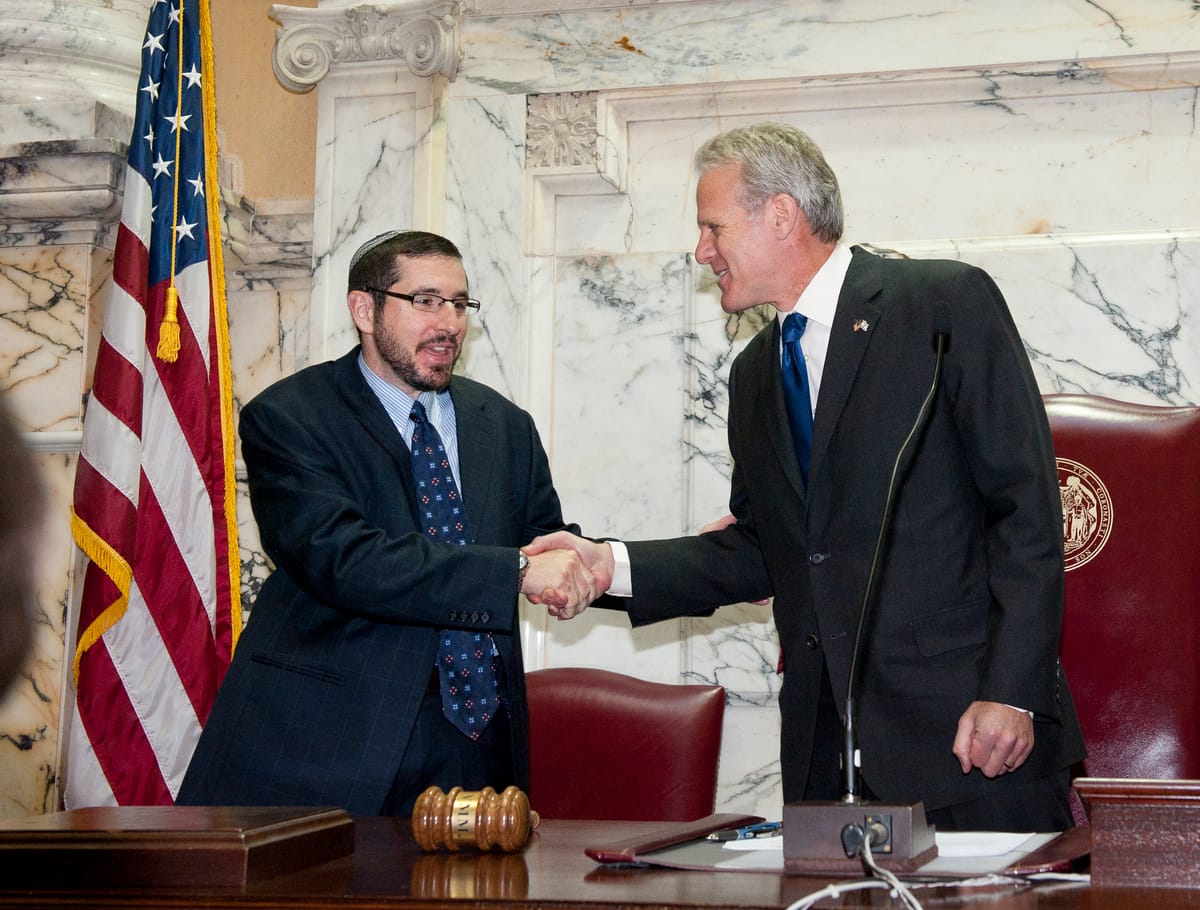
Students, faculty, and other members of the Amherst community gathered together in Johnson Chapel on Thursday to hear from Michael Oren, former Israeli ambassador to the U.S., who discussed his views on U.S.-Israel relations, the Israel Defense Forces (IDF), antisemitism, the war in Gaza, and more.
The event was organized and moderated by Amherst for Israel (AMI), following an earlier event featuring Israel Activist Noa Tishby in November. AMI leaders began with a land acknowledgment, followed by an in-depth overview of Oren’s career and connection to Israel.
AMI co-founder Cal Wider ’28 then facilitated a Q&A, beginning the conversation by asking: “Did Israel commit genocide in Gaza? Why is that claim common?”
“The answer to ‘has Israel committed genocide’ is unequivocally no,” Oren said. “If we have committed a genocide, we’re really bad at it. Because, according to Hamas itself, the population of Gaza has grown in the last two and a half years.”
Oren proceeded to argue that such claims are common because “one of the common threads is that the Jews are always going to be accused of the worst possible crime that any society could think of.”
“The worst thing you can say about anybody today that will completely and utterly delegitimize is to say that they are guilty of genocide,” Oren said.
Following Oren’s answer, an audience member protested and claimed that Oren was spreading lies, sparking minutes of back and forth between audience members. The protesting audience member was escorted out of the event. Another member of the crowd, an Amherst professor, also engaged in the interruption.
After the backlash, the talk promptly picked up again to focus on Oren’s experience with the IDF and the relationship between Israel and the U.S.
Wider then shifted gears to the current war with Iran, asking, “in what ways has the Iran war so far been a success and a failure from a U.S. and Israeli perspective?”
“I tell you without reservation, [the war] is an existential threat for Israel,” Oren said. “All of these debates in the U.S., from this written perspective, are illogical. We literally scratch our heads at these things.”
Wider then shifted to discuss the “massive rise of antisemitism in the U.S.” from both the left and the right, asking “what can be done about this, and why did antisemitism rapidly spread after Oct. 7?”
Oren believes the world viewed antisemitism as “unsavory” in the aftermath of the Holocaust. However, according to him, this sentiment now “has been forgotten.”
After wrapping up predetermined talking points, audience members were given the opportunity to ask questions. Oren specifically requested that students have the first opportunity to ask questions.
Students asked questions regarding U.S. funding of attacks on Gaza and settlements on the West Bank. One audience member asked why people today had forgotten that the 1921 division of the British Mandate of Palestine had already determined historical borders for both Arabs and Jews — specifically with the creation of the Emirate of Transjordan.
Oren responded by explaining Israeli attempts at peace that people had seemingly forgotten. For instance, he talked about his personal experience during the 2005 Israeli disengagement from the Gaza Strip, where “we ripped up 21 [Jewish] settlements in Gaza … to give the Palestinians a chance at self-determination.”
“Why would anyone remember these things?” he asked. He then argued that these moments of selective historical memory were because “we are the Jewish state.”
“The Palestinians are the luckiest victims on earth,” Oren said. “Because had they been the Syrians, Ethiopians, [or] the Sudanese, nobody would have given a feather. People give a feather about them because they’re enemies of the Jews, and that is the truth.” After answering, Oren invited more people to ask quick questions or continue chatting after the event concluded.
A protest organized by Amherst College Students for Justice in Palestine began outside Johnson Chapel prior to the start of the event and continued for nearly an hour, featuring signs and chants for a free Palestine.
Protestors thought Oren’s presence on campus was unacceptable. “There’s an idea here, and in a lot of higher pedagogy, that you have to give both sides a fair platform … but we’re not discussing policy,” an anonymous protestor said. “This is not a political thing. This is the question of whether or not [a] people should exist.”
Editor’s Note, May 6, 2026: Minor edits regarding audience involvement and the protest was made to accurately reflect the situation.

Comments ()