

Zabrina Adorno: Carving Her Own Path
For Zabrina Adorno, connection has always been at the heart of what she does. Spanning humanitarian work and helping other veteran students find community at Amherst, Adorno has never shied away from being her authentic self in pursuit of helping others.
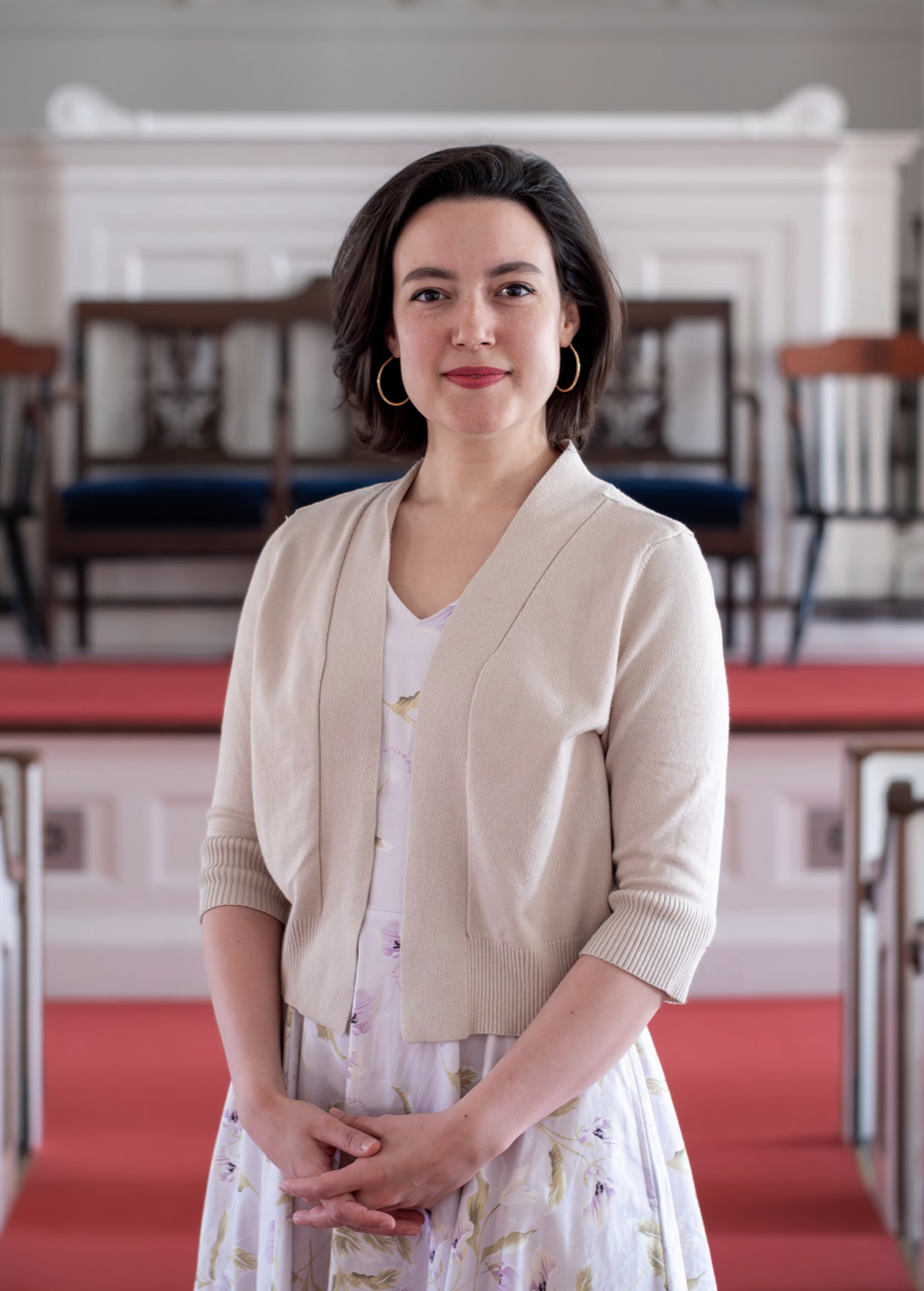
As I entered Frost Library for our meeting, I immediately spotted someone in a beautiful ’60s-inspired dress. Waiting for me was Zabrina Adorno ’26. Calm and stoic, measured and confident — she was poised in every way, something that remained throughout our interview.
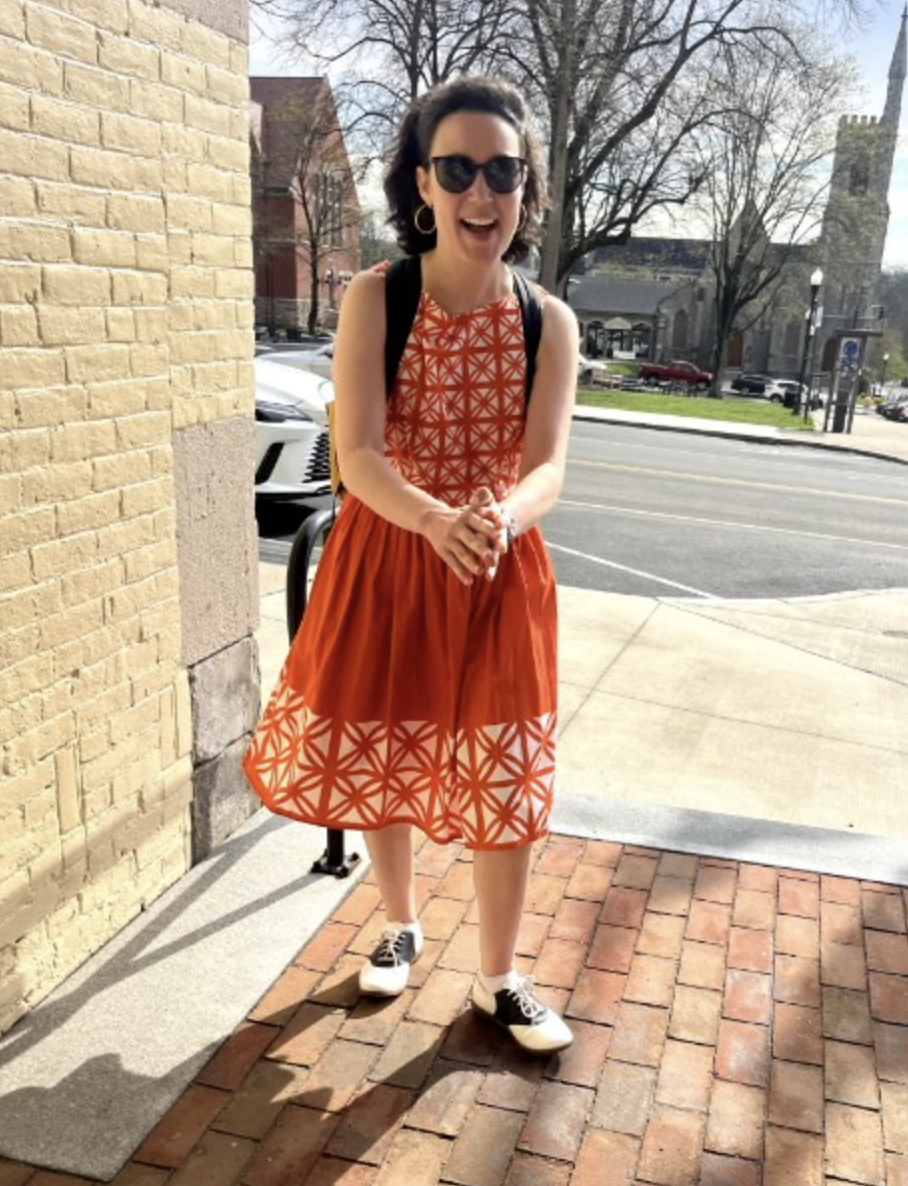
Our first meeting resembled how Reina Garcia Margono ’27, fellow American studies major and Adorno’s friend, first met her: “I saw this girl wearing this vintage dress, and I was taken aback … I did not know that you could walk into places and just be your authentic self … After that point, I knew ‘I don’t know this girl yet, but I know she’s cool.’”
Early Life
Originally from Ohio, Adorno describes to me how her upbringing was a mix between small towns and cities: “I spent my childhood in rural Ohio and then my teenage years in Cleveland, which I liked — getting a little bit of both pieces of Midwest living: rural and urban.”
Her educational life, though in public school all throughout, was a unique one compared to most students. “Public schools in the rural areas suffered from some of the same things a lot of school districts like that suffer from, but my high school was really different,” she said. Her high school in Cleveland, however, was “extremely well-funded” in its programs, allowing her to experience band, science Olympiad, and “all sorts of [Advance Placement (AP) courses].”
Near the end of high school, she initially was on the standard path towards college. “In my senior year, I was absolutely college bound,” she said. “I took a bunch of AP classes and my grades were great.” But she decided at the beginning of her senior year to enlist in the military, something she described as “kind of a wild card decision.”
Adorno recalls that one of the biggest factors in that decision to enlist was that she knew herself very well at that age. “I was immature in some ways, and I lacked a lot of discipline and respect, and I was kind of a goof-off in high school, which I think surprises people now who know me,” she said. Though Adorno knew she could attend a state school and take out loans, she acknowledged that at a fairly early stage, she knew she was “probably gonna just blow it and party.” “I still could have gotten fine grades in college … and could have graduated, but I really, really lacked sound discipline,” she said.
Thinking back on her decision to join the military, she admitted there were also other factors that played a role. “Maybe the military is a pretty extreme decision for that,” she said. “There’s a lot of incentive to join the military … and that appealed to me as a teenager.”
The regimented nature of the military attracted her as well. “You submit yourself to the military as a teenager and then you make no more decisions,” she said. “They decide where you go and what you wear and what you do, and that was appealing as well. Just having a plan that I could walk right into.”
New Beginnings in the Navy
When Adorno first joined the Navy in 2015, she remembers being “really excited” but also shocked in a lot of ways. “They take a couple [of thousand] teenagers from all over the country, and sometimes all over the world, and they ship them off to boot camp together,” she said.
As she prepares to start from scratch in the Navy, Adorno enlisted herself as a linguist, but what she didn’t know was the language. Though she had her heart set on Russian for a long time, she was only offered Mandarin or Korean. She admitted that at the time, she didn’t understand that “one has an alphabet, and one doesn’t.” She ended up choosing Mandarin, a language she had no prior skills in.
The education there was akin to “a two-year immersion boarding school,” where she learned a lot about Chinese culture. “There was a time in my life where I was really, really fluent in Mandarin, [but] I’ve let it lapse a little bit,” she said.
Her subsequent job was on the amphibious assault ship USS Kearsarge. “I worked navigation, radars, machines, trigonometry, calculating, basically making sure my ship didn’t bump into anything,” Adorno said.
During the 2017 Atlantic hurricane season, Adorno’s ship was assigned to do humanitarian work in the Virgin Islands and Puerto Rico. She explained that since her ship was well-equipped with supplies, they planned it such that they could show up and clear roads the very next morning after the hurricanes had come in. This work was particularly personal to Adorno. “I have a lot of family in Puerto Rico, and I had the opportunity to go on the ground there and translate for neighborhood services,” she said. It was Adorno’s first time seeing her aunt and uncle in years.
“The power was out for so long, and… when I got there, my aunt cooked for me,” she said. “She served me chicken, and I was like, ‘what a luxury…Where has this been refrigerated?’ … That was pretty stark.”
Job Hopping
Right after leaving the military in March 2019, Adorno moved to Key West, Fla., where she found herself working “odd jobs in the tropics” for three years.
Just as Adorno was drawn to the military for its regimen, she recalls the difficulty in moving away from it. “The transition out of the military is hard no matter what, no matter where. You put a lot of your identity into the military, and then when you get out, you’re tasked with reshaping that,” she said. Though, since Key West is still a “big military town,” Adorno was able to find some familiarity in the overall tough transition.
During her time there, she worked in a hotel, as a bartender, and as an exhibit designer in museums. It was in that last job where she found storytelling, exhibitions, and collections to be something she found herself passionate about doing to this day. “[It was a] really great experience to work for a museum, and look at storytelling and exhibitions and collections — that’s something that I’d really like to get back to,” Adorno said.
The shift from a regimented structure to a job that afforded her immense freedom was not simple, but the Covid pandemic surprisingly helped. “I think I had a lot of creative momentum built up for months in quarantine … and the first half of it was kind of cool and relaxing and bizarre in a way, and then I was starting to lose it a little bit,” she said. “And so I was champing at the bit, straining at the leash, and by the time I got to this job, I was ready to go.”
Despite successfully creating multiple exhibitions and programs, she left the position as she realized she could only go so far. “I knew that I was super fortunate to get that far without the credentials and the degree … that I probably was gonna hit a wall soon, and I wouldn’t be able to go much further in that field without the education.”
Transitioning to Amherst College
“I lived in a couple different places in the military, and throughout my adult life, I just moved every two to four years. That seems to be my pattern and my lifestyle.” Adorno said.
Ready for a change, Adorno decided the region she wanted before the school, as she was also relocating her permanent home. “I knew I wanted to live in the Northeast, and the open curriculum was appealing,” she said. “For me, it was like Amherst College or [University of Massachusetts] Amherst.”
During her first year, though, Adorno was surprised by the campus culture and was “constantly on the brink of transferring” to UMass. “I didn’t really understand what a liberal arts education was or what the pedagogy of this institution was until I got here,” she said. “My freshman year, I was really frustrated with discussion-based classes. I wanted lectures, I wanted anonymity.”
Adorno sees this transition as the “same sort of story” as leaving the Navy. “I was also a little put off] by the friendly vibes here, it was a lot for me,” she said. “Coming from a military world, I was a little tightly wound … I was really, really on the defense my first year here.”
By her second year, though, she “chilled out.” Adorno remembers sitting herself down the summer before, asking herself “do you really want to do this, yes or no?” She decided to “stay and get with it.”
When it came to deciding her major, Adorno initially went down the history route. “I was ready to fill my first semester schedule with four history classes.” Adorno recalls William McCall Vickery 1957 Professor of the History of Art Nicola Courtright, her pre-major advisor and now friend, saying “absolutely not.”
Courtright also remembers how Adorno initially came with some apprehension about the liberal arts experience. “We had many conversations about what her experience was like in the classroom to break her into the liberal arts experience, which she wasn’t necessarily signed up for in her own mind,” Courtwright said.
Adorno ended up taking some history classes but felt “frustrated” in them. “We learn all the history and the causes of things, but what are the effects? I want to learn the effects,” she said. This brought her to sociology for some time, thinking the social analysis was what she had been needing. Still, Adorno thought something was missing. “That department that had all the effect I was looking for was missing so much cause,” she said.
Caught between her interests, Adorno recalls being set on doing an interdisciplinary major to finally get both the cultural analysis and cause and effect balanced in a way she saw fit. Then, she took two American studies classes in a semester, which “absolutely sealed it.”
“I was like, ‘duh, it’s right here. This is the interdisciplinary approach,’” she said.
One of her favorite classes was “The Neo-Western” with Professor of American Studies Robert Hayashi. The course examined the neo-Western as a genre of media that uses “tropes like old Westerns and subverts them in some ways.”
That same semester, she took “Rethinking Pocahontas: An Introduction to Native American and Indigenous Studies,” with Associate Professor of American Studies Kiara Vigil. “Those two classes worked so well together — talking about the West, Indigenous peoples, and narrative construction … those are the two classes that really sealed [the American studies major] for me,” she said.
Once a Linguist, Always a Linguist
Outside of her department, Adorno continues to fuel her language interest by immersing herself in as many languages as possible. She has taken three semesters of German, two of Russian, one course in Spanish, and one course in Arabic. “I’ve taken a lot of language classes at Amherst that have all been so phenomenal, so rewarding, and really some of the standouts of my time here,” she said.
Having had previous Mandarin learning experience in the military, she found a stark contrast in what the language-learning environment was like in Amherst. “Learning a language in the military is a really intense and largely negative experience. I had a lot of conflicts with my teachers and that dimmed my language learning spark for so long,” she said.
Despite the experience, Adorno was determined to challenge her perspective by taking “Elementary German I” her very first semester. She said her professor, Senior Lecturer in German Anna Schrade, really influenced her. “She didn’t even know she was doing it, but my experience with her really helped heal the Mandarin learning experience that I had,” she said. “[She] totally reignited my language spark.”
The Spanish course she took was “Finding Your Bilingual Voice” with Senior Lecturer in Spanish Carmen Granda. “It’s a class that explores your mixed identity and your heritage speaking,” she said. “It changed my life and my relationship to my ethnic identity.”
Outside of academics, Adorno still finds that her extracurricular activities draw her to languages. “I’m at a language table almost every day … I know that what works for me is to get the language in your body, in your mouth, in your muscles,” she said. You can’t just learn it quietly from a book, you have to use it.”
She also frequently attends departmental language events. “The German department has ‘Kaffeklastch’ on Fridays, which is just another casual chit-chat,” she said. “The Russian department does ‘Russian Tea.’ Anytime a language department is showing a movie with subtitles, I’m there.”
Paying It Forward
As for her time apart from academics, Adorno is most present in the Amherst College Military Association (ACMA). When she first arrived at Amherst, she found a lot of affinity groups “losing their footing” due to Covid. In her sophomore year, AMCA only had four veteran students. Now, it has 11, an increase that Adorno owes to “put[ting] a lot of work into building it back up” her sophomore and junior years.
“A lot of my energy and passion goes into that,” she said, “creating a space where veterans can come to immerse [themselves] and feel that they have social support [from] people who understand the challenges of being a veteran and transitioning out, especially in a place as unique as Amherst.”
Adorno explained that a support space like this is necessary because of how varied veteran student’s experiences and needs are. “Some of us live on campus and some live off. Some are trying to navigate the complicated education benefits from the government and some are using financial aid. So there’s a little bit of everyone all with quite different circumstances,” she said.
Describing her as “a very analytical [and] sharply aware person about [both intellectual and] personal matters,” Courtright believes that the sheer amount of effort Adorno put into creating a community — notably by organizing ‘family dinners,’ a veteran student life handbook, and a faculty advisor for ACMA — comes from her acute awareness through experience.
“[Adorno’s] time in the military and her life experiences really helped her become someone very sharply attuned to how people [are],” Courtright said. “She decided [to put] structures in place, so [veterans] in the future would be able to have an easier and better experience than [she] had initially.”
Adorno’s care has never been limited to her communities. With a smile, Margono tells me about a moment where she was having a bad day, and Adorno showed up with a piece of cake and offered to sit outside and chat with her. “We talked for a couple hours … She has a very insightful mind, and is really engaging, so she’s not just talking about you, but she’s also opening the floor to other things,” Margono said. “Conversation with her was really light.”
Future
After graduation, Adorno will attend a trade program at a community college for a certificate in automotive technology. “I really like cars, and I miss machining physical problem solving, and working with my hands,” she said. “I miss that part of the military.”
Though she’d like to do that for a little while, it won’t be forever. “I’ve been calling it my side quest right now,” she said. Though Amherst has been an “immeasurable value,” she also feels a need to do something that feels more like her life.
In the next few years, she would also love to learn another language through a summer immersion program. When I asked what’s next to add to her already well-endowed list, she said her top three were Polish, Vietnamese, and Bengali. “I’ll see about at least one more in the next couple years,” she said.
For current students, Adorno hopes they “give [others] a chance,” even if they don’t know how to approach them. “There are a lot of communities on this campus that I think people don’t know how to approach sometimes,” she said. “Veterans are one of them. I think sometimes my classmates have questions about their peers and interests, but they don’t know how to ask the right [ones] or they don’t want to offend … I would advise [removing] those bars to your curiosity. Don’t be nervous.”
As for advice for her younger self, Adorno would encourage herself to be more patient: “I would tell [her to] just kind of wait for it … And my younger self would have probably said ‘get lost.’”
Comments ()