

Nina Aagaard: Wholehearted Commitment
An oceanographic chemist, rock climber, and artist, whether she is detailing every step of a woodblock printing process or explaining the possibilities of synthetic molecules, Nina Aagaard commits wholeheartedly to everything she is passionate about.
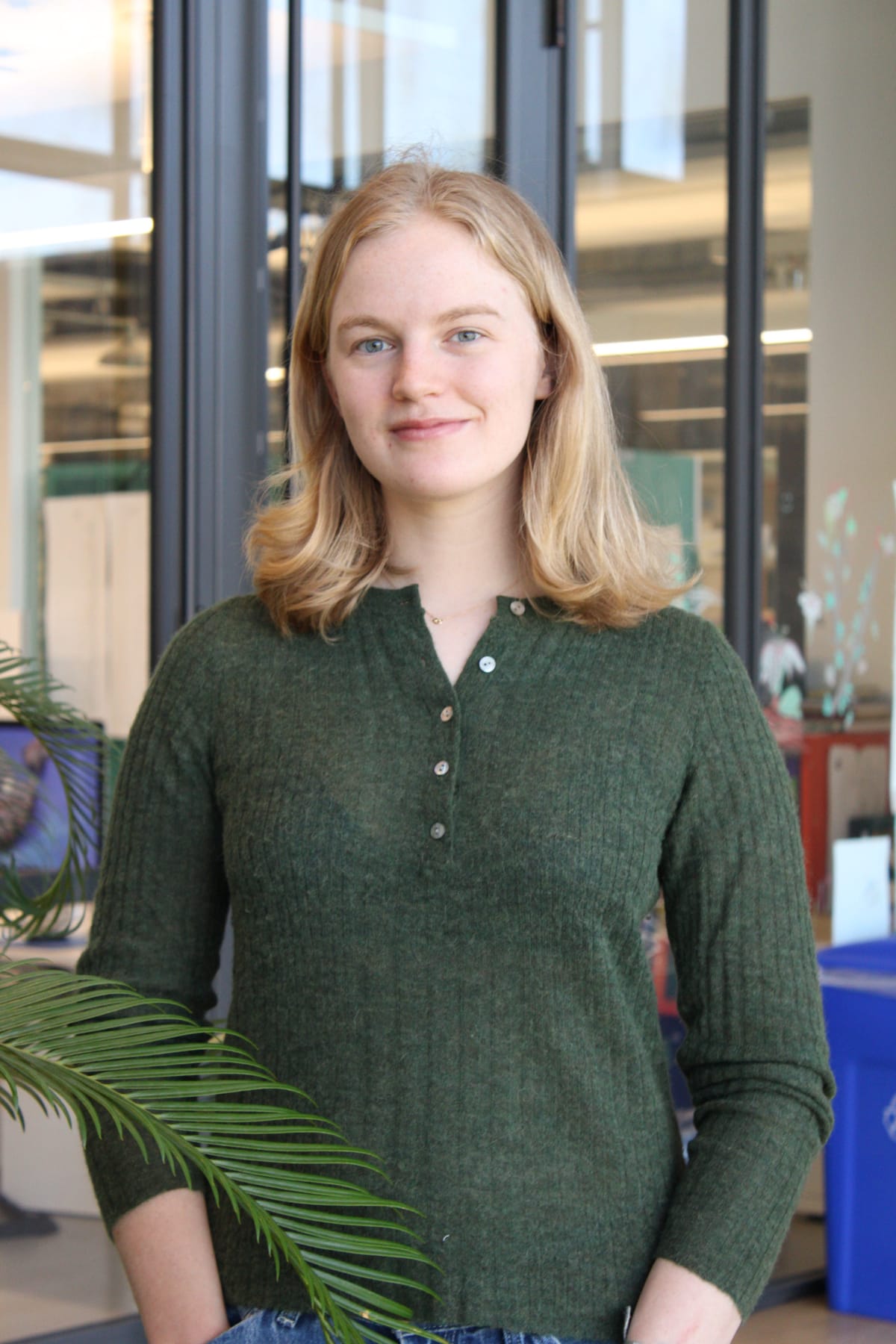
In all likelihood, you’ll see Nina Aagaard ’26 before you meet her. Pasted on stickers on student water bottles, adorning posters on dorm and hallway corkboards, or in the logo of your favorite club’s shirt, Nina’s illustrations cover the Amherst campus. But to know Nina only through her graphics would be to miss the entire picture. A chemist, Amherst College Emergency Medical Services (ACEMS) officer, rock climber, and more, Nina has had an incredible impact on campus through her passionate exploration of arts and sciences.
Figuring it Out
During our conversation, Nina recounted events from her childhood with an alarming sense of accuracy, describing in detail a project she did on urban sprawl in the second grade, the title-page scrap papers her mom brought home that she would doodle on after school, and the editorial illustrations of The New Yorker that she would comb through weekly.
“I was a weird little kid. When I was in kindergarten, I asked my parents for an atlas for Easter,” Nina said. “I was just obsessed with just reading and learning everything. I would tear through whatever books I could get my hands on.”
Nina’s parents, and especially her dad, fed this curiosity from an early age, quizzing his daughter with mind games ranging from “identify this geometric solid,” to “trespass, nuisance, or neither” — an ode to a property law class he was teaching at the time — to debating whether biking or walking was more sustainable while having Nina address nuances right down to the metals used in bike manufacturing.
Growing up just outside of Philadelphia in Narberth, Pa. ended up shaping Nina’s academic interests towards a pre-medicine path. Philadelphia, which hosts three major hospital systems, is a haven for those interested in pursuing medicine. “Everyone is a doctor or a nurse or some sort of technician or researcher,” Nina said.
Nina’s high school, which was a competitive and STEM-oriented public school, also encouraged this path towards pre-medicine. “I thought I wanted to be a doctor … Everyone growing up was like, ‘if you like science and math, you should be a doctor,’” she said.
So when Nina was applying to colleges, she prioritized schools with a strong science program. When it came down to it though, Amherst’s commitment to its students and the resources the college offers blew her away. “At a lot of the other schools I toured, it was like, ‘you can get into a research lab, but you’re going to have to throw some elbows,’” she said. “But, at Amherst, there’s so much to go around. And because that’s not an issue, people really felt like they were just in it for the love of the game and supporting each other.”
As Nina would find out, Amherst ended up being the perfect place to explore her intellectual interests. “I had no idea what I wanted really, or I thought I did but I really didn’t,” she said. “There have been moments in my life, at Amherst, I felt like ‘I’m going to be a doctor, I’m going to go get a Ph.D. in chemistry.’ Now, it’s ‘I’m going to be an oceanographer.’”
To Nina, bouncing around these changes was something that only could have happened at Amherst. “I feel like if I had gone to one of those other schools, I would have just gotten siloed in with the first thing that my 18-year-old self thought I was going to do and would not have been able to break out of that,” she said.
An Accidental Double Major
Regardless of what Nina is pursuing at a time, she is doing it to its fullest extent. “I do not half-ass anything,” Nina said. Claire Holding ’26, a friend of Nina’s since they sat next to each other at convocation, echoed this. “I think Nina pretty much does the things she cares about,” Holding said.
At Amherst, while involved in a dozen different things, Nina’s academic interests landed her in the math and chemistry departments as a double major. Nina started taking chemistry courses her first year and very quickly became attached to the department. “I have loved every chemistry class I’ve taken,” she said. “It’s so fun. It’s just this language for understanding things that really clicks in my brain.”
While Nina initially saw the chemistry department as simply a place to begin her pre-medicine track, she eventually discovered the discipline itself as her true passion. “I think my relationship with chemistry has changed a lot over time,” she said. “I went from being like, ‘this is a tool that is necessary for me to be a doctor,’ to ‘this is everything I love and I just want to do organic chemistry forever.’”
For those of you who have struggled through “Organic Chemistry I,” and maybe “Organic Chemistry II” if you are brave, that sentiment might sound like a shock. But Nina reveled in the challenges that chemistry posed to her, and she enjoyed learning the new language of every class she took. Assistant Professor of Chemistry Ren Wiscons, Nina’s four-time professor and thesis advisor, described that even in the hardest classes, Nina “wants to be pushed beyond the content that’s introduced.”
As Nina continued to chart her path in the chemistry department, she started taking math classes to supplement her science education, and in the spring of her sophomore year she enrolled in “Linear Algebra” because she had heard it was good for the chemistry major.
“This is the best thing ever” isn’t what would come to mind to most people when they hear “linear algebra,” but that is how Nina described her experience in the class. “It was my first real experience with proof-writing in college,” she said. “I was having these epiphanies of, ‘this is how the world works’ every class.”
Coming out of linear algebra, Nina was already planning on taking “Groups, Rings, and Fields” as the sequel to the class along with “Differential Equations,” which was also good for the chemistry major. Nina recalled looking at the math major requirements: “I was like, ‘huh, I’m basically planning to take all of these already, so I might as well add that on.’” So she promptly declared a second major in math.
ACEMS: ‘Under the Hood’ of Amherst
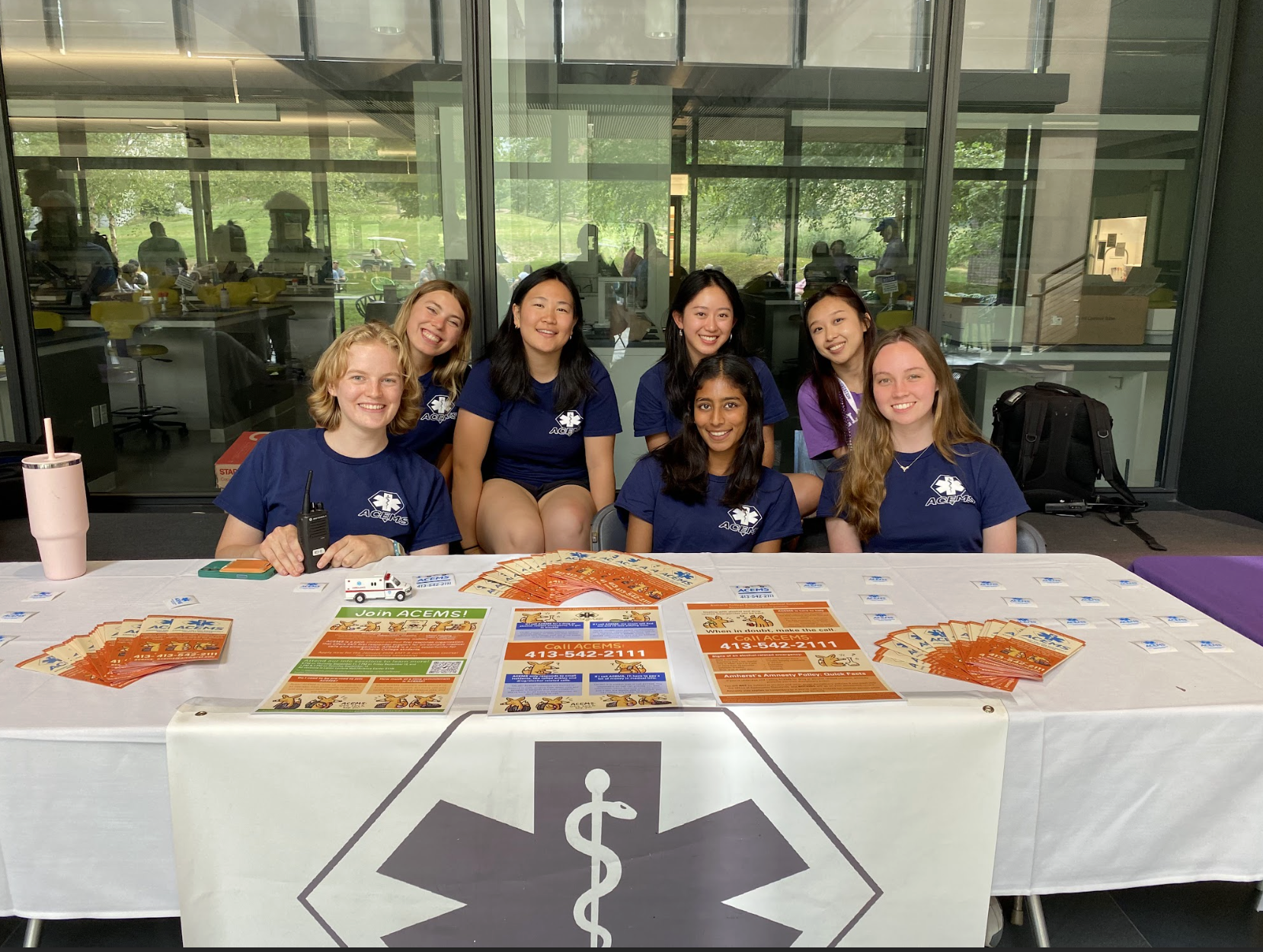
Despite viewing ACEMS as somewhat of “a vestige of [her] pre-med ambitions,” Nina sees her time and leadership in the group as one of her main contributions to Amherst’s campus. “ACEMS is a really direct way to look under the hood of this whole ecosystem of Amherst,” Nina said. “Through my involvement on ACEMS is when I feel like I’m really doing the most for this community.”
A member since her freshman year and a Med-10 (the highest possible rank) by her junior year, Nina took on the role of director of business and administration for ACEMS during her senior year. Among many other things, this position requires Nina to read all the run reports submitted by the squad, which document each call in detail. “Reading these run reports,” Nina reflected, “you get a sense: these are the people who you’re in classes with, and you’re in [Valentine Dining Hall] with, and everyone at this school is dealing with just so much all the time, whether that’s a medical emergency or things at home.”
For Nina, the care she provides through ACEMS has played a vital role in how she feels she can impact the Amherst community. “There’s something that feels very radical and awesome about being free medical care on this campus,” Nina said. Part of the reason that Nina eventually turned away from medicine is the amount of pressure doctors have fallen under to maximize profits and efficiency along with increasing regulation from hospital administrators. “I could never give up this immediacy of when I’m on scene,” she said. “I’m so singularly focused on just being a healthcare provider.”
To Nina, showing up to a call as an ACEMS officer means being there for all levels of peoples’ needs. “I show up as an EMT, but also a lot of times I show up as someone’s friend, or providing mental health support,” Nina said. “I literally have been there to put a band aid on a scrape, and at the end of the day, it’s no sweat off my back.”
‘Bowl-middle’ and Nina Jr.
As Nina’s Amherst education progressed, classes and research opportunities helped her conceptualize her academic identity as an organic and analytical chemist. Part of this development occurred through her work in the Wiscons lab — an organic chemistry and material science lab that specializes in making sustainable organic solids for electronic parts — while other aspects of it happened in the classroom. Nina started working in the Wiscons lab through the Summer Undergraduate Research Fellowship after her first year, and eventually wrote her thesis there.
Wiscons’s class, “Analytical Chemistry,” was where everything began to click for Nina. To Nina, the class helped her see chemistry “as a tool for understanding, solving, and addressing environmental problems” by combining her chemistry lens with her love of math and the environment. In “Analytical Chemistry,” Nina designed and 3D printed her own photo reactor, “Nina Jr.,” — which she would rework to complete her thesis work, aptly naming her second reactor “Nina Jr. Jr.”
Nina’s thesis, which builds on multiple years of work prior to hers, focuses on the nitrogen-centered, triangular molecule azangulene. When asked to describe the molecule in layman’s terms, Nina put it: “It’s basically a little pop-it, and it can flip between ‘bowl up’ and ‘bowl down.’ And when it does, it changes the … direction of electron density in the molecule.” Whether or not the bowl is pointing up or down can correspond to ones and zeroes, meaning binary can be encoded on the molecular level.
For a while, the Wiscons lab thought that the molecule could only be up or down. But now its researchers know “it can spontaneously become flat at high temperatures.” Not only does the bowl become flat at high temperatures, but its fluorescence also goes from blue to green. The purpose of Nina’s thesis was to look more closely at this transition — or as she put it “bowl middle” — by heating up the molecule using a powerful microscope in the Science Center’s basement and gathering data.
Nina described her process as feeding “a computer a bunch of frames of the crystal turning from blue to green.” Then, the computer would “spit back out numbers” that can give her parameters to help get thermodynamic conclusions. All of Nina’s work is done with the purpose of evaluating the performance of the molecule as a potential storage of electronic information.
Wiscons described the work Nina did on her project as requiring a specific set of skills that Nina had developed through her previous math classes, coding projects, and large data analysis. It is, in essence, something that could only be arrived at through Nina’s unique combination of creativity and confidence.
Art in and out of the Classroom
Though cemented rather officially at Amherst, Nina’s art career started long before stepping on to campus. Nina started keeping sketch books in the second grade, and has kept every single one she’s filled since then. In high school, Nina completed a fine arts sequence including two Advanced Placement art classes and twice-monthly critiques. Her commitment to art only expanded during the pandemic lockdown, reaching a point where she even considered applying to art schools post-high school graduation.
But, by the time Nina arrived at Amherst, her capacity for fine arts had been burnt out, encouraging her to look for art-related opportunities outside of the classroom. One avenue Nina pursued was becoming the go-to illustrator for The Student as Managing Graphics Editor.
Then, after a two-year hiatus in the fall of her junior year, Nina was ready to return to classroom art and enrolled in (or rather, forced her way onto the roster of) “Printmaking I” with Senior Resident Artist in the Department of Art and the History of Art Betsey Garand. “I had given art the time and spaces that I needed to make it feel relaxed and meaningful,” Nina said. “When I came back, I just felt like I was rewarded threefold … it was everything I wanted it to be.”
In a written correspondence with The Student, Garand highlighted Nina’s ability to capture beauty in mundanity through her attention to detail. In describing her own work, Nina’s actual process often took priority over the final product. This is evidently shown in Nina’s printmaking “lab notebook,” where she wrote down the exact procedure that went into creating each print she worked on.
In Nina’s approach to art, it is impossible to separate her scientific background from her creative output. “Each print and mixed media piece was made with a focused and imaginative intention, combining her interests in science, the environment and history,” Garand said. To Nina, the interaction of her interests became a way to dissect her relationship with her surroundings. “I think, to me, art has been this way for a really long time of making sense of my environment and who I am in relation to the space that I’ve occupied,” she said.
Another recipient of Nina’s graphic design skills has been Amherst Rock Climbing (ARC), for which Nina was a founding member and president. Fellow climber, current roommate, and long-time friend Mia Sanchez ’26 brought Nina to boulder with her during their first year. Nina was hooked immediately. “All of a sudden I understood what people really liked about sports,” she said. Sanchez remarked on Nina’s involvement with not only ARC, but all of the groups Nina’s a part of on campus, “She finds a way to get involved in organizations in a way that’s really true to herself,” Sanchez said.
Scholarship, Research, and Beyond
After her first year in Wiscon’s lab, Nina spent her following summer in a lab at the University of Michigan that focused on industry-related chemistry. Though intended to be an experience that would allow Nina a glimpse of her future, her time in Ann Arbor actually showed her a path she did not want to take. “I didn’t see myself working in Big Pharma or doing [agricultural chemistry], and that left me really confused,” Nina said.
Despite this blow to her career ambitions, the experience functioned as the basis for the work that earned Nina the Goldwater scholarship, an honor awarded to college sophomores and juniors for excellence in science research. The application experience ended up proving especially fruitful to Nina. “To actually write about science research you’re doing just requires this whole other level of understanding,” she said. “To really sell it to someone else and say, ‘hey, the work I’m doing is important,’ … that’s how you get funding, that’s how you work as a scientist.”
Going into her junior year unsure of what her career would look like, Nina quickly revised her trajectory in response to a cascade of climate change related catastrophes in 2024: one of the worst hurricane seasons in years, followed by the destructive Palisades fires. “I remember looking at my phone every day and seeing people’s entire houses and lives getting destroyed,” Nina recounted. “I had this moment of, ‘if I’m doing science, I have to do climate science.’”
During her junior year, Nina began to conceptualize this reorientation. “I did a hard pivot and started thinking about, ‘what are ways that I can use chemistry in an environmental context?’” she said. Nina then fell into the rabbit hole of chemical oceanography, a field she described as “using chemical systems to understand things like climate, the environment, and biological metabolic processes that happen in the ocean.”
The rabbit hole eventually turned into a summer spent at Woods Hole Oceanographic Institution on Cape Cod, where Nina processed massive data sets of water characteristics measured by autonomous underwater vehicles. Nina will continue this work as she pursues her Ph.D. in the Oceans Department at Stanford University’s Doerr School of Sustainability. With a huge grin on her face while describing her future work, Nina once again delivered a sentence that for some would be concerning, but for her was cause for delight: “I’m going to be out on boats for 30 days at a time to collect thousands of bottles of water to test in the lab and run samples.”
While the people in Nina’s life are worrying about how they’re supposed to contact her while she’s at sea, they could not be more proud and less surprised about Nina’s future. As Wiscons put it, “I have high hopes that she will continue pursuing whatever is meaningful to her, regardless of whether it seems like the thing that other people would [tell] her to do, and I think that that’s really consistent with who she is as a person.”
Comments ()