

Humphrey Chen: Hands and Heart Full
Humphrey Chen has spent four years learning that every person carries their own world. Now, with a gentle soul and a full heart, he is ready to spend a lifetime honoring that truth for others as much as for himself.
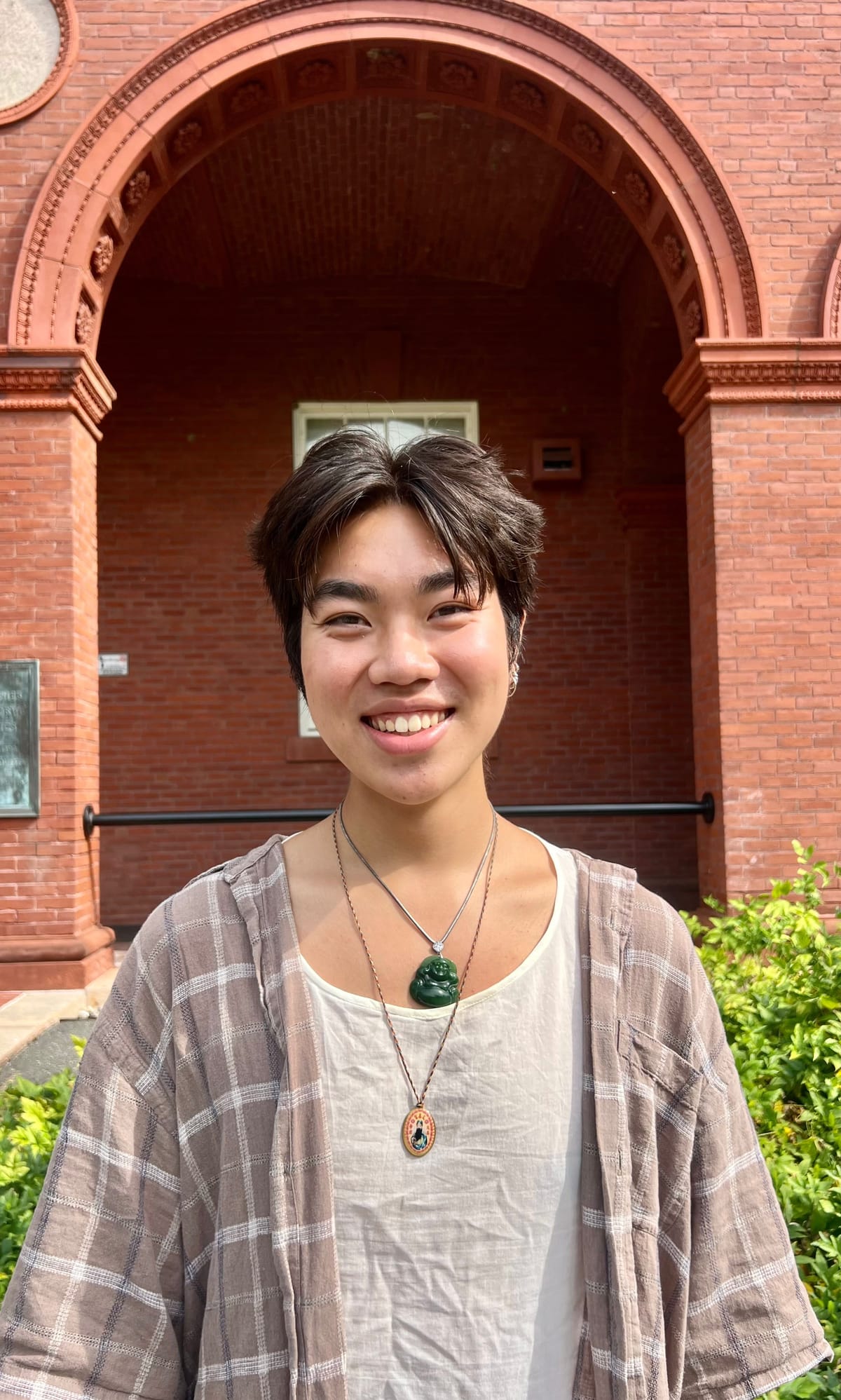
Humphrey Chen ’26 arrived at Amherst College through sheer force of will.
In the spring of 2022, the Amherst admissions office was the target of a singular, relentless, and personal campaign. Chen, then a high school senior trapped on the college’s waitlist, wasn’t sending the standard letters of continued interest; he was bombarding them with a constant, vibrant scrapbook of his soul.
“I’d send emails to every single person on the admissions board, like 20 emails every week,” Chen recalled with a laugh. He sent short updates and poems, along with photographs of the intricate things he was making by hand — including the prom suit he had sewn for himself.
“What made me want Amherst so badly was how open and free their explorative resources were,” he said.
Maybe Chen was right to desire Amherst in his slightly “manic and crazy” way because, throughout his time in college, he has absolutely blossomed from that openness.
When his acceptance finally arrived on his birthday, it marked the beginning of a process that would transform him from an “awkward, stumbling little dentist” into a scholar-practitioner who submerges his soul within both the sciences and religious ethnography.
Today, Chen is a biochemistry and religion double major, a responder to late-night emergency medical calls, an artist of biomaterials, and a researcher dedicated to the intimate social work of healthcare. He is a student who has learned to find stories in everyone he meets, treating every friend and faculty member as their own world.
Outside of the Script
Chen’s story begins in Basking Ridge, N.J., a suburban enclave defined by a high-pressure academic culture where everyone was GPA hungry. In his competitive public high school, the atmosphere was overrun by the constant tension following the return of every exam.
In this environment, success was measured by the script one followed. Initially, Chen’s script was to become a baker; he imagined a vibrant life at the Culinary Institute of America.
“I watched all these Food Network videos of Guy Fieri visiting people with his mohawk and his dark sunglasses, and just seeing these little home businesses that were so vibrant and so full of life … I remember thinking that baking is a really great way to meet people and nourish them with happiness and food,” Chen said.
However, his parents steered him toward dentistry. Chen welcomed the pivot as an acceptable and money-making career that would satisfy parental expectations. Plus, the dexterity required for sculpting flowers with frosting didn’t seem so different from fixing teeth.
Upon arriving at Amherst, Chen initially followed his pre-professional track, enrolling in the standard pre-dentistry classes like chemistry and biology. He even added a psychology course to his schedule, thinking it would help him understand the patrons he hoped to one day nourish. But as he moved through the coursework, he found the psychological approach to human behavior frustratingly narrow.
In the spring of his freshman year, Chen enrolled in “Introduction to Buddhist Traditions” with George Lyman Crosby 1896 & Stanley Warfield Crosby Professor in Religion Maria R. Heim. The class was transformative for Chen, not only for its philosophical depth but for the perspective it offered in examining how people live. “I was finally getting to a point where I could see people making decisions, doing, and being in life … by virtue of how they were raised,” Chen reflected. The class prompted him to reflect on the shortcomings of psychology.
“Psychology took a very minute approach,” Chen said. “Psychology looks at the trees, the bark, along with the little insects crawling up and down. But understanding sociology and anthropology is like looking at the forest.”
It was in these religion classes that he met Yanlin (Alina) Zhou ’26E, who navigated the major alongside Chen. Zhou reflected that, after taking several courses together and becoming friends, “[Chen’s] chaotic energy and kindness just immediately shined through … He’s one of the few people I’ve met that, whenever he speaks, I feel like I live in the world his words create.”
Ultimately, Chen found an intellectual home in the religion department, which he describes as being populated by professors who are deeply invested in their students. He emphasized that the faculty care so much that they might have a kombucha under their desk or a fainting couch in their office for thesis writers to rest on.
“These professors are so kooky. Ph.D. holders who are vibrant and have such sparkling personalities,” Chen said. “It’s so inspiring to see that people who go through academia can turn around and invest their entire lives in changing students, one cohort at a time.”
Time Well Spent
While religion taught Chen to ask questions, Amherst College Emergency Medical Services (ACEMS) taught him what it means to answer them. He joined as a freshman, drawn by the idea of being more integrated into the campus atmosphere as an EMT, but what surprised him was the intimacy of the work.
Responding to calls at 2 a.m. — sitting with students until they felt safe — taught him that community care lives in the smallest, quietest moments. “I had so many moments with people on calls,” he said softly. “It takes a familiarity to the person treating you for the treatment to work best.” He remembers helping students back to their dorms in the middle of the night and those quiet moments of vulnerability. “A lot of [Registered Student Organizations] do large forms of engagement, but that community care and minute, smaller form of engagement is really rare.”
ACEMS solidified his path toward medicine. For Chen, being a doctor is “half social and half listening,” a philosophy that officially shifted his trajectory from dentistry to pre-med.
At Amherst, Chen’s love for art never disappeared, although his relationship with “making” evolved. To onlookers, it’s clear that, as Zhou explained, “he refuses to sacrifice the authenticity and the force of himself for anything. He’s so consistent … with his personality, his thoughts, his words, and his art.”
This interest in art reached a peak during his first summer at Amherst, when he worked as an intern for Assistant Professor of Art Lucia Monge, a studio art artist and biomaterial sculptor.
Monge asked Chen to recreate a chicken bone out of clay over the summer, but when he produced a cartoon bone, she told him to start over. She wanted him to capture every drop shadow on the tiny object. “It took an entire day until I could get a bone that looked good,” Chen recalled. “She said, ‘okay, now 200 of these.’”
“Every material and method of making was so meticulous,” he remembers. Coming from a high school where “people were doing things for academic momentum and didn’t care,” watching Monge deliberate for twenty minutes over color choices showed him what it looks like to care about something for its own sake.
Seeing this in someone who was older than he was, a woman who had so many accolades and still was doing this down-to-earth meditation, Chen knew “this is the intentionality and care that I want.”
The feeling was mutual as Monge looked back on her classes with Chen, including a Special Topics course that culminated in Chen’s own sculptural artwork, which examined female practitioners’ socio-religious positions. “He creates these warm spaces and is ready and open to learn and is curious about lives in a way that’s refreshing and non-disciplinary,” she said. “He’s just a person who wants to know and learn stuff, and recognizes that every single person around him has something to teach him.”
The lessons in intentionality within art followed him to Texas during his sophomore summer, where he shadowed surgeons in Houston Methodist’s Thoracic Surgery department. “It made me want to be a surgeon because it’s very artistic,” he said.
The experience also radicalized him: “Seeing people in the clinic who were beaten up both physically and by the system, I realized I can’t work in a system, in a penthouse with a pension and high salary, without contributing to reform and bettering it.”
He emphasizes that being a doctor is half social and half listening. For “people who are sick [and] have been neglected by the system,” he wants to be someone who has the perspective to perform the intricate social work that makes medicine durable and effective.
“Medicine is an individual choice. [Though] passion is not as durable as the care and intimacy of medicine.” He paused, then added, “I don’t mind living a life partly for other people.”
Experiences Elsewhere
“[Chen] has always been a very engaging person to be with, and he’s so kind. There’s something very gentle in his manner … and that has stayed the same. But he’s gotten more confident and had a lot of great experiences that have shaped him.” Heim noted.
In his sophomore winter, Chen participated in Smith College’s Tibetan Studies in India interterm program. As part of an ongoing academic exchange with Tibetan universities in exile, each year the Five Colleges send students to study Buddhist philosophy, Tibetan history and culture, and Tibetan textual analysis in an intensive program taught by the Central University of Tibetan Studies in Sarnath, India. Sarnath is also the location of the Buddha’s first teaching after attaining enlightenment.
“I think that was probably pretty instrumental to his development as both a student and just a human being … As it does for all the students who go, that trip had a really huge impact in his life and cement[ing] his ideas to really study Buddhism and religion closely,” Heim said.
Chen would agree. “It was just really nice speaking to real religious people, getting lived experiences, and having a glimpse of what resistance and intergenerational survival looks like,” he said.
The following winter, he went to Taiwan for ethnographic fieldwork with Indigenous communities at Taipei Medical University’s Baqlu Lab of Indigenous Studies, Anthropology, and Public Health. “I was introduced to ethnography and being able to go into the field,” he explained. He studied how tobacco and betel nuts, important parts of indigenous culture, had been appropriated and pathologized by colonial settlers. Serial colonialism had created a cycle of abuse, and he saw that established relationships of neglect meant you couldn’t just fix the symptoms — like the people — but needed to fix the root of the problem.
These realizations culminated in his senior thesis, where Chen returned to his own community in New Jersey to study Tzu Chi, a Taiwanese international Buddhist charity organization his family has long been a part of.
During the summer before his senior year, Chen conducted ethnographic fieldwork at the temple in Jersey, a satellite branch of Tzu Chi that also serves as a Chinese language school. There, he interviewed multiple generations of temple members, asking what made them stay and how Buddhist compassion became indivisible from who they are as a person.
Chen’s fascination with human beings influenced his approach to his thesis. Heim shared how “[Chen]’s interested in taking people at their own terms … he just ethnographically wants to document and record what other people think without judging or boxing them in while trying to record and preserve that in some way.”
Interviewing people to understand how the organization refashions religion to engage immigrants through Buddhist compassion, Chen said he “wanted to look at Tzu Chi to recognize moral mediation by larger social structures and take a look at ourselves and the things that make us good,” tracking how faith and belief feed into everyday action and habits.
For Chen, the “force of what people believe is a lot more important than what a microscope can show you. How you create your own world and how that changes your relationships and physical reality is really interesting.”
Close Conversations
Outside of academics, Chen dedicates time to working in the Queer Resource Center (QRC) or blasting pop music at the Queer and Trans People of Color (QTPOC)’s renowned garties (gay parties).
As an organizer for QTPOC, Chen created spaces where everyone could establish organic and platonic relationships, which he believes requires a deliberate framework to arise on a campus as small as Amherst.
“It kind of takes an engineered space for people to enter with questions, and icebreakers for really hard topics to surface,” he explained. Reaching out to faculty and other organizations to make each event the best it could be, the group hosts jubilee events, panels, and parties. “When these identities are so embodied, being able to submerge yourself in the atmosphere is a fun release,” he said.
QTPOC represented Chen’s quiet rebellion against the quantitative achievement metrics of his high school years. “Coming from an environment where diversity and identity politics weren’t part of the conversation, seeing Amherst students center these questions felt refreshing,” he said.
Monge explained that, when you’re in conversation with Chen, “he is … interested in everything, and whenever people bring up topics, he’ll genuinely stop, listen, and try to think about it and then make connections.” She noted that, “he’s incredibly smart and incredibly kind, and he is genuinely his own self. I think that allows people around him to feel comfortable, to be themselves, too, because he’s showing us who he is.”
The Road Ahead
Chen’s post-graduation plans reflect his conviction that medicine is fundamentally about care, not just treatment. He’ll spend this summer researching ascending aortic aneurysms at the Mayo Clinic in Jacksonville, Florida, then head to Johns Hopkins University in the fall to pursue a master of public health in social and behavioral interventions. As a part of the program, Chen will have the opportunity to engage in more fieldwork from another location, and he’s excited about making an impact as a master’s student before applying to medical school.
Currently, Chen envisions working in surgical oncology because he thinks surgery would satisfy both his hands and his mind. But he also joked that he might just as easily become a plastic surgeon and “give people [Brazilian butt lifts]” tomorrow.
Regardless of what path Chen chooses, those who know him, like Zhou, are confident “he will be the kind of doctor who just cares about people … And also, he will be fun. He will crack jokes that just make your life better.”
Monge put it simply: “His generosity and genuine care for others will make him an outstanding doctor. He really cares, and he listens, and that is such an important part of medicine … Plus, I’ve seen his sewing skills. I would be very happy if [Chen] were my surgeon.”
Chen’s free time at Amherst has been defined by the same restless manual precision he brings to his clinical work, and his hands are often occupied by his most enduring hobby: sewing, a craft that has evolved from his high school prom suit into altering clothes, making gifts, and stitching together going-out tops alongside his contributions to the arts and fashion club Design House. While Chen has truly branched out throughout his past four years, the artistic and driven individual who yearned and begged to get into Amherst is still a part of him today.
His original dream of being a baker still manifests in his volunteer work at Not Bread Alone, a local food pantry where he helps provide hot meals and groceries to the community. Even his approach to music is a balance between his past and present; while he no longer has time for a regimented practice schedule, he frequently returns to the piano to ensure he hasn’t lost the skill.
Fittingly, Chen now even considers giving blood as a beloved hobby, fascinated that a single donation can save three lives. It’s no wonder Monge describes him as someone equipped with “mental skills, hand skills, and human skills.”
Above all else, Chen is grateful for his friends, and he speaks of his social circle with overwhelming love and care. “I came in as this awkward, stumbling little dentist,” he said. “They not only brought me out, but they are also so proud of who they are and where they come from.” He explained that every person carries their own unique world of “lore,” emphasizing that the diversity of Amherst is incomparable.
Chen is graduating not just as a student of science and religion, but as a steward of stories who is ready to live a life dedicated to himself and to others. His final question to the community is one he has pondered along this journey: “If you’re going to wait for your life to start after graduation or residency or fellowships, are you living right now?”
Comments ()