

“Popping the Gilded Bubble”
Contributing Writer Rizwan Ayub ‘27 examines how, despite Amherst priding itself on cultivating a diverse campus environment and admitting students from all walks of life, the very structure of elite institutions and the admissions process creates a certain kind of intellectual homogeneity.
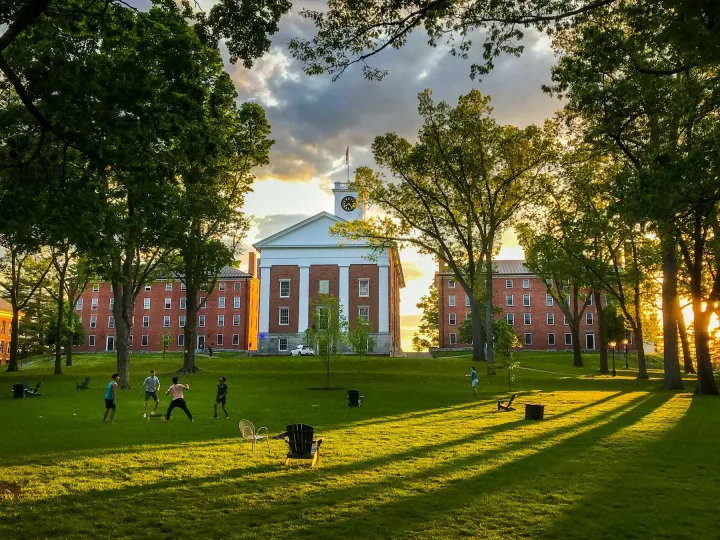
Amherst College likes to present itself as a place where, insulated from the real world, its carefully handpicked group of diverse students can learn among the best and brightest. The first representation you see of the college when you open its front page is a series of very pretty drone videos of Amherst’s pristine campus. That same front page touts how Amherst students are “curious about people, places, and everything else.” The college’s press release for the Class of 2029 boasts that it received 15,819 applications and admitted just 1,222 students — 44 percent of whom were domestic students of color. The college’s website and press releases are designed to sell an image of Amherst, or more precisely, the image of itself that the college is trying to present: pretty views, socioeconomic diversity, and deep intellectual discussions on the First-Year Quad.
However, something feels off to me about Amherst. I am talking about, as a hypothetical, the political science class discussing gun control where seemingly everyone agrees with each other. In our perfect little seminar rooms, this highly contentious issue appears straightforward. I am also talking about the fear that something we do will be picked up on Fizz and then used to shame us anonymously for violating the campus orthodoxy. Why, with so much diversity on paper, does Amherst feel like a homogenous bubble so utterly detached from the real world at times? I propose that Amherst’s very structure as a highly selective, residential college is the root cause of its homogeneity. Not only does Amherst solely select for a particular type of student, but, more nefariously, the college is designed to keep out of sight from us anyone who does not fit the mold of an “Amherst student.”
Let’s begin by looking at Amherst’s admissions. For the Class of 2029, Amherst rejected around 93% of its applicants. Amherst and peer institutions disproportionately draw their student bodies from a few feeder schools whose student bodies tend to be white and wealthy. And, even the low-income students fall into a phenomenon that sociologist Anthony Abraham Jack ’07 refers to as the “privileged poor”: first-generation/low-income students with enough cultural capital to succeed in places like Amherst by receiving full scholarships to and attending elite private high schools. On a fundamental level, earning the grades and standardized test scores that Amherst requires for admission necessitates that a prospective student be a particular type of learner. This person is someone who can sit at a desk for long periods of time, learn by reading, obey authority figures without fail, and manage any learning disabilities they might have.
Of course, this does not describe most people. Instead, what we’re left with at Amherst is a very specific type of learner: motivated by professional success, well-spoken, and conventional in a way that would fit well in The New Yorker. Let me paint a more specific portrait. Maybe they attended a well-funded public school in a suburb of New York City or Boston, or maybe they went to a private school, either on scholarship or by paying expensive tuition. These schools’ cultures heavily parallel that of Amherst’s. Their letters of recommendation describe them as “good kids” who were curious, well-spoken, academically successful, and friendly. They might be low-income or not, but the fundamental characteristics remain the same: They made it to the top of the American educational hierarchy by obeying the rules of the game. And to even play the game requires privilege.
There are a million ways I could discuss the privilege needed to come to Amherst, but I will focus on one most people do not usually think about: the ability to even physically get there. For the 86% of Amherst students who hail from outside Massachusetts, coming to Amherst requires a substantial amount of effort and change for one and one’s family. This is not possible for every high schooler in this country. I myself come from a community of South Asian immigrants on Long Island, where it is somewhat rare for people to attend college out of state. In the immigrant circles I’m familiar with, families typically place a significant emphasis on keeping family members physically together rather than sending students away for college. This is because we immigrant families rely on each other and the ethnic social networks that provide care, protection, and community in a foreign country.
Of my home friends, I am one of few who left Long Island for college. Until I was accepted into Amherst off the waitlist seemingly at random and received a generous financial aid package, I thought my college experience would consist of me commuting to Fordham University and back every day on the Long Island Rail Road and Metro-North. Reflecting on my own background makes me realize that Amherst selects for a very specific type of student: one whose family prioritizes education and is willing and able to send their child far away to college, despite the financial and emotional costs. This skews Amherst’s student body away from students with backgrounds like those of my home friends.
Now, my problem is not that Amherst selects for a very specific type of person; a lot of the circumstances that lead to this are completely out of Amherst’s control. The problem, though, lies in Amherst’s structural design that keeps us from interacting with anyone who does not fit this mold.
Let’s look at the college’s fundamental characteristics: Around 97% of students live on campus. We eat most of our meals at Valentine Dining Hall, which is primarily used by Amherst students, faculty, and staff. Our meals are made for us by Valentine employees that most of us students will never see. Then we have the First-Year Quad, which is designed to facilitate interaction and connection-building among first-years. In fact, the entire campus is laid out so that you could theoretically spend a whole semester without ever physically leaving campus. This insulates us students from the town community because it turns the town into a luxury accessory to be enjoyed by students, rather than being an essential part of Amherst College.
These measures have a noble goal: if you take care of students’ immediate needs — food and housing — and put them together in physical proximity for four years, then you can build a tight-knit community dedicated to learning. But these are the same measures that separate us, both metaphorically and physically, from those who aren’t like us. Olivia Tennant ’27 made this fact jarringly clear when she described the feeling after you splash the Val employee behind the utensil chutes: “You might feel a flicker of guilt for a moment, but the second you step out that skinny hallway ... it fades.”
I reflected on how Amherst insulates us students from those outside the college last spring when, for a class, I conducted a research project on East Gables — the housing development right by the Softball Fields. Many of its residents are formerly homeless. East Gables’ plans discussed bringing in tutors and volunteers from Amherst College to interact with residents. I received the same message when I interviewed East Gables’ former resident services coordinator, Kiara Stevenson, that they want Amherst students to interact with residents. According to her, though, Amherst students have not come to East Gables. Amherst does not explicitly prevent students from interacting with community members like those in East Gables. However, through its infrastructure, layout, and very structure as a highly selective residential college, the college very much disincentivises these interactions. The people the college deems as valuable sources to learn from, like the students and professors, are all already on campus.
My point is that Amherst’s insularity and homogeneity risk turning us Amherst students into a “hollow elite” whose education leaves us without the humility and empathy to serve those unlike us. For instance, Amherst risks creating alumni who, as a hypothetical, could eloquently use feminist theory to argue the importance of protecting abortion access for low-income women while also not understanding why those same low-income women might support pro-life policies. Incidentally, the college, in part due to this same insularity and homogeneity, is also quite good at training students to belong in the corridors of power. It only takes one glance at the alumni directory to confirm this. The institutions that alumni of Amherst and peer institutions lead, like Wall Street banks and government agencies, risk becoming out of touch with the needs of ordinary people. We are already seeing this play out with the rise of a populist strand of politics, whose proponents — led by President Donald Trump — heavily distrust institutions like Amherst.
So, what am I advocating for? I’m not saying that Amherst should become an open-admissions institution or radically change its structure. However, the institution can and should do more to build connections between the student body and the local community. These past few years, Amherst College’s relationship with the town has been tenuous and largely based on a narrow, self-interested vision, as evidenced by the opposition from several faculty members to East Gables’ construction in 2019. To its credit, though, Amherst College has taken steps to improve relationships with the town, such as its $2.5 million donation to the Town of Amherst last February, and by establishing the Center for Community Engagement (CCE).
Amherst as an institution and we as students should move forward by forming partnerships with the local community, the staff members at Valentine Hall, and local residents. Furthermore, we should treat community members as equals to learn alongside and from, instead of as objects to be improved by the supposedly superior Amherst College student body. Cultivating these partnerships and this culture of mutual respect would both be immensely beneficial to the local community. It would make Amherst College’s local resources more equitably distributed and enable us Amherst students to develop empathy and humility.
The Association of Amherst Students (AAS), via its ability to fund and conduct long-term projects, is a great starting point for us students to develop connections between the college and the broader community, and I hope to help with this work on the AAS during my last three semesters at Amherst. We students can begin to be part of positive change right now by signing up to take more community-based classes. The two community-based classes I’ve taken thus far — “Justice,” in which I worked alongside incarcerated students at the Hampshire County Correctional Facility, and “Reading/Writing/Teaching,” in which I tutored adults at Holyoke once a week — showed me that there are all sorts of valid and interesting ways of viewing the world outside of what is valued in Amherst’s classrooms. Ultimately, we students should not despair in the face of the college’s structural issues; rather, we should view Amherst as a tremendous home base to learn both in class and from the world around us, perhaps starting in our very own town.


Comments ()