

Presidential Scholar Talks Changing Political Landscape
Last Wednesday, Pulitzer Prize-winning historian, journalist, commentator, and Presidential Scholar Anne Applebaum discussed her two latest books, “Twilight of Democracy” and “Autocracy, Inc,” amidst the changing political landscape in the U.S. and globally, democratic backsliding, and autocracies.
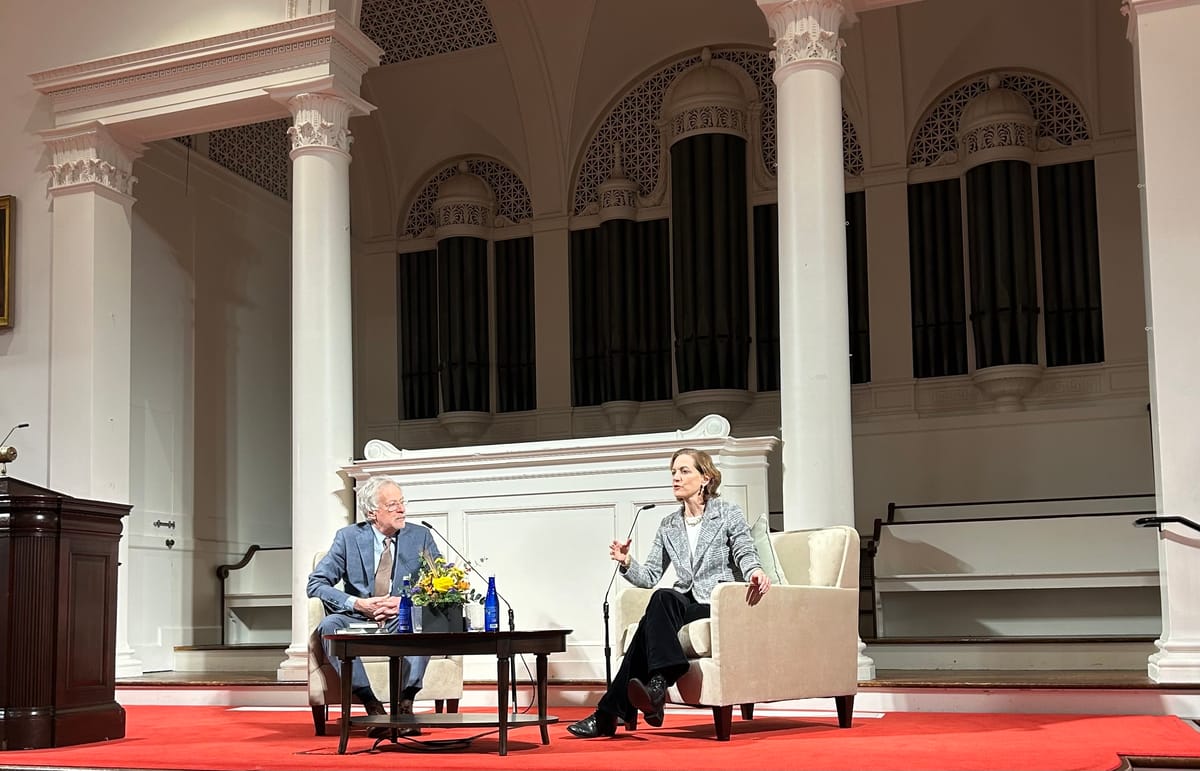
Last Wednesday, Pulitzer Prize-winning historian, journalist, commentator, and Presidential Scholar Anne Applebaum discussed her two most recent books — “Twilight of Democracy” and “Autocracy, Inc.” — and how they related to both democratic backsliding in the United States and established autocracies worldwide. James J. Grosfield Professor of Law, Jurisprudence and Social Thought Lawrence Douglas moderated the talk, followed by a Q&A session with the audience.
Applebaum identified a pattern of radicalization that she believed had emerged in all three places she has lived in: Poland, England, and the U.S. About 15 years after the Cold War, the center-right politicians she knew split in two directions. One side hoped to reunite Europe and rebuild, while the other “really missed being culture warriors, and they missed the sort of drama of the fall of communism,” she said.
As such, “by 2015 in Poland, by 2016 with the Brexit debate in England and obviously, with the rise of [President] Donald Trump, there [were] a lot of people latching themselves on to what they saw as a new kind of politics,” Applebaum said.
She said that before Trump, the U.S. “didn’t live up to our ideals … but nevertheless, to the outside world, even to the autocratic states, we stood for a certain kind of aspiration.” Now, however, Applebaum felt that “we suddenly seem so willing to undermine all of those things.”
One particular impact that Applebaum highlighted was the recent freezing of funds for the U.S. Agency for International Development (USAID). She described USAID as “a source of influence and soft power, a source of attraction [to the] United States.” The agency was an example of the “ways in which we try to transmit our ideas and our values.”.
Applebaum visited Sudan twice this year and found its citizens confused by the lack of aid. “They asked, ‘Where are the Americans?’” she said. Amid the current civil war, the Sudanese people were desperate for support from the U.S. or the United Nations. Applebaum said that it was hard to explain to them that foreign policy was not a priority of the current administration.
Applebaum highlighted the “kleptocratic” nature of the current administration. She explained that while there had been democratic backsliding in American history, the administration’s efforts to enrich themselves using American policy had never been seen before. Applebaum cited that the Qatari government gifted Trump a private plane in exchange for technology sales.
She compared Trump’s actions to those of autocratic leaders, including Russian President Vladimir Putin and Chinese President Xi Jinping. Applebaum argued that, while 20th-century dictators had been rooted in ideology, 21st-century dictators prioritize accumulating wealth. “These links between autocratic countries [are] based not on ideology. They’re based on a common set of interests, very often, financial interests,” she said.
Despite many signs of global democratic backsliding, Applebaum concluded her talk on a hopeful note by saying that political reconciliation amid threats to democracy is possible. When Poland was trending towards a dictatorship in 2023, “a very broad coalition, ranging from people who were quite far left to people who were quite far right … fought back, and they won an election,” she said.
She added that people worried about democratic decline should resist according to their skill sets. “I think the way to think about pushing back is to think about what [it is] that your particular situation allows you to do,” Applebaum said.
The audience’s reception of the talk was positive. Taylor Hoganson ’29 appreciated Applebaum’s response when asked whether it is actually possible to politically reconcile people. “Her goal with that is not political camaraderie,” he explained. “It is just these ... very politically disparate people [who] would agree around the idea of 'We still want a democracy?' and then sort out the politics later.”

Comments ()