

Professors Host Teach-In Amid Minneapolis Unrest
A professor-led discussion was held on Thursday, aiming to detail the political and social ramifications of ongoing ICE activity in Minneapolis. Students heard from six professors, who detailed their personal and critical reflections on the situation.
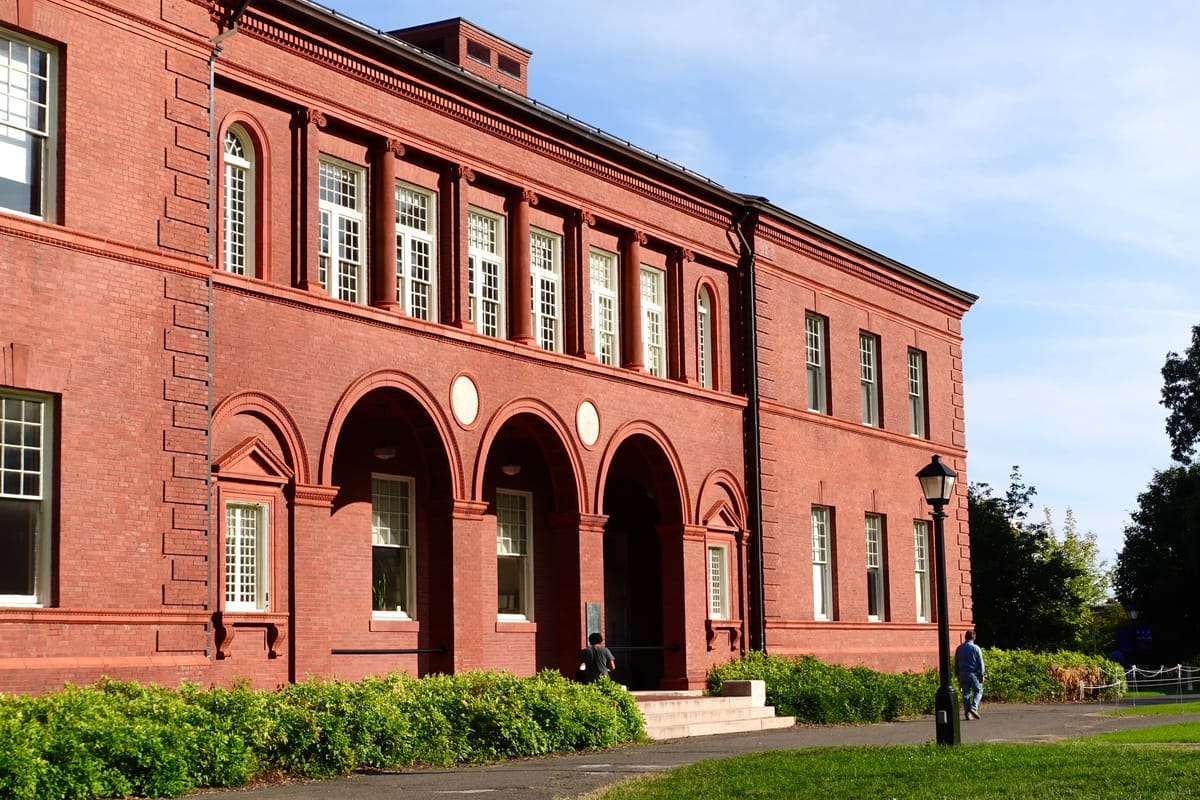
On Thursday, six Amherst College professors hosted a discussion on recent Immigration and Customs Enforcement (ICE) activity in Minneapolis in Pruyne Lecture Hall.
During the first week of classes, students received an email from the President’s Office on Tuesday, urging them to attend the event. Despite the impromptu nature of the teach-in, Pruyne Lecture Hall was at capacity, with some students having to sit on the floor or on the staircase. Professors leading the discussion hoped to “make sense” of this moment in American history and elucidate its impacts on the college community.
Assistant Professor of Geology Nick Holschuh, who grew up in Minnesota and spent part of January in the Twin Cities with his parents and brothers, opened the discussion by sharing his personal ties to the city. Over the last month, Holschuh has connected with friends and family in Minnesota to clearly understand what is happening on the ground.
Holschuh described the scene in Minneapolis, stating that sometime in January, the Department of Homeland Security (DHS) transitioned from operating targeted investigations to a “dragnet.” ICE agents began a randomized investigation process, stopping and searching primarily people of color in public settings where they are the most vulnerable. Holschuh gravely pointed out that 20-40% of students in school districts with widespread federal activity are absent from classes.
“My eight-year-old nephew’s school has prevented them from going outside during recess, out of fear that confrontation between ICE agents and students would lead to children being harmed,” Holschuh shared.
William H. Hastie ’25 Professor of Political Science Thomas Dumm spoke next. Dumm anchored his reflections in the theories of political behavior presented by Michel Foucault — a revered French philosopher, historian, writer, political activist, and literary critic. Dumm emphasized one of Foucault’s concerns: that a rare strain of fascism has ingrained itself into our souls.
Dumm asked, “How does one keep from being a fascist when one believes himself to be a democrat? How do we fare against the fascism that is ingrained in our behavior?”
To answer these questions, Dumm highlighted that ordinary activities under violent repression are a non-fascist way of resisting in this state: by networking horizontally to organize, report, and alert others about activity surrounding ICE. A “retained humanity” may be the guiding light amidst the chaos. He lastly assured that Amherst College has an “exemplary” model for what the institution will do when, and if, ICE reaches our campus.
Pawan Dhingra —the vice president for equity and inclusion and professor of Asian American and Pacific Islander studies, American studies, and education studies — took the floor next. Dhingra quickly asserted that the DHS’s tactics “make sense,” tracing their formation back to the Sept. 11, 2001 attacks. He claimed that the national tragedy led policymakers in the Bush administration to associate immigrants not just with criminality, but with a terrorist threat. This set the stage for the systemic refusal of asylum applicants, detentions, and unjust refoulement. Dhingra emphasized that part of these policies’ intent is to create fear, reiterating the immoral logic behind the Trump administration’s immigration agenda.
“Under this framework, protestors against ICE are domestic terrorists. [This is a] logical extension of a government system they have already put in place,” he said.
Dhingra passed the mic to Leah Schmalzbauer, associate provost and associate dean of the faculty. Schmalzbauer, a proud Minnesotan and immigration scholar, decided to tackle the question, ‘Why Minnesota?’ In the 1970s, the twin cities intentionally established themselves as a welcoming center for refugees fleeing the Vietnam War. State resettlement policies and non-profit efforts helped immigrants start businesses and supported local immigration organizations. Schmalzbauer emphasized that these efforts reflect the cities’ “ethos.”
“[The cities’ commitments] are a part of a larger commitment to build and strengthen community. Neighbors know each other. Communities know each other,” she said.
Assistant Professor of Philosophy Lauren Leydon-Hardy spoke next about the dangers of modern-day propaganda. Instead of conceptualizing propaganda as a tool to influence our ideas and behavior, we should view it as a mechanism to depoliticize and desocialize us. Hardy warned that propaganda effectively compels Americans to retreat to their safe spaces and echo chambers out of fear and exhaustion, stifling our sense of community.
“[Propaganda] can make you complicit and lead you to become a part of the political infrastructure that’s oppressing you,” Hardy said. She went on to explain the dangerous effects of the assumption that someone can be inwardly free, but outwardly unfree.
Lastly, William Nelson Cromwell Professor of Jurisprudence and Political Science Austin Sarat began his section of the teach-in by reading out the names of eight victims who were murdered by ICE agents in 2026.
“I am terrified. If you are not, you should be. I have faith. If you do not, you should. Why should you be terrified? Because you have committed yourself to a project [that] is deeply dangerous, and that is the project of thinking. You are on the enemy’s list,” Sarat said.
Sarat reiterated the need for civilians to keep one eye on Minneapolis and another eye on the future of this country. He referenced a New York Times interview with President Donald Trump on Venezuela. When asked if he has limits to his global powers, Trump responded by saying, “One thing: my own morality.” Sarat enthusiastically urged students to participate in the “ICE Out” protest on Friday at 3 p.m.
“Without faith, fear leads to paralysis. Be afraid, but don’t lose faith,” he said.
Some students had mixed reactions to Sarat’s call to action. Parker Smith ’27 opened up about his response to Sarat’s urge for students to “be afraid.”
“I am still reflecting on the call by some to ‘be afraid.’ I agree that if fear mixed with faith motivates people to act, then we should be afraid. However, often fear is paralyzing, and today cynicism has a very strong pull,” Smith said.
As a Minnesotan woman of color, Ayres Warren ’26 interprets what activism means to those with similar identities.
“To other Black women and women of color, I would say that protest is not the only radical act you can take. I have felt fatigued, taken my space, and redirected my energy to what I am passionate about, taking action there,” Warren said.
Warren went on to point out that political violence and civil unrest should incentivize community, rather than pressure historically prejudiced minorities to put themselves in a vulnerable position for the sake of protest.
“In the identity politics of it all, some people may be more easily predisposed to see in [to] the cracks in the system, but the onus doesn’t fall solely on them to analyze, educate, and solve it, even if that is the historical precedent. It has to be intersectional,” she said.
Correction, Feb. 4, 2026: A previous version of this article misstated that Holschuch grew up in Minneapolis. While he is from Minnesota, he has never lived in the city.

Comments ()