

Quick Questions: What’s Happening in the East Lot?
In this edition of Quick Questions, Managing Features Editor Ava Nair ’28 answers what’s behind the parking disruptions in the East Lot and why construction has taken over much of the space this year.
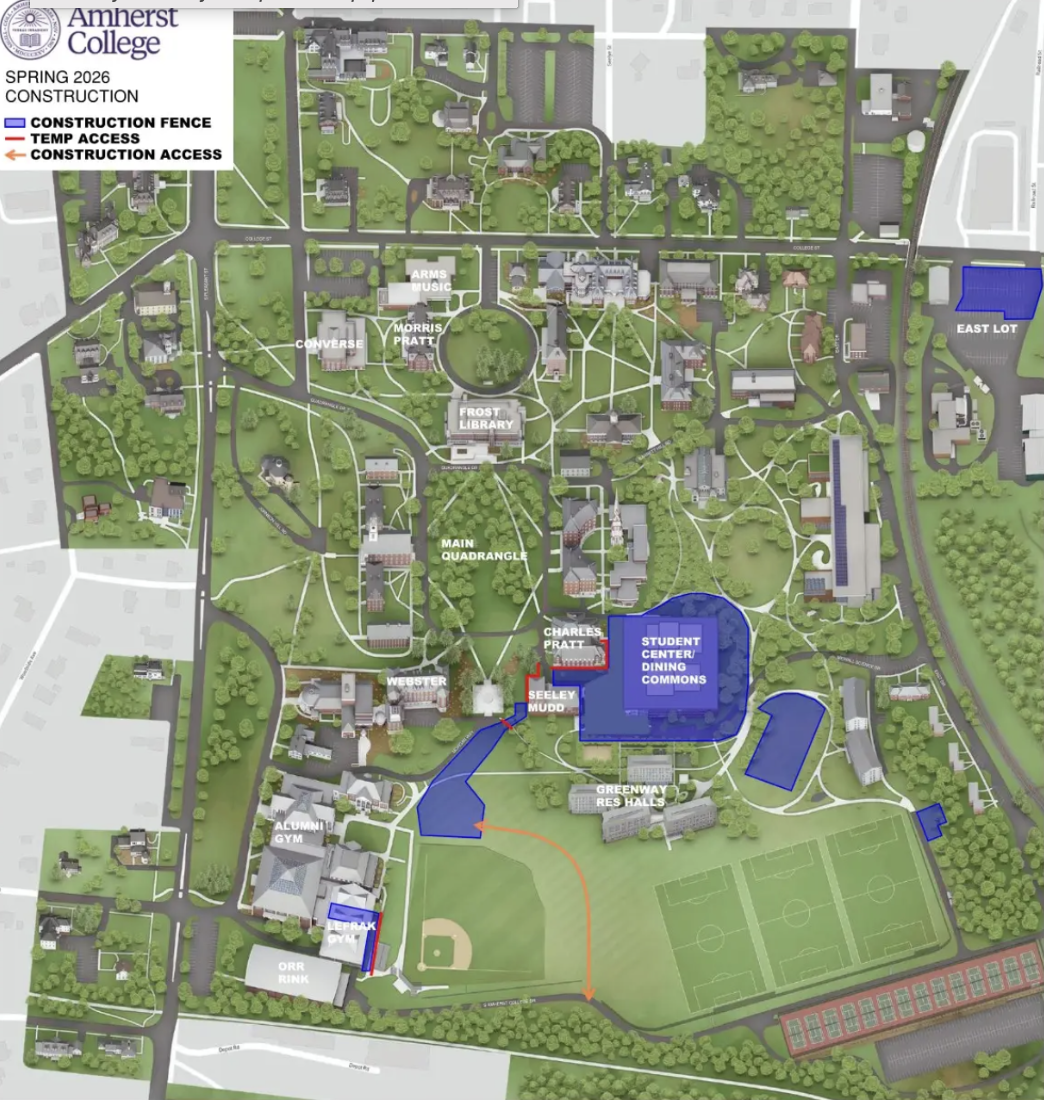
For much of this school year, the East Parking Lot (East Lot) has looked less like a student parking area and more like a construction site. Fencing, equipment, and shifting painted lines gradually reduced the number of available spaces, as campuswide emails warned students of phased closures and temporary relocations. As work continued through fall and into winter break, many wondered what exactly was being built.
Campus notices sent through email during the 2024–25 academic year warned students of phased closures and capacity reductions in the East Lot. At one point, the lot’s capacity was reduced to 60 spaces. A Dec. 2025 notification stated that parking would temporarily shift from the north side of the lot to the south side after a brief period when the entire lot was inaccessible, with that full closure ending Jan. 21.
Prior to the 2025-26 school year, students were encouraged to consider not bringing vehicles to campus, and parking regulations in faculty and staff lots were strictly enforced as alternative student parking areas absorbed demand. The East Lot reconstruction consists of two related but distinct projects: The completion of a new centralized food preparation facility and the continued installation of geothermal infrastructure as part of Amherst’s Climate Action Plan.
The first project, known as the Cold Prep Kitchen, was completed over winter break. In an email to The Student, Associate Vice President for Planning, Design, and Construction Tom Davies clarified that the facility will serve as a centralized prep kitchen for campus dining.
“Bulk deliveries are received at this location and efficiently processed and stored for use at our dining commons, catering kitchen, and multiple retail operations,” Davies said.
Rather than constructing a brand new building for this project, the college converted an existing storage structure to meet the need for more prep and storage space. Davies said this approach reduced costs and allowed the project to be operational sooner. The centralized model is intended to streamline procurement and preparation, reduce the number of large delivery trucks traveling through the campus’s pedestrian-heavy areas, and support expanded sourcing from local farms and suppliers.
The facility also connects to Amherst’s new ground-source heat pump network, a key component of the Climate Action Plan. “These freezers and refrigerators actually provide useful heat as a byproduct of operation that will be used for heating buildings and water on campus,” Davies said. In this system, energy generated by refrigeration is not wasted but instead captured and redistributed through the campus heating network.
The Cold Prep Kitchen is not the only project occupying the East Lot. Davies confirmed that construction currently underway in the lot relates to the installation of the Climate Action Plan’s geothermal bore field. A geothermal bore field consists of a network of deep underground wells that allow buildings to exchange heat with the earth, forming the backbone of a campus-wide heating and cooling system designed to reduce reliance on fossil fuels. “That will be completed this summer, and the full East Lot will be available prior to the fall semester,” Davies noted.
When complete, the geothermal infrastructure will contribute to the college’s broader transition away from fossil fuels, supporting campus heating and cooling systems across multiple buildings. Davies says the bore field installation will conclude this summer, restoring the East Lot to full capacity before the start of the fall semester.

Comments ()