

Results from The Student’s First-Year Survey
In this year’s installment of The Student’s First-Year Survey, Managing Features Editor Mira Wilde ’28, Assistant Features Editor Ava Nair ’28, and Contributing Writer Mark Anthony ’29 explore the backgrounds, values, and outlooks of Amherst’s newest class.
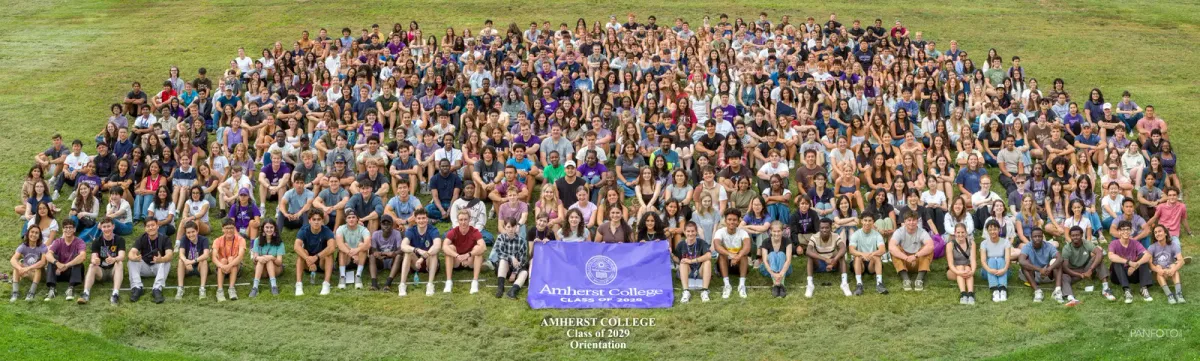
The newest Mammoths on campus, the class of 2029, bring with them a wide range of stories, ambitions, and perspectives from across the country and world. Who are these students? What do they believe in? What are their experiences? How do they see their future unfolding at Amherst? To find out, The Student surveyed the class of 2029 on everything from study habits to political values to social life.
Method
The Student’s first-year survey was distributed online to the class of 2029 in early October. 181 students responded, representing approximately 37% of the class. Response rates varied slightly by question, and certain groups (notably women and Northeast students) were overrepresented, so results should be read as a lively snapshot rather than a census. Still, the numbers, however approximate, paint a portrait of a class that feels both familiar and new: driven, self-aware, idealistic, and more anxious about the future than their predecessors, but still … unmistakably ready for the next four years.
Where They’re From
The class of 2029 represents a broad mix of regions and hometown environments. Just over half of the 181 respondents (52%) reported growing up in suburban areas, while 34% came from urban settings and 14% from rural communities.
Geographically, the Northeast remains the most common point of origin, home to about 45% of respondents. The West (16%), Midwest (13%), and Southeast (12%) followed, with the Southwest (5%) rounding out the group. Roughly 10% of students reported growing up outside the United States, maintaining Amherst’s steady international presence.
Together, these figures reflect a class that is regionally diverse but still concentrated in the country’s northeastern corridor — a distribution consistent with Amherst’s historical applicant trends.
How They Got Here
Educational backgrounds of Amherst students vary widely. Around 50% of respondents attended non-magnet, non-charter public schools, and private school graduates made up roughly 45% of the class, including 14% from boarding schools, while 2% reported being homeschooled.
Although Amherst has remained test-optional since 2020, standardized testing appears to have stayed a near-universal step in the application process for the class of 2029. Nearly 70% of respondents reported taking the SAT or ACT more than once, and one in 10 even took the exams four or more times. Only 4% never sat for them at all. That sense of preparation often extended beyond the classroom: Approximately 40% of respondents worked with a private SAT or ACT tutor or admissions counselor, while 60% did not.
However, academic achievement was a clear common denominator. One in five respondents reported being valedictorian of their high school, reflecting a high-achieving applicant pool.
What They Believe
Politically, Amherst remains reliably left-leaning. Nearly 80% of students identified as very or somewhat liberal, with 10% identifying as moderate and just 9% as conservative. If the 2024 presidential election were held on campus, Kamala Harris would have received roughly 78% of the vote (compared to receiving 87% of the class of 2028’s votes), President Donald Trump would have received 5% (compared to 4% from last year), and 17% for third-party or write-in candidates (an increase from last year's 7%).
Their media diets reflect a mix of both traditional and social media sources: about 40% consume news daily, another 36% do so every few days, and 22% only when major events occur. The New York Times remains the most frequently named outlet, while social media, especially Instagram, ranks as the second most common news source.
When asked to reflect on more abstract questions, the class of 2029 struck a nuanced tone.
In response to the prompt “everything will be explained by science,” nearly half either agreed or strongly agreed, a quarter disagreed, and a quarter remained neutral — a gentle reminder that faith in empiricism still contends with skepticism.
When asked whether they felt optimistic about the future, 44% agreed, 28% disagreed, and 28% described themselves as neutral.
When asked whether it mattered that they earned more money than their peers, responses were nearly evenly divided, with neutrality (34%) narrowly winning over disagreement (33%).
Social activism, though, remains a defining value: over 70% said it is important to them, while only 6% disagreed.
In short: the class of 2029 seems pragmatic, socially aware, and hopeful … even if cautiously so.
How They Live
We also asked students about their social aspirations and habits. Around 80% said they plan to or have already attended parties at Amherst. Participation is nearly universal among athletes, but also high among non-athletes — as roughly 77% of non-athletes said that they intend to go out.
On academic honesty, 42% admitted to having cheated on an assignment or exam at least once. Whether the definition of “cheating” includes ChatGPT is another question — but when asked directly, two-thirds said they never or almost never use generative AI for schoolwork; 26% use it “sometimes,” and 6% responded “often” or “very often.”
As for their less academic endeavors, about 60% reported having consumed alcohol, 29% marijuana, 17% vaping or cigarettes, 10% using a fake ID, and three percent having tried harder drugs. Those figures are broadly similar to last year’s — and, perhaps reassuringly, suggest that the newest Mammoths’ wild sides remain comfortably under control.
What Keeps Them Up at Night
When asked about their biggest worries upon entering Amherst, 42% named academics as their top concern. Social life (29%) followed, then financial pressure (11%) and being away from home (10%). Still, overall survey-takers were extremely excited about the prospect of Amherst. Nearly 90% said they felt eager to start college, including 53% who “strongly agree.”

Comments ()