

Revisiting Shakespeare: “As You Like It”
For this week's Revisiting Shakespeare, Editor-in-Chief Edwyn Choi ’27 discusses the comedy “As You Like It.” In this article, Choi dives into the absurdities and playfulness of the plot and also notes its lasting relevance in the academic and legal worlds.
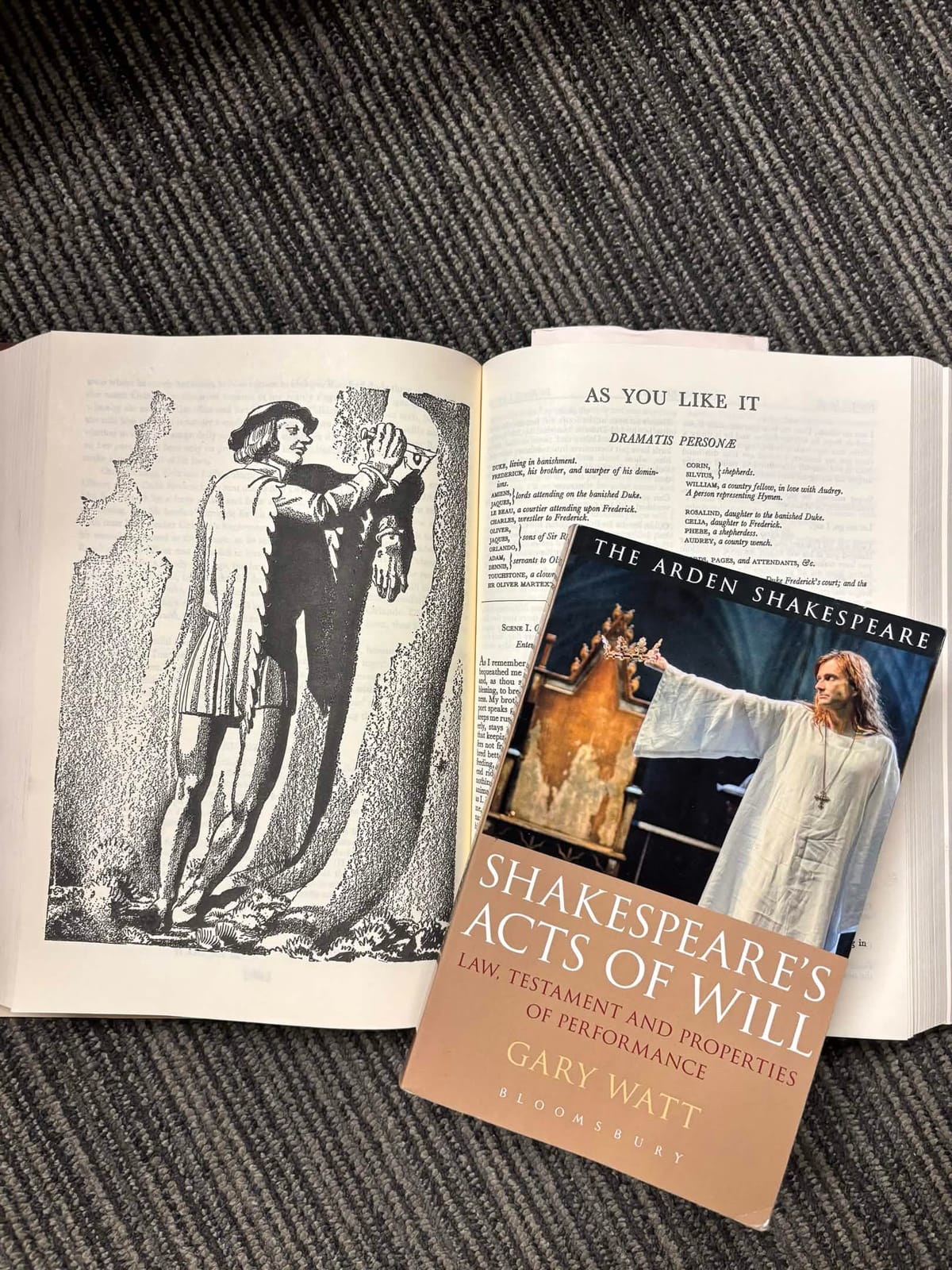
“As You Like It” technically counts as this series’ first “real” comedy. The previously reviewed comedies, “Measure for Measure” and “The Merchant of Venice,” are oftentimes categorized as problem plays because of their inability to be easily placed into one genre. If we’re grossly oversimplifying things: too dark for a comedy, yet too lighthearted for a tragedy.
For “As You Like It,” however, there’s no doubt that this play is a comedy: There’s (spoiler alert) a marriage at the end, crossdressing, and a lot of movement between two different environments. In the case of “As You Like It,” there’s another label we have to add: This is not only a comedy, but a pastoral comedy at that. A pastoral comedy, in the simplest terms, is invested in representing the rural world through an idyllic, nostalgic, and picturesque lens — a romanticization of the life of a shepherd, to put it one way (the word “pastoral,” by the way, literally means “Of or relating to shepherds or their occupation”). This is often in contrast with the harmful and constricting lifestyle of the city.
It’s no coincidence, then, that “As You Like It” opens with someone complaining about the law, which is about the farthest thing from the romanticization of nature that I can think of. Here’s the first line of the play:
ORLANDO
“As I remember, Adam, it was upon this fashion bequeathed me by will but poor a thousand crowns, and, as thou sayst, charged my brother on his blessing to breed me well. And there begins my sadness. My brother Jaques he keeps at school, and report speaks goldenly of his profit” (1.1).
Translation: Orlando is owed some money according to his father’s will, but the executor, Oliver — who’s also Orlando’s older brother — isn’t giving Orlando what he’s owed.
Oliver, meanwhile, plans to have Orlando killed in a wrestling match so that he doesn’t have to give his younger brother his share of the inheritance. Orlando, however, wins the match; it is during this match that we first meet our protagonist, Rosalind, who sees Orlando wrestle (in a handsome and charismatic way, I guess?) and exclaims, “O excellent young man!” Orlando, who has also taken an interest in Rosalind, has an attraction for Rosalind so strong that his “ ... better parts / Are all thrown down, and that which here stands up / Is but a quintain, a mere lifeless block.”
Rosalind’s father, Duke Senior, has been usurped and exiled to the Forest of Arden by Duke Frederick before the start of the play. In addition to expelling her father, Duke Frederick suddenly banishes Rosalind, giving her no less than 10 days to leave the city. He’s particularly worried that Rosalind’s popularity might outshine that of his daughter, Celia, who is also Rosalind’s close friend: “[Rosalind] robs thee [Celia] of thy name, / And thou wilt show more bright and seem more virtuous / When she is gone.” Celia, however, loves Rosalind so much that she decides to escape with her: “Shall we be sundered? Shall we part, sweet girl? / No, let my father [Duke Frederick] seek another heir.” They decide to flee to the Forest of Arden together with their fool, Touchstone, where Duke Senior has been exiled. Rosalind assumes a male disguise, going by the name of Ganymede, while Celia assumes the name Aliena.
Meanwhile, Orlando has also decided to flee to the Forest of Arden after he’s told that Oliver is trying to kill him, yet again. From this point on, the rest of the play takes place in the Forest of Arden, where we’re introduced to several new characters and their romantic pairings. It’s in the Forest where we get the “All the World’s a Stage” soliloquy. But the important thing to note is that Rosalind-as-Ganymede begins controlling the various love affairs of all the characters we meet in the story, even if that means deceiving Orlando with her disguise and inadvertently entering a love triangle with a shepherdess who has fallen in love with Rosalind’s male disguise.
This play is pretty interesting, and there’s a lot to like about it — one person even told me this was Shakespeare’s best comedy. The one thing I’ve never personally understood as a modern reader, though, is Rosalind and Celia’s friendship — I don’t know if I could remain friends with someone if their dad decided to steal my dad’s job and also banish him to the woods. But maybe I’m just really petty.
To return a more thematically relevant point, there’s a reason why all these shenanigans happen in the Forest of all places. As I mentioned in the beginning, “As You Like It” celebrates the apparently simple lifestyle of the rural world and criticizes the frustratingly complex lifestyle of its urban counterpart. What’s striking is that the Forest of Arden (despite referencing an English territory) transcends borders: There’s no clear indication in the play as to what real country or region the Forest maps onto, which I read as a subtle reminder that the pastoral fantasy is just that: a fantasy.
Much scholarly discussion of “As You Like It” has thus focused on the Forest and the pastoral qualities associated with this play. Marjorie Garber’s chapter on the play in her 2004 Shakespeare companion, “Shakespeare After All,” provides extensive commentary on pastoral themes in the play. Todd A. Borlik’s essay, “‘Hast any Philosophy in Thee, Shepherd?’: Environmental Ethics and the Good Life in Renaissance Pastoral,” also provides an interesting treatment of the history and legacy of the pastoral genre.
If you’re having trouble understanding what exactly the pastoral should look or feel like, modern parallels include farming-heavy video games like “Stardew Valley” or “Minecraft,” and online trends like being a “tradwife” or having an “ancestral lifestyle” promoted by the likes of Liver King (okay, maybe he’s not the best example). These aren’t pastorals in the strict sense — nothing really fits perfectly into the pastoral comedy label nowadays — but what these trends share with the genre is that nature, in harmony with humans, can free us from the modern-day ailments we associate with cities.

Obviously, there’s more to “As You Like It” than just genre: Crossdressing plays a huge part in the play, which has opened the text up to a variety of queer interpretations and performances. Only men or boys were allowed to perform during Shakespeare’s time, so having a female character like Rosalind disguise herself as a man meant the actor was a boy dressed as a woman dressed as a man, potentially talking to other boys dressed as women dressed as men; there are levels to this sh*t. It’s no surprise that there’s a lot of commentary on gender in “As You Like It,” enough to warrant another article on its own, but a good place to start if you’re interested in diving deeper is Juliet Dusinberre’s introduction in the Arden Shakespeare Third Series edition of the play (which also borrows its name from this text).
To give credit where credit is due, I’ll note that some of these texts and frameworks have been borrowed from Associate Professor of English Anston Bosman’s class, “Shakespearean Publics,” which is being co-taught this semester with two other cohorts at George Washington University and the University of Delaware; the course uses “As You Like It” to draw connections between Shakespeare’s plays and the broader material ecosystem he worked in. We also get a free trip to the Folger Shakespeare Library’s ongoing performance of the play later this spring, which is open to the public.
Speaking of performances, the college has access to Digital Theatre+’s 2009 production and the Royal Shakespeare Company’s (RSC) 2019 production. The RSC is putting on another production of the play later this fall, starring Jonathan Groff, who you might’ve seen in the original “Hamilton” and David Fincher’s “Mindhunter.” On an offbeat note, I also can’t help but think of Richard Powers’ 2019 Pulitzer Prize-winning environmental fiction novel, “The Overstory,” for its attempt to reimagine human relationships with nature.
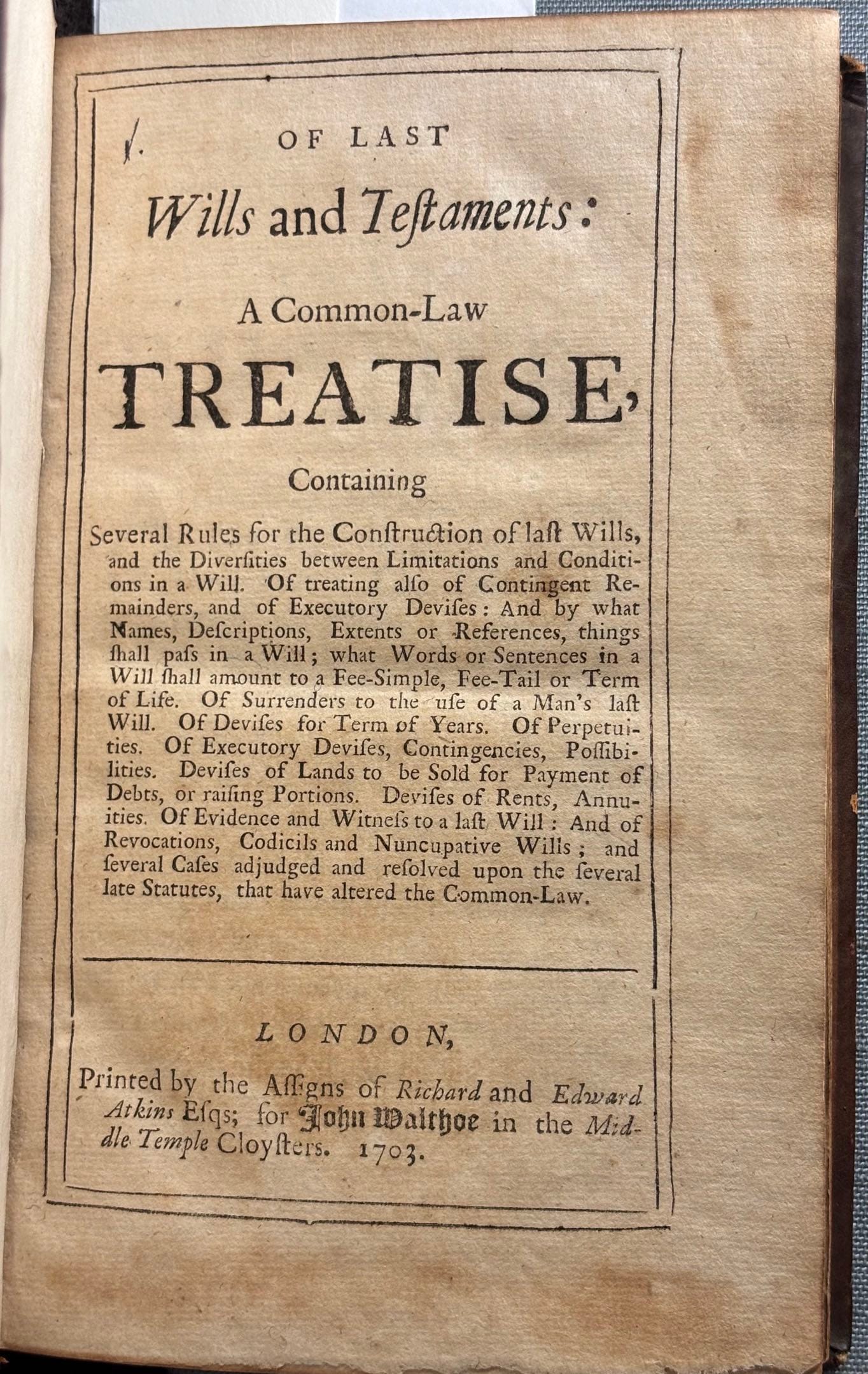
As a concluding note, I want to return to the play’s beginning: the invocation of the will. “As You Like It” is full of testamentary themes, as Gary Watt points out in his 2016 book “Shakespeare’s Acts of Will: Law, Testament, and Properties of Performance.” We can begin thinking of Shakespeare’s texts as a type of written testament. The actors become the executors, the audience the witness. We might say the testator is Will (no pun intended) Shakespeare himself, and that his dead hand physically controls the actors’ bodies in the same way a will allows a person to control their beneficiaries long after death.
I bring this framework to “As You Like It” specifically because Rosalind has a level of agency and fourth-wall breaking that is afforded to no other character across Shakespeare’s plays. At the end of the play, she steps out of the story and directly addresses the audience: “I am not furnished [dressed] like a beggar, therefore to beg will not become me.” She rejects the actor’s role of performing a character. She is neither executor nor witness. That leaves us with the role of the testator — Rosalind as a surrogate of Will Shakespeare himself. As Watt writes, “[Rosalind] has a testator’s quality of being simultaneously and absent in the world.” Her speech acts throughout the play thus assume a “world-making power,” or the power to control and create through language alone — similar to the written power a last testament has.
If we recall that Rosalind begins managing the love affairs of all the characters in the forest, we get a troubling implication: the exercise of free will we see in the Forest actually falls under the control of Rosalind-as-testator’s will. While contrived endings are commonplace for comedies, I get the sense that there’s something deeper about the artificiality of “As You Like It” than mere laughs. The play seems to insist that whatever free will we think we have might be an illusion.


Comments ()