

Storytelling the Physical World — Alumni Profile, Karen Fox ’91
From science journalism to children’s books to dating advice writing, Karen Fox ’91 continues to embody the virtues of a true liberal arts student in her pursuit of intellectual exploration and accessibility.
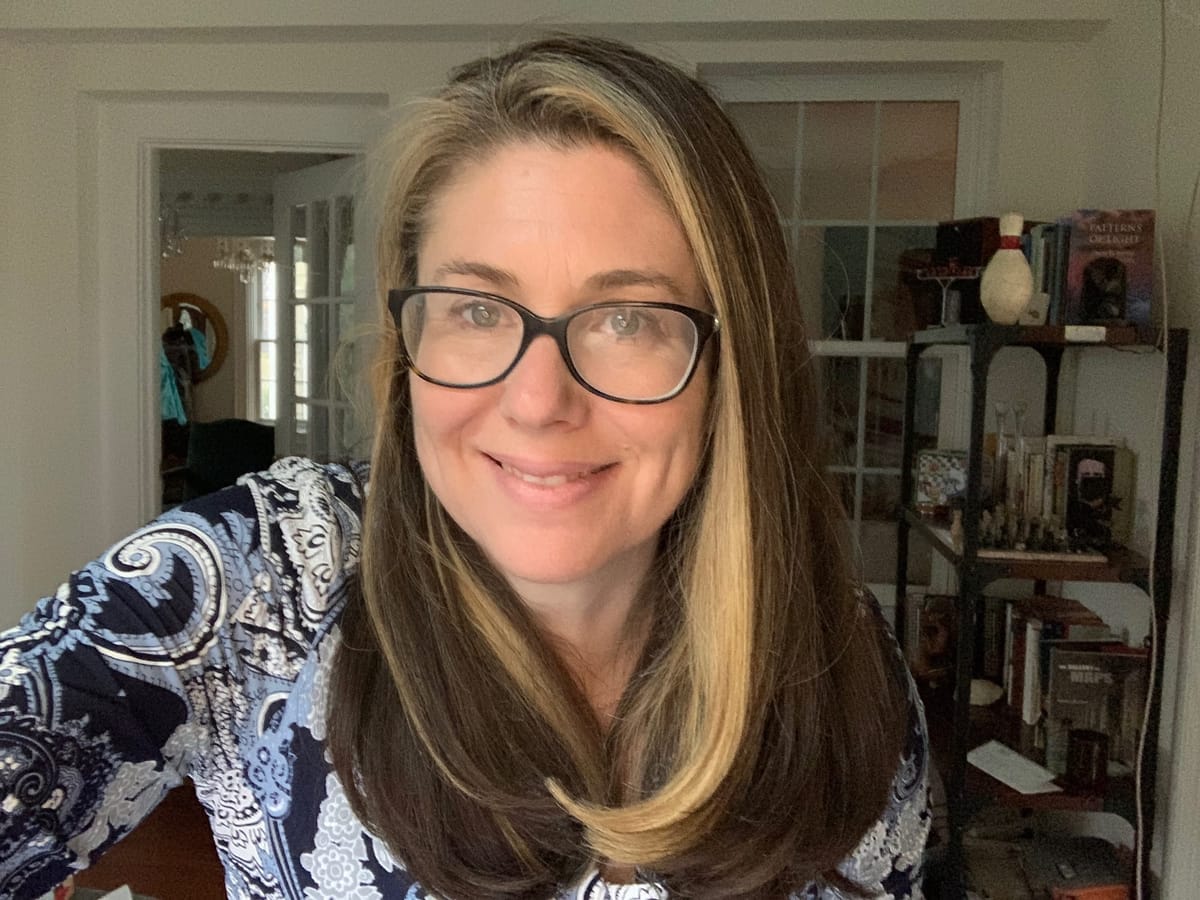
Karen Fox ’91 describes herself as a storyteller. “You’ve already witnessed that, right?” she asked me.
And I did, from the beginning. After we had a Zoom meeting time dysfunction, as a consolation, Fox emailed a funny story from an early radio show job where a scientist interviewee angrily called accusing her of missing their meeting, when, in reality, they had already conducted it the week prior.
When we got to speak, Fox explained this further to me: “I’ve always known that [trait] about myself, but I only recently realized the degree to which [storytelling] is its own skill set that not everybody has and the degree to which I use that to explain things.”
From her current role as senior science communications officer at NASA, to children’s science books, and even an online dating advice column, this passion for storytelling has been the common thread across Fox’s various careers.
A "Crystal Clear" Path
Fox, a Washington D.C. native and resident, has been, for as long as she can remember, a reader, writer, and problem solver. She recalled her favorite toy from childhood, for example, was a Capsela — a toy similar to LEGOs, “but with engines and batteries, so you could create moving machines.”
Despite growing up with a father who was a lawyer and a mother who was an artist, Fox explained that her passion for physics was always “crystal clear, and it has continued to be clear.”
Fox attended an academically rigorous high school where she studied physics and calculus early and developed a love for them both: “I knew I was good at math, and I knew I liked physics, [which I took in] ninth grade or 10th grade … I declared pretty early on that that’s what I wanted to study.”
While passionate about physics, Fox also always had a love for English. “I was always a reader. I was always a writer,” she said. “So one of the things I really valued about Amherst was that you could be a physics major, and manage to be an English major.” She declared physics by the end of her first year, and, when realizing she was going to complete the English major without even trying, she tacked that on as well. She told me, “In hindsight, I was always grooming myself for this career [in science writing], but I didn’t know that at the time.”
Fox loved her academics and also gravitated towards exploring areas outside of her majors. One of her favorites — which she described as “the ultimate liberal arts class” — was “Reimagining the Human in a Technological Age,” taught by a professor from the physics department and another from the art history department. In it, the students built mini cathedrals, fired clay pots, and even visited a medical school to look at dissected cadavers. Fox also loved a classics course called “Epic and Mock Epic,” where she got to read “The Odyssey,” the “The Iliad,” and Dante; she still thinks about their conversations and assignments to this day.
During her senior summer, Fox studied tidal movements at the Woods Hole Oceanographic Institution in Edgartown Harbor, Martha’s Vineyard, which she developed further writing her physics honors thesis on it.
While at Amherst, Fox’s social support system was important alongside her academics.
“Amherst was so formative.” She explained: “I absolutely miss living in a dorm with my close friends — what a luxury to be able to see everyone so easily, to socialize without having to make plans, to simply be in the orbit of the people you value.”
Fox fondly recalled Paula R. and David J. Avenius 1941 Professor of Physics David Hall, her close friend and classmate, who is now a physics professor at Amherst. “David helped get me through a lot of physics problem sets, and I will always be thankful,” Fox laughed.
Becoming the Dating Diva
After graduating from Amherst, choosing to follow both of her interests, Fox completed a graduate program in science communication at the University of California, Santa Cruz. Fox worked on the physics radio show Science Report at the American Institute of Physics. As a member of the National Association of Science Writers, she received her own free website, something unheard of at the time: “We’re talking old school website stuff. Really basic HTML coding.”
After experiencing a breakup during this time, she decided, with the power of this new platform, to write the “Karen Fox Dating Rules.” And so, the Dating Diva was born.
At the time, Fox was one of only two people with a website dedicated to dating. People started asking her for dating advice, eventually bringing her to the attention of AOL — one of the major email and information platforms — which offered her a job where she wrote essays on dating concerns and answered questions every other week in chat rooms where people would come seeking her help.
Fox explained that this job, although seemingly unrelated to her academic interests, enabled her to continue her passion for writing about science. “While [the AOL job] was not a living wage, it was enough of a regular income that, when I decided I wanted to go freelance … I had just enough coming in that I could augment with my science writing. I never stopped the science writing.”
Fox’s dating advice career, for various reasons, concluded soon after AOL was bought out by Oxygen Media in its early days. However, Fox said that she was okay when this position ended. “At a certain point, living your whole life in public — something that’s fun to do for a short while — [becomes] not as much fun,” she said. “You’re writing about your daily life, and at a certain point, you’re like, ‘I don’t want everybody to know about my daily life anymore.’”
Reaching for the Stars
Throughout her consistent career as a freelance science writer, Fox has always found her position as a communicator invaluable: “There’s something really lovely about [being] on the front lines,” she said. “To be the first person interviewing [and] to sit in the meetings and hear people talking about it — that’s pretty incredible.”
Fox has written for prominent science magazines, including Discover and Popular Mechanics, while also writing children’s books, such as “Older Than the Stars.” Fox explained that she loved writing for children because of their curiosity. “Every child wants to know,” she said. “They haven’t been told yet that science is hard. I actually find that to be a much easier audience [and] I believe very firmly that you can make something simpler without compromising fact or truth.”
Fox is often disappointed by how some scientists insist on unnecessary complexity in their writing, since this limits the accessibility of their findings. She believes “[writing] can be true and not quite as specific as you insist that it be.” Fox mentioned findings that writing in simple English versus ‘science-ese’ can increase the chance of approval by reviewers and general audiences. Despite this, she explains, “people still think ‘I have to sound erudite.’”
Fox credits her English coursework at Amherst with helping her to communicate scientific information in an accessible way. “I feel that I’ve been very lucky that I have a facility with the English language where I’m like, ‘No, look, this is the way people interpret what that says,’” Fox said.
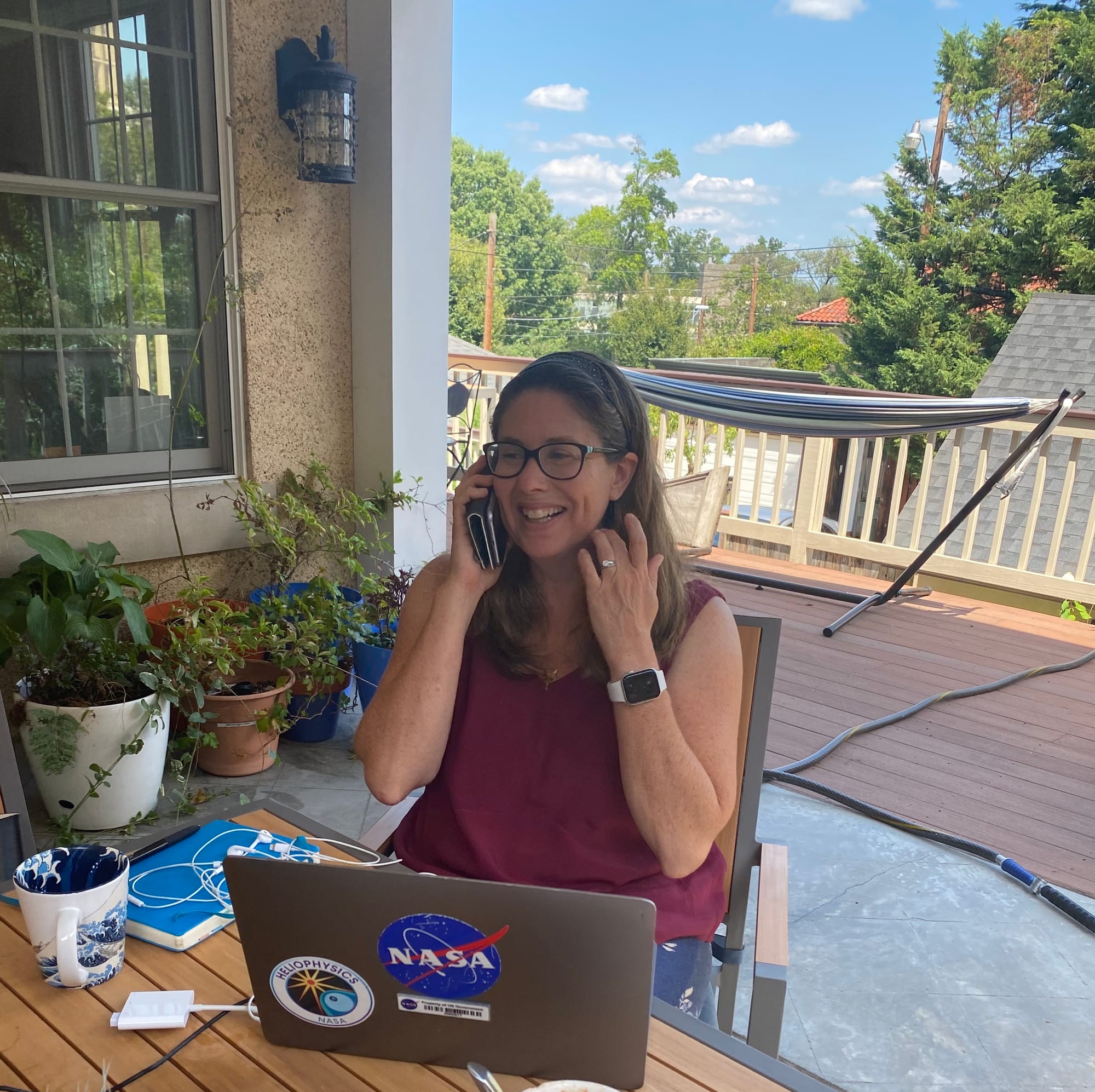
After freelance science writing for 12 years, Fox explained that her job at NASA in 2010 came somewhat fortuitously. Initially, the subject was quite new to her: “[Heliophysics] was a subject I didn’t know, but I spoke the language. I knew my physics. I knew how to write about it,” she said. With a one and three year old at home at the time, and both her and her husband looking for a new job, she reminisced “it was such a boon to land someplace where it was new information to me ... [as a family we were] trying to figure out what to do next. And here I landed at a job where I was interested but not overwhelmed ... it was very lucky.” Fox started writing for the Heliophysics Division, which studies the sun and “all the particles [it’s] spewing out,” called space weather, which affects our GPS and satellites. Heliophysics, according to Fox, is about plasma — the fifth state of matter — which is essentially “just charged particles moving crazily.” Heliophysics considers how those kinds of particles can trip onboard electronics on a satellite.
About five years later, Fox became the head of communications for the Heliophysics Division at NASA. Now, Fox is the senior science communications officer at NASA, overseeing communicators and media releases in everything from planetary science to her former department, Heliophysics. At NASA, the researchers’ main areas of focus relate to laying the groundwork for future trips to the Moon and Mars, searching for life (in fact, at a press conference a couple of months ago, they announced finding the best evidence that there may have been microbial life on Mars), and protecting humanity through learning about and mitigating disasters.
Recently, Fox had also been involved in communicating the Parker Solar Probe which went directly to the Sun’s atmosphere, the closest any human-made object has gone. “I got to go to the launch for that […] in 2018 [and] to watch its lifetime was fantastic,” she recalled.
Going Down Rabbit Holes
Outside of work, Fox is just as much of a Renaissance woman. “I crochet, I do origami, I garden, and I read and cook like crazy. I actually find myself having to reign it in quite a bit,” she said. Fox recalled that, throughout high school and college, her love for origami was twofold: a deep passion for the art as well as a fun way to destress. “I’d be like, ‘I can’t study for this test — I’m working on this eight-legged Scorpion,’” she laughed.
Fox’s hobbies are much indicative of her desire to explore new things, which is why she finds herself lucky to have found her career: “There [have been] times in my life [where] I’m like, ‘I’m going to do something else …’ And every time I have found another place within science writing that works [because] there’s such a breadth.”
And to be a journalist, to be a writer, she made a conscious choice: “It’s not that I didn’t want to know things well, but [that] I didn’t have to know them perfectly.” Fox found that “the journalism and writer’s career allows for that in a way that I think really works with my brain. And my hobbies and interests jumping all around, I think, reflect that.”
It is clear that intellectual and creative exploration which drew Fox to Amherst, are the very ideas she continues to embody in her professional and personal life. Fox advises students to be aware that, despite what you may hear or believe, there is great variety in jobs, careers, and opportunities for different interests. She noted: “It’s worth really going down rabbit holes to find associations and people who are doing work in the fields you are interested in and see what’s out there.”
As for aspiring writers, she assured “You’re a writer if you write. So write.”
Fox’s journey is a testament to the success one can find following curiosity and interests wherever they may take you.

Comments ()