

Student Squared: Narina Girotra ’29
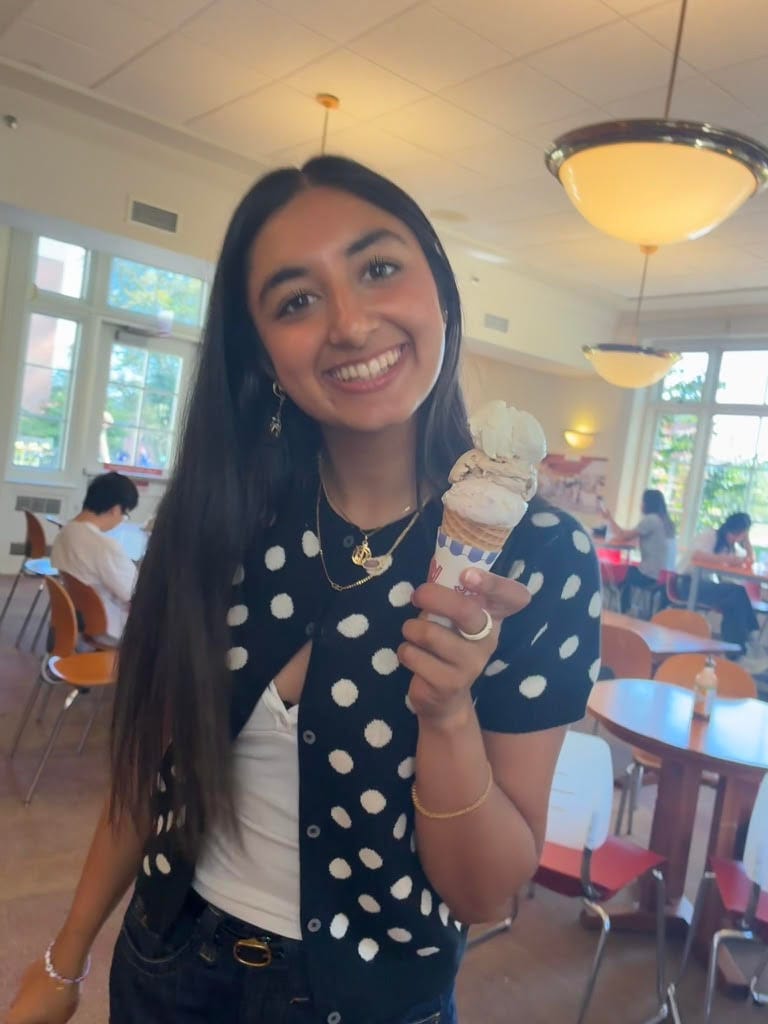
In this edition of Student Squared, Managing Features Editor Belaine Mamo ’27 speaks to Narina Girotra ’29 about home, extracurriculars, music recommendations, and reflections on her Amherst experience thus far.
Q: How is your freshman year going?
A: It’s been going really well. It’s been so nice to meet so many new people. Just to be in an environment full of people who are all really dedicated and really good at what they’re doing, and they’re the best at what they’re good at, is so cool. Also, I’ve always been in academic environments similar to this that are pretty intense, and everyone around me is always really driven, so it’s nice to have some sort of continuation of that environment because it makes me feel even more empowered to work harder and do my best.
Q: Tell me about where you’re from, where’s home?
A: I grew up in Hoboken, New Jersey. It is right across the Hudson River from New York City. I kind of grew up in a little bit of a bubble … with [a] small town type of feel. I went to a public middle school, and then I applied to and got into a few private high schools in New York City. I ultimately chose Trinity [School]. The commute from New Jersey to New York City wasn’t as hard as people say, but it was definitely a big part of my high school and growing-up experience. I had to become much more comfortable with big, bustling environments and a lot of things going on around me, which is kind of why coming here is a big change, because there’s not as much going on.
There’s such a strong community where I come from. Everyone, in Hoboken specifically, knows each other. [Growing up], I did a lot of work with the Hoboken City Council. I was a Girl Scout until my senior year of high school … Hoboken is just the type of community where everyone is so invested in the community and everybody understands how much and how hard the city council works. [It] makes people much more committed to giving back and fostering a strong community, which is really awesome.
I am [also] so lucky to have grown up in a place where my best friends are a five-minute walk away from me … It’s nice to come home and see my people and just remember where I’m from. I think that community has been such an important part of [my] growing up and being who I am.
Q: Do you think you found that same or similar kind of community here?
A: Definitely. And I think that was why I was looking at small liberal arts colleges from the get-go. I knew that being in a small academic environment and a small living community was super important to me … At home, I can’t walk out of my door without seeing my brother’s friend’s mom, or family friends who live close by. I think the type of community that we have [back home], of always running into people who know you, who care about you, and who are invested in your growth, is a type of environment that I see here at Amherst [College] as well. [Even] having places like [Valentine Dining Hall] is almost analogous to the diner I go to with my family. It’s a very similar experience.
Q: What does a usual day in your life look like?
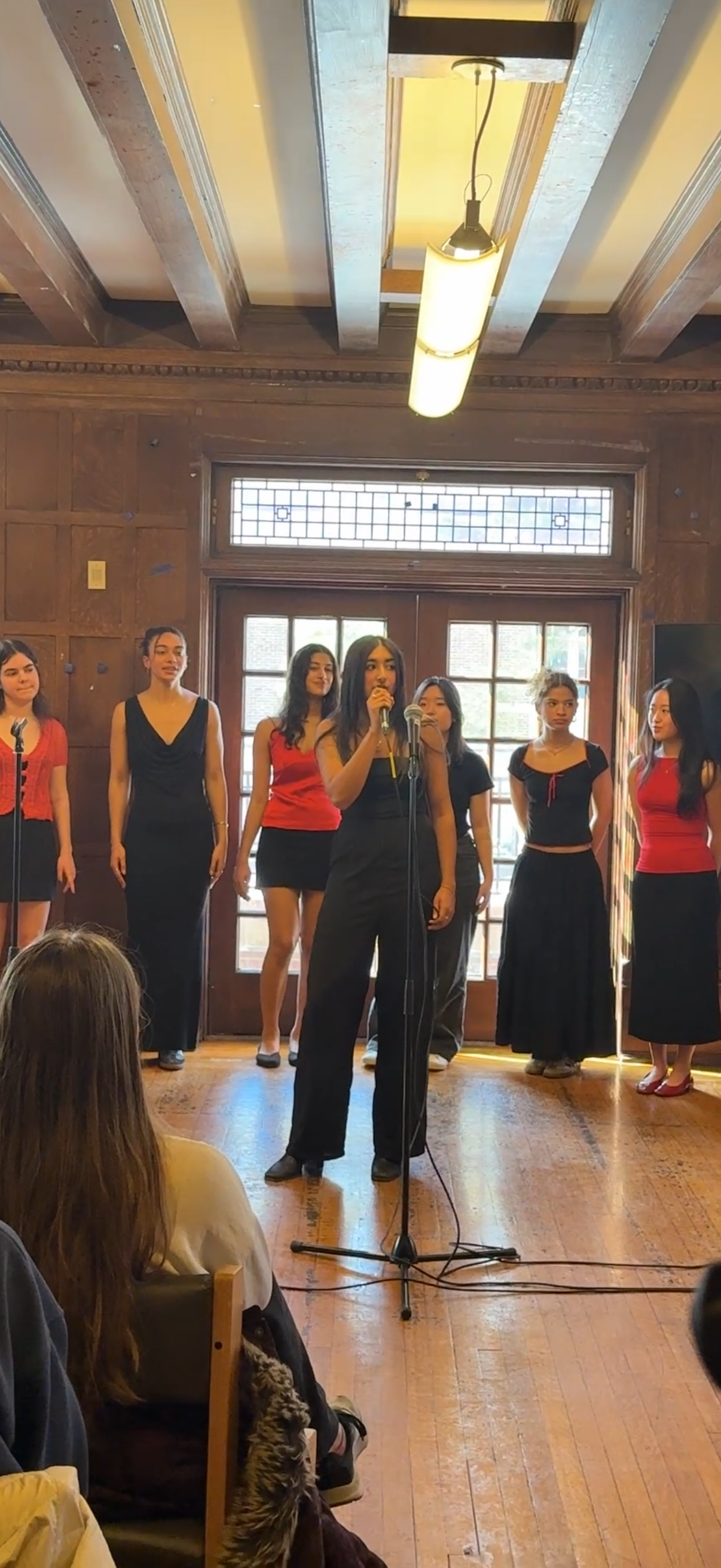
A: It depends. This semester, I was a walk-on to the varsity softball team. So, my schedule for tomorrow, [starts with] practice in the morning from 6 to 8 a.m. I have lift from 8 to 9 a.m., then I have classes from 10 a.m. until 4:30 p.m. because I have my [“Science and Music”] class, which I love. It’s so cool. Then I have chemistry class, and then I have chemistry lab until 4:30 p.m.. After that, I have a cappella in the evenings because I’m part of the Sabrinas too.
For softball, we practice 6 days a week, and for a cappella, 3 days a week. Not too crazy, but definitely rough. [For example], tonight I have rehearsal from 8 to 9:30 p.m. and tomorrow morning, I have to be up at 5 a.m. It’s definitely a balance that I have to strike, but it’s so nice to be able to … exercise these two different, but equally important parts of who I am and what I’m interested in. [Having] a space where I can play my sport and a space where I can be more creative is super awesome; I feel really lucky.
Q: Did you do both a cappella and softball in high school as well?
A: I played softball my whole life. The recruiting process, [though], was not for me. I just knew that I would be better served by my academics than my athletics. So that’s ultimately how I got here. And then, my whole life, I’ve been a huge musical theater and music nerd. It’s a shame we don’t have a good musical theater program here, because that would have been really awesome. But it’s nice that we have a cappella and the Coffee Haus at Marsh [House] — all these fun, smaller spaces where music comes up more organically, which I really like.
Q: Do you know what your major will be?
A: Right now, it’s kind of up in the air. I think if I were to go a more conventional route, I’d either do history and chemistry or history and biology. I’m also thinking about an interdisciplinary major, so I’ve been talking to a few of my professors about it. I want to find a way to integrate history and science in a way that tells a story, because that is what I’m most interested in: exploring the social determinants of health, public policy, and public health.
The two fields really do feel like they naturally intersect, and the social sciences are so important, along with the material sciences. I’m also interested in health economics; there are so many different things that I am super interested in. So, trying to find a way to weave them all together into an interdisciplinary major [which] would be the coolest thing ever.
Q: What’s the best class you’ve taken so far in Amherst?
A: That’s really hard [especially because] I’ve only taken eight. Right now, I’m loving CHEM-161: [Chemical Principles]. It’s so challenging, but it feels like an exercise in problem-solving and critical thinking in a fun way. I think another favorite class that I am taking right now is my pandemic politics class with [Assistant Professor of Political Science] Ruxandra Paul in the political science (poli-sci) department. I’ve never taken a poli sci class before … so I have really enjoyed learning a completely new framework for thinking about the world that simultaneously connects to my interest in public health. The class [has] so much reading, but I think it’s the only class since high school that I’ve felt like I want to sit down and do all of the reading because it’s all just so interesting.
Q: What’s your favorite spot on campus?
A: There are a few spots. I really like the music library in Arms [Music Center] — it’s nice and quiet. I like the Science Center on the second floor. There’s this nook near the spiral staircases. That’s my favorite spot to do any type of work because I love just seeing the view of the mountains. Sometimes I get distracted because I like to just stare out the window.
Q: What has surprised you since coming to Amherst?
A: I think one of the most suprising things was how much the professors, specifically, care. Everyone says, “Oh, at a small liberal arts college, your professors are gonna be so invested in you and your growth,” but I don’t think I fully realized just how invested and how much every single professor cared until I ended my first semester. I was talking to my [First Year] Seminar professor about the types of interactions and relationships that I was able to develop over just four months–which were probably some of the hardest four months of the past few years–and just how comforting it was to realize that I have all of these people in my corner.
Q: If you could trade lives with someone at Amherst for the day, who would you choose?
A: It’s really, really basic, but I think it would probably be Michael Elliott. I just really want to understand what the president does. I’m really interested because I see all the “Between 2 Mammoths,” and I’m just so curious about what the President does. It would be that, or probably an admissions officer. For context, I was waitlisted here before I got in, and [later] I spoke to the admissions officer who called me to tell me I got in off the waitlist earlier in the semester. He remembered who I was, which was so cool. He walked by me, and he went, “Hi, Narina.” Then I saw him again later, and we had a conversation. I know they recorded one of the admissions sessions, and I had seen that, so it was just cool seeing this person who reads God knows how many essays and applications, and here he is having a conversation with me about something that I wrote about and asking me about my experience here. I think that is such an important and cool part about Amherst.
Q: If you could only listen to one artist for a year, who would it be?
A: I was having this conversation with someone earlier, and they asked me who my favorite artist was, and I said I could not tell you. I’ll give you two — I have one basic answer, and one niche answer. My first would be Harry Styles, just because I have been a mega Harry Styles fan since COVID. He just generally has such a diverse range. I feel like no matter what mood I’m in, I could listen to some of his music. And then I think the other artist would be Gregory Alan Isakov, especially if I’m in this area. His music is very folk, more Western.
Q: If you could spend an hour with your future self, what would you say or ask?
A: Not to get too deep, but I think I would ask whether I started to feel more comfortable and confident with myself, and how I was able to stop doubting my abilities. … I would also ask something about trusting the process … I would just kind of want to observe how future me functions. I think that would be a very helpful perspective now. Part of it would be, “Did it really matter as much as you made it feel like it mattered?” And I think that kind of ties into whether or not I felt more comfortable and more confident with myself. Like, “was the pressure I put on myself worth it?” — I think that would probably be the question.
Q: Is there any advice you want to share?
A: The advice that I would have is that Amherst really is what you make of it. We have so many opportunities at our fingertips, and the impulse [should be] to try and do it all. I think that’s definitely what I’ve tried to do. Ultimately, you’re gonna have to choose what you want to prioritize, but at the end of the day, there’s a reason that Amherst has an open curriculum, and I feel like the social environment here mirrors the academic structure in that it is truly open. Do what’s right for you and prioritize yourself, but also don’t let these opportunities slip by because there’s not going to be another point in your life where you can learn anything or do anything in an environment full of people who care so much about so many things.
The second part of that advice would be that I think people tend to paint a picture of college as this perfect, beautiful, amazing experience and, in a lot of ways, it is. I’m having an amazing time here. I think that the way that the college admissions process is structured right now can put a lot of pressure on the applicants because it feels so high stakes, and it is high stakes. But, the type of dialogue around “find[ing] the perfect school,” is such a dangerous thing, because there’s going to be good parts and bad parts of every college. Expecting your college experience to be perfect would be doing yourself and your college a disservice because there are always things that we can improve, and there are always things that you can do to improve it. It really is all about what you make of it and your mindset going in.
Comments ()