

Students, Community Rally in National Shutdown Protest
Hundreds of students and community members joined in a day of protest on Friday, voicing their disappointment towards the Trump administration’s ongoing ICE activity nationwide.
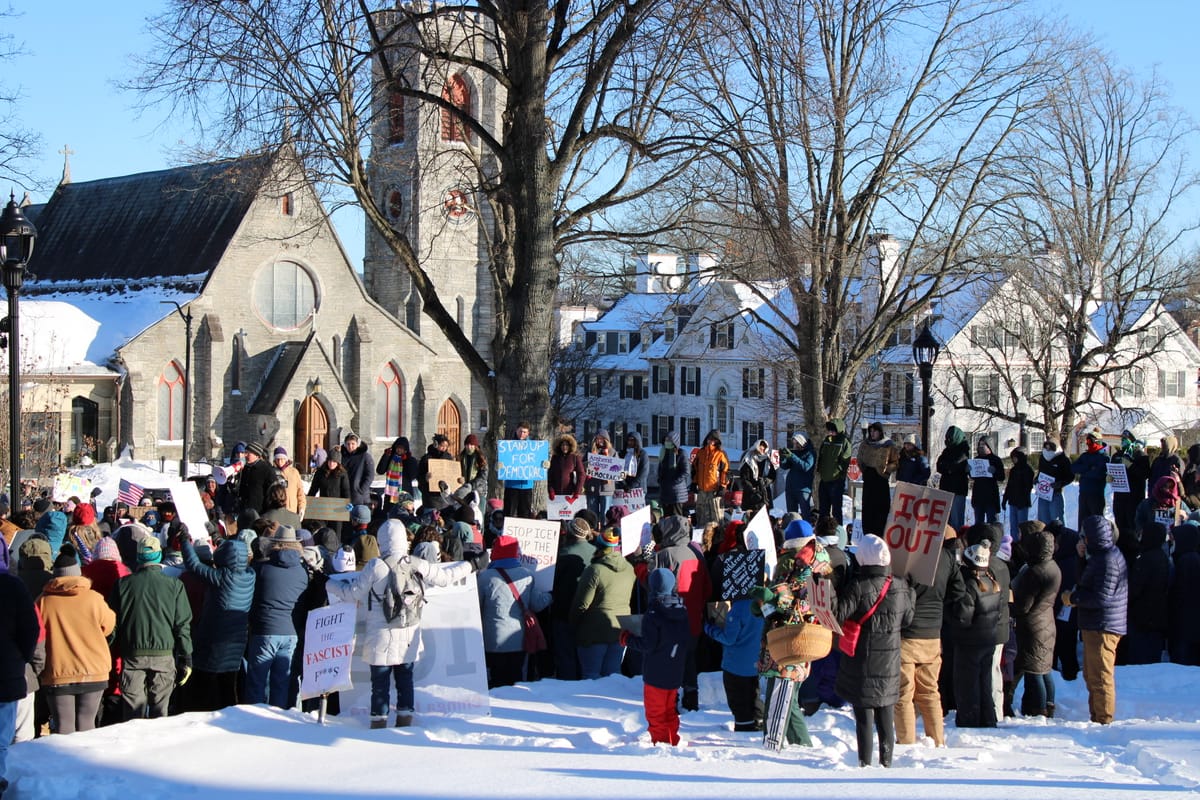
Hundreds of students and community members gathered on the Amherst Common amid a negative-20-degree wind chill on Friday, joining hundreds of organizations in a day of action termed the “National Shutdown.” Packing the common and lining up the streets, protesters voiced anger and disappointment towards the Trump administration and recent Immigration and Customs Enforcement (ICE) activity in Minnesota.
The nationwide strike — calling all to pause work, school, or purchasing for the day — was brought to the Amherst community by Amherst College (AC) Democrats president Caroline Flinn ’28, as well as independent student activist Xyoa Wilding ’28. According to Flinn, who is also a managing opinion editor for The Student, the protest was organized with a high sense of urgency as it aimed to produce a culminating response to “unconstitutional” acts of the “Trump regime.”
“We cannot proceed as if this is normal life, because the second we pretend that it’s normal the worse it gets,” Flinn said. “We also want to stand in solidarity with Minnesotans, because what happens there could also happen here.”
Within 12 hours of hearing of the national movement, Flinn contacted multiple Amherst town council members and political organizations across the Five College Consortium, as well as local grassroots organizations, including Indivisible West Quabbin and the LUCE Immigration Justice Network, which has set up a state-wide ICE alert hotline. By Friday morning, the organizers finalized an array of speakers from all backgrounds: constitutional attorney John Bonifaz, climate justice advocate Jeff Conant, Amherst-Pelham Regional High School (ARHS) student Liana Page, LUCE representative Maia Seetal, and an Ecuadorian activist.
“I think we had a great representation of the community, and I think it’s really important to have a variety of voices,” Wilding said. “Everyone is experiencing this in a different way. A high schooler is obviously going to have a different experience of the national events than an attorney working to impeach [President Donald] Trump. And I think it says a lot when they can all come together and agree on one thing — that we don’t want ICE anywhere near Amherst [or in] our country in general.”
At the protest, Amherst students found themselves joined by town residents, students from Smith College and ARHS, and peacekeepers from Indivisible West Quabbin in support. Surrounding the common, people held signs that read “abolish ICE,” “this ICE tastes like fascism,” and “ICE can’t stand this melting pot.” As more protesters arrived, many residents brought snow shovels to clear out more space for people to stand.
“What is happening in Minnesota is not isolated. It is part of the same pattern of state violence, impunity, and dehumanization we are confronting here,” Flinn said, pausing for applause. “Minnesota has become another reminder that when the state arms itself with unchecked power, it is always marginalized communities who pay the price.”
Amherst students at the protest echoed Flinn’s sentiments. A student who preferred to remain anonymous shared a personal frustration towards the Trump administration’s distorted portrayal of immigrants.
“I’m seeing a lot of lies from the news outlets and … a lot of statistics are made up, and I just feel like people should deserve to hear the truth,” she said. “And I feel like [there are] very false and negative stereotypes towards immigrants, and as an immigrant myself … I know this is not true.”
Other residents shared that it has been hard to process recent news, especially the photos and videos that documented the death of citizens and deportations of young children.
“It makes me lose sleep at night, because I think about all my friends who could just get kidnapped by ICE at any second, and I wouldn’t want that to happen,” a student from ARHS said.
An Amherst resident and employee of the college added that she “cried over the little boy with the blue bunny hat” the night before, referring to Liam Conejo Ramos — a five-year-old from Minneapolis recently detained with his father by ICE. Her daughter, holding up a sign alongside, muttered, “ICE bad.”
Wilding said that she was very impressed with the protest’s turnout and the sense of empowerment brought by the crowd, especially the mobilization across age groups.
“I think intergenerational protests are really important, because often in Western [Massachusetts] the protest side of activism is led by the older generations,” Wilding said. “I think that the Five Colleges is an underutilized opportunity for mass collaboration. We have so many students here in this one tiny area. That offers a bigger base for actions like this than [other towns] of a similar size to Amherst that [don’t] have all these colleges.”
The protest marks a change in student engagement with activism. Both Wilding and Flinn said that there has been a notable lack of student-led advocacy on campus regarding recent events due to Amherst being a “bubble” of privilege, and that the college needs to be more activist-oriented.
“I don’t think anyone is reacting enough to what’s going on,” Wilding said. “I think it’s very easy to become debilitated by the fear of what’s going on, but ignoring it will [not] make it go away.”
Regarding the next steps AC Democrats will take, Flinn recalled the success of their recent event urging students to call their senators to reject a proposed funding package that would have provided billions of dollars to ICE, and said she plans to collaborate more closely with local organizations and the Five Colleges.
“Through this [protest], I’ve actually met some really cool people and hope to continue [getting] the Five College community more connected,” Flinn said. “Elections that are coming up, other issues that might arise. We will never forget about this. This is still an issue, and it’s not going to end tomorrow.”
Editor’s Note, Feb. 9, 2026: The article was modified to remove the mentioning of a person due to safety concerns.
Comments ()