

The MLB Adopts ABS: When Do We Stop?
Assistant Sports Editor Ethan Niewoehner ‘29 responds to the unveiling of the MLB ABS system in spring training, cautioning against adopting technology in sports at the expense of the human dimension.
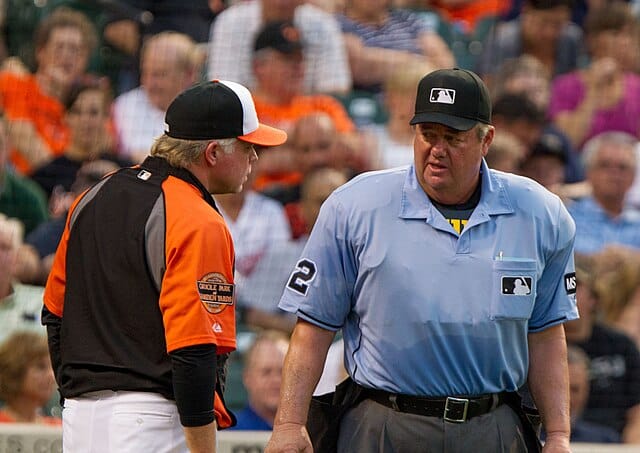
Baseball fans start to get excited around this time of year. The first pitch of the 2026 Major League Baseball (MLB) season is less than a month away, the spectacle that is “America’s Pastime” is about to return to the spotlight, and, if one squints their eyes, one can almost see a hard line drive splitting the gap out in left-center. But we’re not there quite yet.
Spring training provides the opportunities for excitement that fans have craved over the winter months. At the bare minimum, going to a spring training game or practice is an excuse to laze about beneath the warm Floridian or Arizonian sun with a drink in hand: Who could say no? For the entry-level fan, spring training offers a first glimpse at the star talent and household names who are primed to dominate the next eight months. Perhaps the avid fan pays attention to their team’s bullpen depth, and maybe the true sicko statistician takes spring training as an opportunity to see if B.J. Murray Jr.’s bat speed is finally AAA-ball ready or whether the sweeper will continue to terrorize power hitters.
But this year, spring training is also the stage for the unveiling of the Automated Ball-Strike system (ABS). The ABS system allows players on either team to challenge a home plate umpire’s decision on whether a pitch was called a ball or a strike. A player, catcher, or pitcher taps their head, the umpire signals to wind up the ol’ trusty ABS system, and a graphic on a scoreboard somewhere in the outfield dramatically replays the pitch in 3-D space, delivering an authoritative final verdict one way or the other. Think of the Hawk-Eye challenge system from tennis; ABS is essentially the same thing.
There are plenty of restrictive guidelines: teams begin the game with only two challenges; challenges must be made instantaneously; players, not managers, can challenge calls, etc. Yet the effect is all the same: more technology calling the shots and less room for human judgment.
This is not the first time technology has infringed upon umpires’ domain in baseball, nor even the most intrusive instance. In 2014, the MLB — as the last major sports league to do so — finally added managerial challenges with instant replay, fundamentally altering the game’s framework. In 2023, MLB debuted the pitch clock, dramatically shortening game duration. ABS, on the other hand, will only, for the foreseeable future at least, impact four or five strike calls every game. Inoffensive, almost.
Yes, a review system is popular. Scapegoat umpires, such as Angel Hernandez or Joe West, riled up loud segments of the MLB fanbase thanks to widely publicized bad calls and instances of ‘umpire egotism.’ Growing frustration over missed calls and umpire antics helps explain why 72% of players and 70% of fans favor some form of review system, according to MLB. Factor in the fact that in baseball history pitchers have never thrown harder, with more movement, or with a greater variety of pitches, and it makes total sense for umpires to receive this unobtrusive form of technical assistance.
But I still don’t like it.
I don’t hate the system on its own; honestly, by itself, I find it unproblematic. However, its introduction concerns me because it is yet another instance of both the MLB’s, not to mention the broader sports world’s, obsession with eliminating all human error from sport.
It’s an odd thing to get animated about, I’m aware. In cultivating a cleaner product — in letting the athletes’ talent — and their talent alone — decide outcomes, aren’t we “purifying” America’s pastime? Not quite. You see, it’s a slippery slope. Baseball is a sport of detail and personality, a sport defined by its eccentricities and relationships. Human umpires — and, yes, their strike calling — are part of that, and when we remove these features, when we attack baseball’s spirit, we risk losing what makes it so special.
Pedro Strop donning a sideways hat, Jorge Posada eschewing batting gloves, the torpedo bat craze: these are the idiosyncrasies baseball fans crave; they are what give the sport its texture. Umpires with slightly different zones, tendencies, strike three gestures, and accuracies are as well.
Great umpiring, like Pot Hoberg calling a ‘perfect game’ in the 2022 World Series, takes on a narrative of its own and adds intrigue to the game. As does poor umpiring. In fact, poor umpiring has directly led to some of baseball’s most memorable moments. Kyle Schwarber only throws a temper tantrum befitting an elementary-schooler to the delight of 40,000+ Philadelphia Phillies fans if Angel Hernandez makes enough bad calls. Rays manager Joe Madden only takes to the field to protest like someone storming the Bastille if Marty Foster ends a game with a truly abominable strike three call. Mets manager Terry Collins only loses his mind, rants profanely, and becomes an internet sensation if umpires give him material to disagree with.
Baseball, in a different manner than basketball, football, or hockey, is an eminently personal game. Umpire Dan Bellino staring down pitcher Madison Bumgarner before ejecting him — after Bumgarner had, in his patently ornery way, expressed displeasure with a couple of calls the half-inning before — beautifully captures the human dimension of baseball. People matter. Relationships matter. I mean, boiled down, the entire sport is just a series of one-on-one matchups between two humans being mediated by yet another human. Approaching baseball with this in mind helps explain why people choose to spend three hours at a ballpark; there is more at play than just the results on the field. Without the added detail and drama furnished by human officiating, baseball isn’t baseball.
In the rush to standardize, automate, and perfect baseball, MLB risks losing sight of what makes its product so special. Though the ABS system by no means threatens the integrity of the sport on its own, it is symptomatic of a broader modernizing process that, in my opinion, prunes the sport’s beautifully flawed, gloriously human essence.



Comments ()