

The New “Tradition” of Poet Jericho Brown
Staff Writer Harry Finnegan ’28 reports back from the second annual Rhonda Cobham-Sander Lecture, where Pulitzer Prize-winning poet Jericho Brown captivated the audience with his inventive “duplex” poems and spellbinding stage presence.
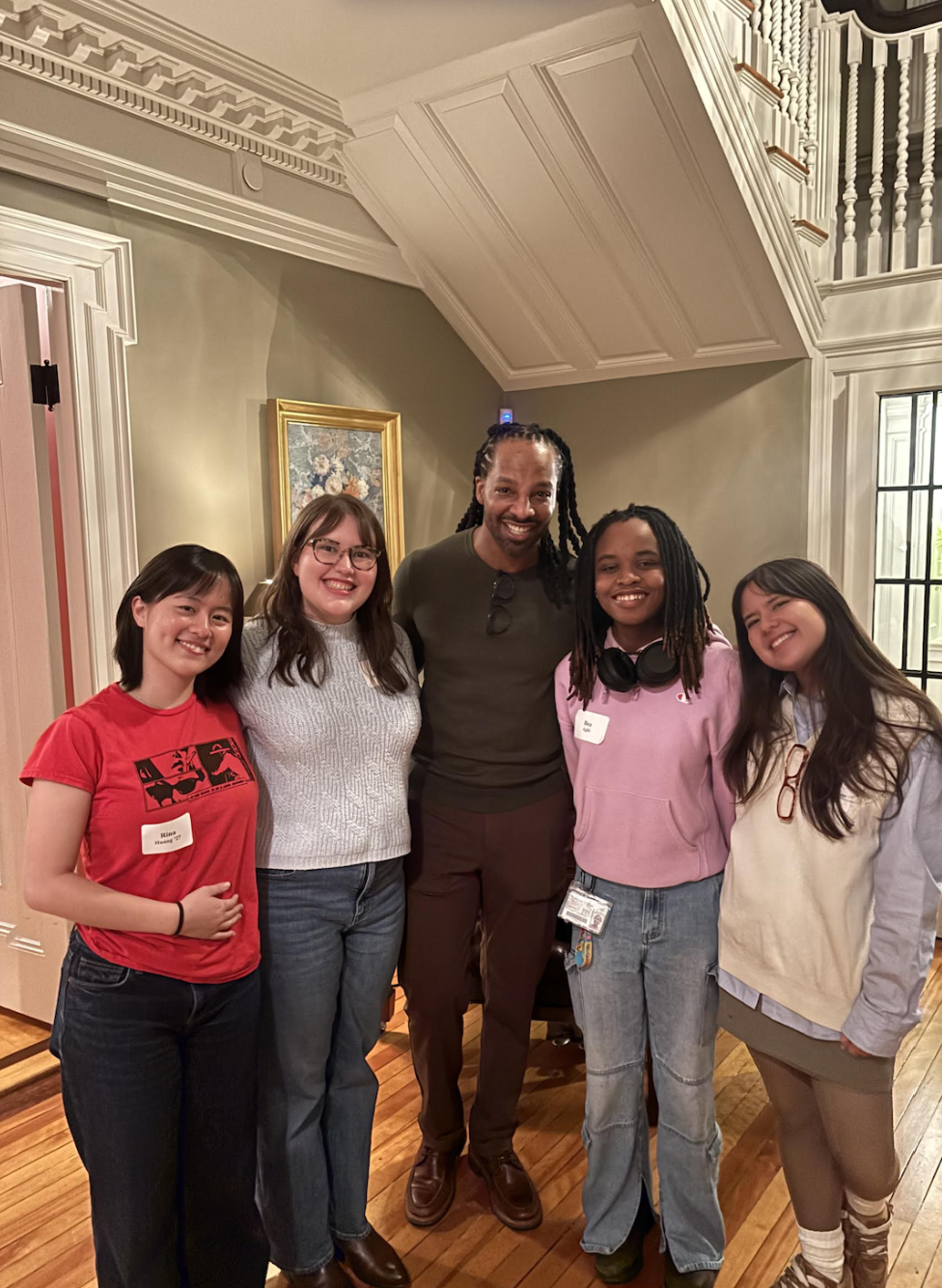
On Oct. 29, the English department and the English Student Steering Committee invited poet Jericho Brown to speak at the annual Rhonda Cobham-Sander Lecture. Brown is the second speaker in this series, following last year’s inaugural lecturer, Hanif Abdurraquib.
The lecture is named in honor of Emily C. Jordan Folger Professor Emeritus of Black Studies and English C. Rhonda Cobham-Sander. Cobham-Sander grew up in the Caribbean, and her work has explored issues of gender and childhood in African and Caribbean literature, as well as the multifaceted broader questions embedded within them. The series aims to reflect these commitments, and the selection of Brown as the speaker affirmed these goals. “[Brown’s] work embodies Professor Cobham-Sander’s commitment to discussing important issues of race, gender, and history, both inside and outside literary spaces,” Steering Committee Member Emily Wykoff ’26 said when introducing Brown to the event. Cobham-Sanders’s presence at the event was greeted with warm applause.
The resume and repertoire of Brown certainly match these claims. He is simultaneously inventive and intensely poetic: One of his main claims to fame is his invention of a new form he dubbed the “duplex,” which is a mix of the poetic styles of the sonnet, the ghazal, and the blues poem that creates a pattern of echo and return throughout its short duration. Across his collections, Brown carefully depicts lives shaped by race, gender, history, violence, and love. His recent honors include the Pulitzer Prize in Poetry for his 2019 collection “The Tradition” and a 2024 MacArthur Fellowship.
Brown’s poetic voice and personality were felt immediately when he began to speak. He moved easily between a careful and emotional recitation of his poems with short transitions that betrayed a sense of humor. The audience was visibly invested in his style, leaning forward at each new beginning and relaxing only when he stopped. At one point, he even fulfilled a bet from a fellow poet who worked under President Michael Elliott when he was a dean at Emory University to call Elliott “fine,” shortly before launching into the poem “Prayer of the Backhanded,” an eloquent remembrance of an abusive father. This sequence of events may sound strange, but the effect of the talk was a completely spellbound audience primed to feel every word.
Everyone in that audience likely left with a different poem that they would call their favorite, the one that they felt the most. Of particular note are the final poem, titled simply “Duplex” after its form, one made meaningful from the pillaging of other duplexes for lines, “Track 1: Lush Life,” a meditation on Billy Strayhorn’s song alongside the violence of love, and “Bullet Points,” a deeply moving reflection on death and police brutality. It may constantly change, but my personal favorite is also the most summative of Brown’s most common themes: “Sitcom.” This poem addresses nostalgia, family, the working of other media forms, violence against Black people in America, the destructive potential of society, and the redemptive possibility of love and hope, all under the guise of exploring a single scene of gun violence directed at the matriarch of the titular family in the television show “The Jeffersons.” Brown’s verse carries the reader or listener through the poem smoothly, even amid the complexity of its themes.
But the most memorable moment of the talk was not any poem or any aside from Brown himself. Instead, it was when Brown directly called upon one member of the audience, Wyatt Wahl ’29, whom he recognized from a workshop he had led earlier that day. In that workshop, he explained, 22 students each wrote one poem in the duplex form. Before reading a duplex of his own, Brown invited Wahl up onstage for a miniature poetry talk within his larger one. Although Wahl did not expect to be put in the spotlight, his poem spoke to the heart of the form and the poet, just as Brown’s work did throughout the talk.
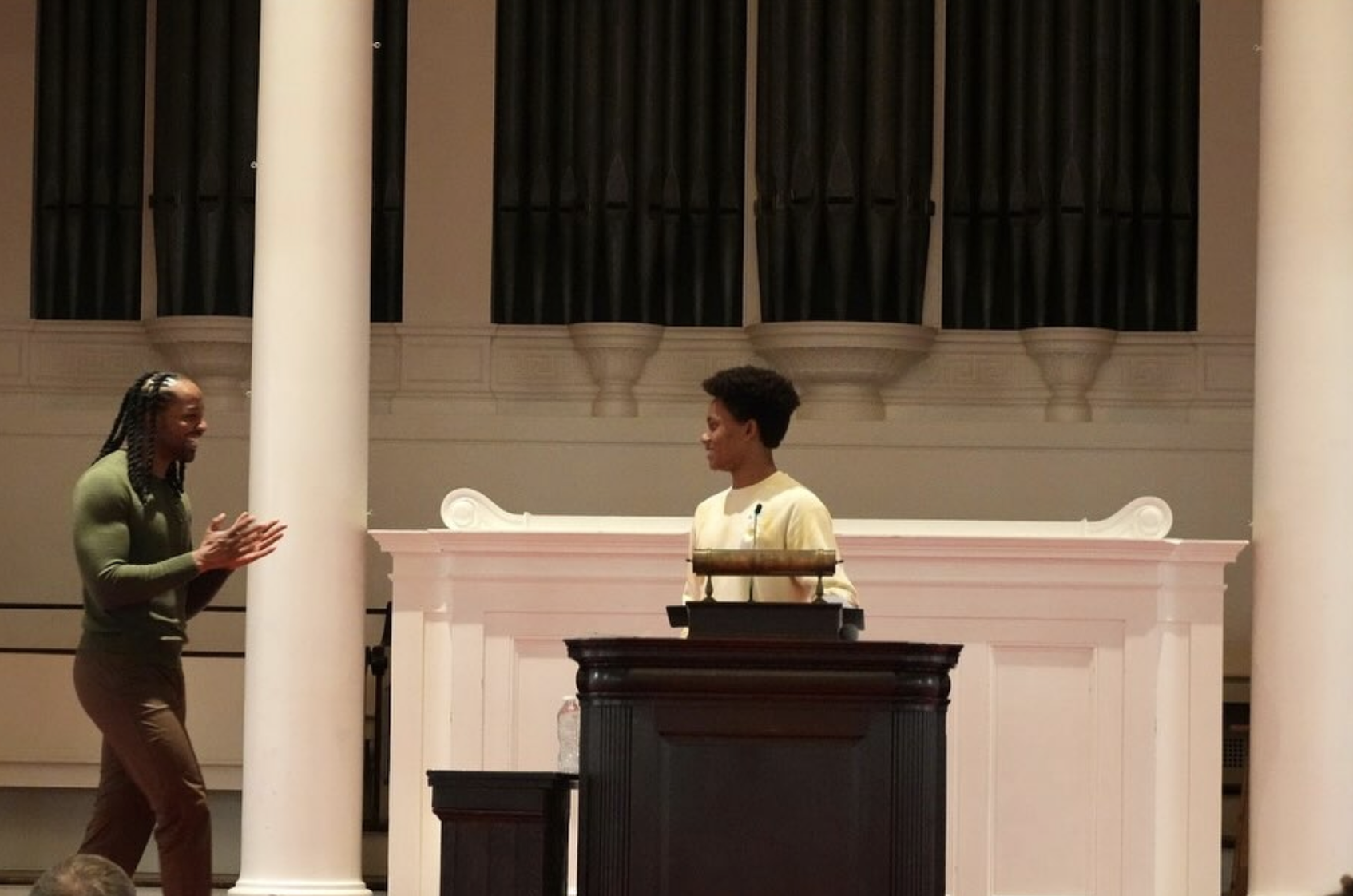
When answering questions about the poems and his process after the recitation, Brown returned to his invention of a new form and the role of the poet. “Poetry is just a bunch of praying,” he said. This hopefulness is particular to each person, who Brown says will take from what they have seen and shape it continuously until it is as perfect to match themselves as it can be. To Brown, “[a] poem has to be about discovery,” and that discovery must be present in the writing and in the reading. His creation of the duplex fed into this feeling of discovery, as it was an accident that came about from pure experimentation and devotion to the poetic process.
I think that was why Brown invited Wahl onstage to read a poem that was not his. We in the audience came to see Brown and were surprised to discover an entirely separate poetic voice alongside him. After Wahl and Brown finished their readings, Brown reflected on the other duplexes created by the workshop, which were all written by students. Brown encouraged everyone in the audience to, now that they have heard one of the 22, ask everyone they see, “Do you have a duplex?” In doing so, one can hope to find and hear all of the duplexes.
I have yet to ask anyone this question. I only have one of the duplexes in my collection. But Brown’s challenge extends beyond the form itself: Many people carry poems that you will never hear unless you ask. I plan to ask. Will you?

Comments ()