

Translating Across Campuses: The Five College Center Platforming Under-Instructed Languages
Amid cuts to language programs across the country, opportunities for a solution might be in our backyard. Managing Features Editor Belaine Mamo ’27 spoke to the director of the Five College Center for the Study of World Languages for more information on its beginnings, functions, and future.

For most students at Amherst seeking to learn a language, the experience can feel restricted to the offerings available on campus. French, Spanish, and other commonly taught languages dominate enrollment, while others, less common in American educational contexts, face uncertainty often citing low enrollment.
But what about the other languages of the world that students may be interested in learning for personal, cultural, or familial reasons? This seems like an even greater challenge especially since Amherst students come from all over the world, hailing from 70 countries.
How can we supplement interest in languages spoken by friends, family members, or even just for fun — especially when so many are being cut elsewhere?
One solution might be closer than many people think.
Tucked away in the former Baptist church at 79 Pleasant St. lives the Five College Center for World Languages — where I sat down with Director of the center Janna White and Director of Strategic Engagement for Five Colleges Kevin Kennedy.
White came to the Center in the fall of 2018 seeking an “opportunity to work more directly with students.” A Smith college alum herself, White spent time in India as a study abroad student, learned Hindi, but didn’t know about the Center then. Thus, she is now enjoying “help[ing] other students get to do what [she] didn’t get to do at that time.”
Origins of the Center
The Center itself began in 1991 after Deans hailing from all five campuses came together to form a resource for students wanting to study languages that individual campuses lacked capacity to offer. They appointed Dr. Elizabeth Mazzocco, late professor of Italian at University of Massachusetts, Amherst (UMass) who later became the first director of the center, to find a solution. The language center intended to maximize the number of languages available to Five College students over a sustained period of time.
Rather than competing with existing courses, the center is supplementary, providing courses that do not have enough interest at individual colleges, but are sustainable across the Five Colleges. In any given year, the center offers about 30-35 languages at a time, including rarely taught languages like Amharic, Serbo-Croatian, Dari, and Tibetan, with an average of 250 students in a year.
The number of languages available for students in total, when accounting for courses across the five colleges, reaches about 60, making the center’s offerings among the highest number available at any institution (or collection of) in the country.
Since 2018, the center has added about five to six languages to their offerings and are currently looking at others to further expand offerings. Their main goal, made possible by their funding and organization style is “to be able to be pretty responsive to changing student needs and interests.”
With regard to their wide range of uncommonly taught languages, White explains that the center is “mostly pulling on the very large and wonderful population of international students that exist on each of the campuses,” as well as the “domestic students and other students who are bi[lingual] or trilingual have multiple languages from other backgrounds.”
The center is funded collectively by the Five Colleges. “Like every other Five College program, our funding comes collectively from the five campuses,” said Kennedy, “we also have an endowment specific for the Language Center that funds a part of our programming as well.”
Creating a Class
A complete language center class needs three things: 1) at least one interested student, 2) an in-person instructor that knows the language, and 3) a professional evaluator. A unique aspect of the program is that it operates with a maximum enrollment or an enrollment cap, rather than a minimum. As long as there's one student interested in learning a language, a conversation partner will be found and the center will provide a textbook for them to run the class. This means there can be multiple languages taught with only one student. “That's one of the things that's really special about our program on the campuses,” White said.
For the second piece of the puzzle, in order to recruit teachers for their offered courses, the center draws on graduates of the program or community members to hire as conversation partners. White explains that the center is “pulling from any communities that we have connection to where we can find speakers of the languages.” Their main goal is to find experts in speaking, not necessarily in teaching. Often, undergraduate students who are speakers are trained as conversation partners even if they lack formal experience.
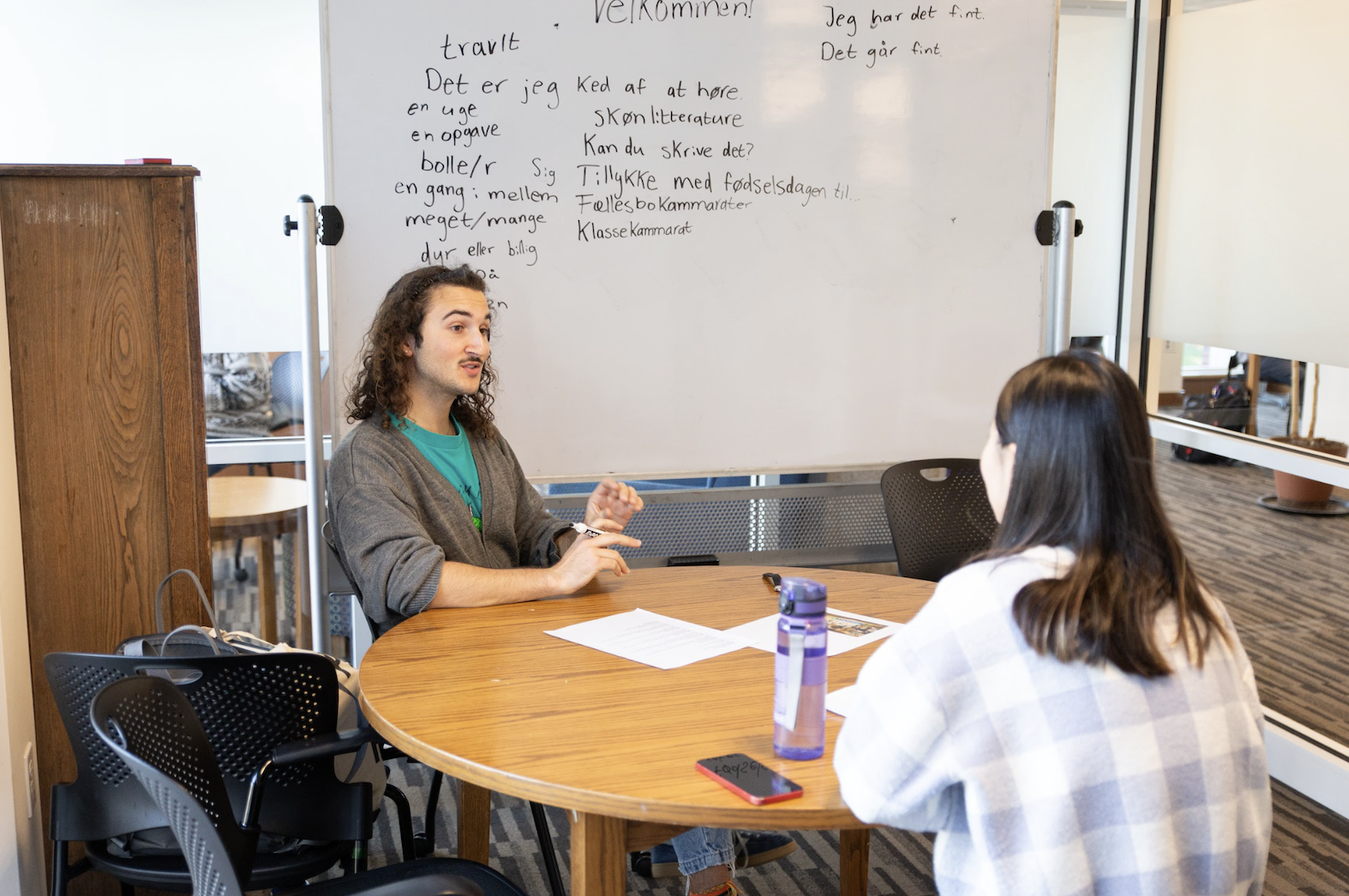
The last element needed for a complete language center course offering is an evaluator — a professional instructor of the language from an institution who can assess students at the end of the semester. The center has existing networks to find evaluators and publishers of textbooks whose formats work well with the self-study style. Additionally, the center works with Five College campus groups when looking for speakers and experts. For example, when beginning to offer Igbo, White explained that the center “worked closely with the African Studies Council and the African Graduate and Scholar Association at UMass to see if [they] could find speakers to work as conversation partners.”
Along with interpersonal practice, the center also provides a variety of material resources to interested students including a textbook and audio resources. Specifically, the LangMedia site created by the center provides self-study resources to any student who wishes to learn. The site is the product of two projects: 1) “Language By Country” and 2) “CultureTalk” both of which aim to preserve and provide spoken language resources. The site houses visual and audio material captured by participants who recorded days in their life and conversations in their countries of origin. Prior to a recent financial investment into upgrading the site, LangMedia was a relic of the early 2000s when most materials were uploaded. The free site supplying videos of regular people with their families and friends provides useful casual material for any language learner in the world to profit from.
Regarding the feasibility of adding classes when there’s student interest, White explains that the center does in fact add languages periodically, with the most recent being Kazakh and Igbo. Typically, to add a track, a student initiates the process by coming to the center and expressing interest in an unavailable language.
The Language Learning Landscape
Amidst recent federal cuts to language programs, the Five College Arabic Language Initiative was terminated last semester, cutting Arabic language education completely at Amherst and partially at UMass due to reports of low enrollment. All over the country, language programs are being cut or downsized, often justified by claims that they do not advance American interests.
White explained, “There have been a lot of highly publicized cases of language programs, closing, and other places. We haven’t seen that locally for the most part.”
Despite increased attention on these programs, White shared, “he campuses collectively are still really committed to continue to be a center for language study, a place where … students from anywhere could come up with a wide variety of other academic interests and pursue a wide range of language study welfare here.”
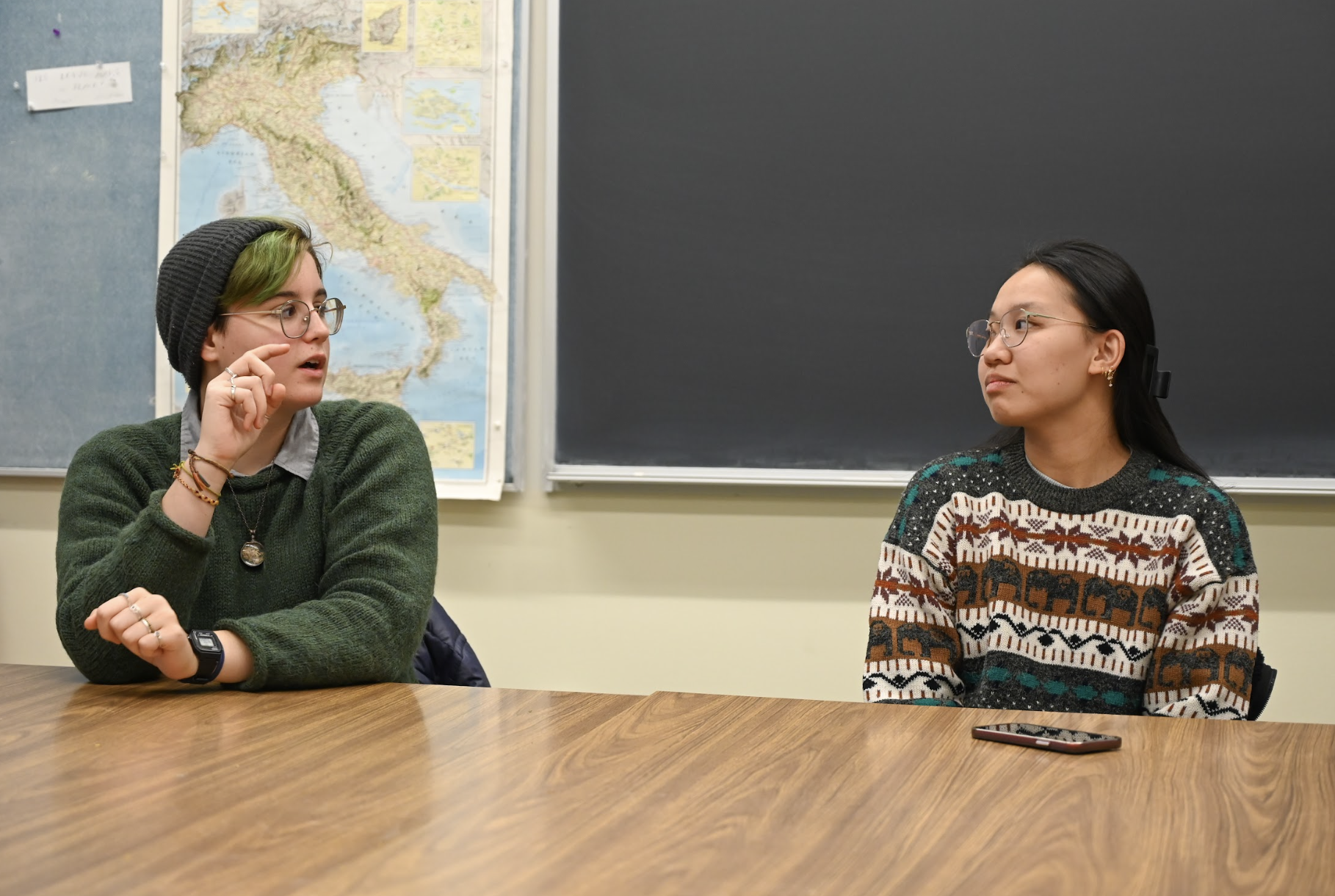
In doing so, they must remain responsive to the times. This year, the center is bringing together groups of faculty from Smith College, Amherst College, and those sponsored by the center for a faculty seminar, “bringing together instructors and faculty from across different languages to promote language study together and think about the role of AI and language study,” White notes.
In response to these cuts, there are attempts to make language learning something appealing to people of any area of study. “[Think] about how you can sort of infuse language study across the curriculum,” White said. “If you're an engineering student, can you still make space for language study and maybe actually pair that with your engineering study?”
In some cases, the daunting national trends have inspired more efforts to protect language learning. “If anything, I think that some of the threats to language programs have led the language folks here … to work and collaborate even more closely together to try to support one another and continue to make language studies viable and attractive as possible,” White noted. “And we’re lucky because the Five Colleges as an organization already exists and the campuses are already collaborating in so many ways we have this existing sort of platform and relationships for all of that to happen.”
Adapting to the Times
White sees the center as a place to bridge the gap between commonly spoken and commonly taught languages. For example, White notes that while there are hundreds of millions of Hindu speakers, it's not commonly offered in higher education.
On the importance of the efforts of the center, White elaborated on its particular focus on so-called “less commonly taught” languages. While there is often overlap between less taught and less spoken languages, White shared that there is often a disconnect between languages that are taught in educational settings and what languages are most popular: “What’s commonly taught doesn’t necessarily mean less commonly spoken.”
The center fills a gap within language education that opens up doors for personal, professional, and travel opportunities to students, regardless of how often their language is spoken or taught. “I think [exposing] yourself to that [learning] is going to be a great opportunity for personal growth, in addition to academic growth, [for people] to connect with different parts of themselves,” White said.
To someone who wants to start learning a language, but maybe feels apprehensive at the beginning? White would tell them: “Language is so fun.”
According to White, this sentiment is shared widely among the center’s users. “We hear from a lot of our students that it's actually a really nice break and counterbalance from the rest of their academic work…and it's not that learning a language isn't academic, but it's different,” White said. “It's much more interactive and human, and promotes connection.”
White acknowledges that, for some, “it can be intimidating especially [because] people aren't necessarily comfortable making mistakes and putting themselves out there.” But the center’s unique approach to language learning allows students to work with a peer so they can practice their language with somebody who has no role in grading or evaluating them.
“We hear from students that that makes it a lot more comfortable for them to just try and practice and to make mistakes and not feel as scared by that,” White said. “And that can really promote more comfort and more confidence.”
As for the future of the center, White said she hopes they can “continue to be really responsive to Five College students.” As new students come in, who are interested in new languages or speak languages currently not offered by the center, they can “put the pieces together and continue connecting our students and creating those learning opportunities.”
White added that, “we’re very lucky to have such a diverse population despite being in a relatively rural area.” Both for speakers to utilize, but also for learners across the campuses. She explains that, “about a third of our students are heritage speakers of the languages they're studying, meaning they have some kind of family or community connection to the language … so they can come here and further connect to themselves ... And that's a really special opportunity that we're privileged to make possible.”
Comments ()