

Winter Break in Minneapolis: City Under Attack
As ICE continues to reign terror on the streets of Minneapolis, Managing Features Editors Talia Ehrenberg ’28 and Belaine Mamo ’27 spoke to Amherst students and parents from the area on their experiences during January break.
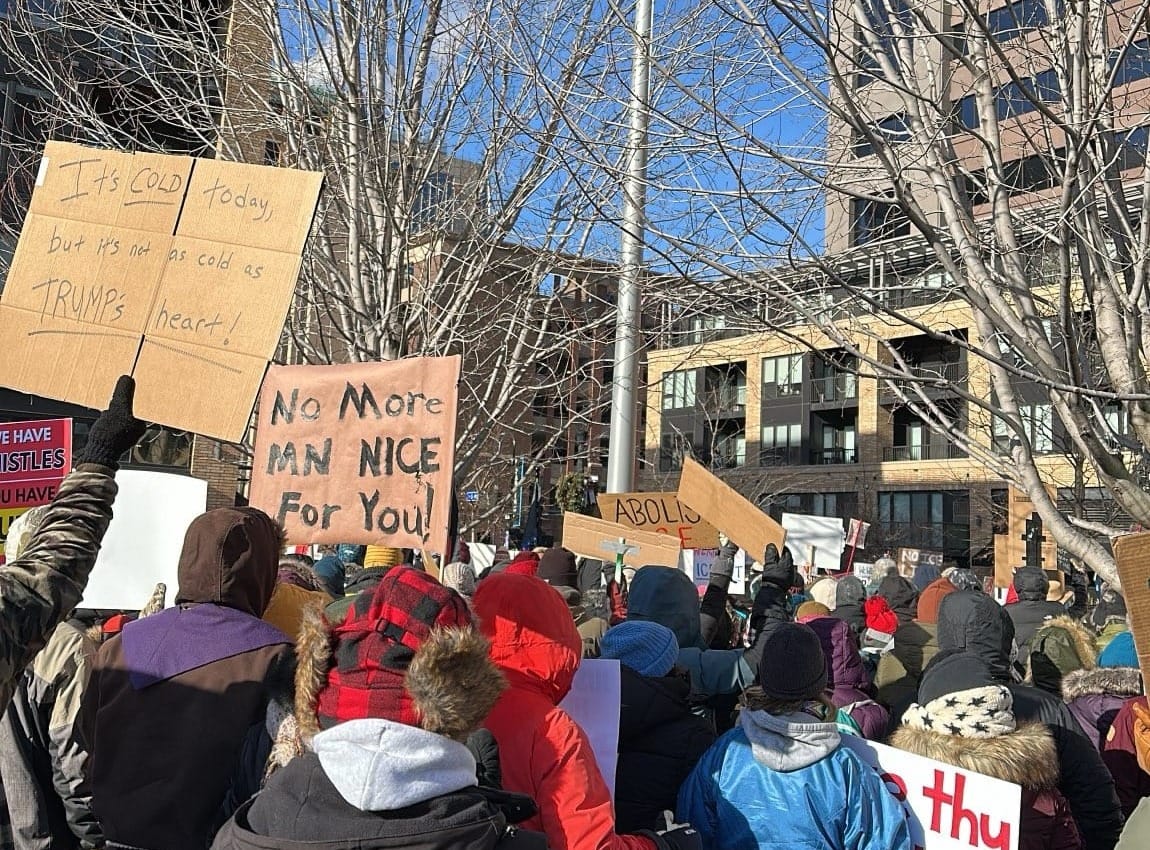
The influx of headlines on the escalating violence of federal agents in Minneapolis hit close to home for many members of the Amherst community. Students from the midwestern city lived through January in indescribable terror as Immigration and Customs Enforcement (ICE) agents rapidly flooded neighborhoods. The Student spoke to students and a parent from the greater Minneapolis metropolitan area to share their observations, the impacts on their communities, and the wisdom they carry as they transition away from home for the semester.
With ICE opening fire 20 times and murdering five people since the beginning of President Donald Trump’s term, Renée Good was not the first civilian to be murdered at the hands of ICE. However, her videotaped death on Jan. 7 ignited a new level of urgency, sparking anti-ICE protests in Minneapolis and across the country. Since Jan. 20, more lives have fallen to ICE: Veteran Affairs nurse Alex Pretti was shot in public while both a five and two-year-old were detained.
In line with the Trump administration, the Justice Department has continued to press state leaders to release voter rolls with personal identifying information of residents, including social security numbers. On Monday, Trump deployed “border czar” Tom Homan to the city to lead on-site federal operations. With federal agents outnumbering local police five fold, the federal government is actively occupying Minneapolis and causing immense physical and mental trauma, described by The Guardian as “generational.”
Voices from the Ground
Translating news alerts to lived experience, the four students and one parent we spoke to added synthesizing clarity to the situation unfolding in the city.
“There are over 3,000 federal agents in the state. Now, the majority of them are in Minneapolis and St. Paul. They are just ripping people off the streets [and] beating them up,” said Max Aronson ’28, who lives only a six-minute drive from downtown. “They don’t care whether or not you’re a citizen. And the really scary thing is that it doesn’t feel like there’s a rule of law. There's no due process.”
Zoe Mulvihill ’27, who lives in the center of the city, added that “Minneapolis is a much smaller city than Chicago or [Los Angeles] or the other [sites of] crackdowns … [so] even watching the news stories feels like a lot more if you can’t really escape it — it feels like ICE is literally everywhere.”
Multiple students spoke to the visceral racial profiling of ICE agents, whose violence appears to be significantly more directed towards people of color.
“They’re showing up in the city, they’re showing up in suburbs, at Costcos, just looking for people who aren’t white … they take them into custody, rough them up [for] 12 hours,” Aronson said. “Then their information will check out, and [ICE will] throw them back on the street somewhere.”
“They’ll just pick up anybody who’s brown,” Zoe Mulvihill added.
Zoe Mulvihill’s mother, Eli Mulvihill, jumped in during our conversation, stating that she would’ve sent her daughter away had she been home and not in Amherst in January. “There’s no way you, as a person of color, could be in Minneapolis. I would have [flown] you to California or to Boston. That’s how bad it is,” she said. “People of color cannot walk on the streets because they’re being abducted or kidnapped just for the color of their skin. I've seen it with my own eyes.”
The situation in Minnesota intensified seemingly instantaneously. When Zoe Mulvihill left for Amherst on Jan. 4, she had no knowledge of ICE’s upcoming arrival in Minneapolis.
“When I left, it was really calm … I was out and about. It just felt typical, normal,” Zoe Mulvihill said. “And then … all of a sudden there’s a bunch of ICE agents. My mom was sending videos of this military-looking [person] patrolling right across from our street.” Zoe Mulvihill’s mom reported back to her daughter on the escalation of interactions in her neighborhood, sharing that a woman’s ribs were broken.
In addition to physical violence, Eli Mulvihill described the psychological toll of their now hyper-surveiled neighborhood. “We live a block off of Central Avenue in Northeast Minneapolis, so most of the businesses are immigrant owned. ICE has been driving by our house, circling our house,” she said. “But they’re changing their tactics, so now we don’t know who ICE and who’s not. Now they’re in plain clothes, they’re not identifying themselves, but we’re so hypervigilant now in the neighborhood.”
Eli Mulvihill added that ICE has moved onto digital surveillance, setting up an antenna in a nearby Home Depot parking lot to potentially monitor residents’ phones. “I learned this morning that they circle a neighborhood because they’ve been messing with our cell phones,” Eli Mulvihill continued. “They have a technology to tap into our cell phones ... I think we’re ground zero for a lot of military surveillance. They’re testing it on us.”
This fear has reshaped the ways neighbors communicate and sustain community support systems, but ICE seems to be attempting to infiltrate these mutual aid networks. According to Eli Mulvihill, ICE agents have been in community group chats for patrol, mental health, and food drives, attempting to message people.
“They’re trying to DM us and say, ‘Hey, let’s meet in person and talk about getting rid of these Nazis at the city,’ but we know it’s the Feds doing that because of the way they’re wording it,” Eli Mulvihill said.
“It’s terror. They’re terrorizing our community, and they’re doing that on purpose. I’m constantly looking over my shoulder, looking for ICE.”
This climate has taken a significant toll on the mental health of community members, as violent acts of ICE agents began to feel increasingly threatening.
“We’ve had so many people abducted and kidnapped … You could be driving [and] all of a sudden, three or four ICE agent cars stop, they block the road, they jump out. They abduct somebody. You jump out with your cell phone and your whistle, and then you’re trying to document it. It can happen in a split second,” Eli Mulvihill said. “Our nervous systems are hyper-vigilant … I’ve had to back off of social media because my nervous system can’t tell if it’s real life trauma … the mental health stuff is huge.”
This sense of terror is shared amongst others in Minneapolis, especially people of color who are more likely to be targeted.
Eli Mulvihill recounted an instance outside of Mercado, a local marketplace, in which ICE agents engaged in a physical altercation with two people exiting the store. Having been thrown to the ground, one of the people was badly injured and had a serious split in his head. “He clearly needed stitches, and he refused to go to the hospital because ICE is in the hospital, they're in the ER room,” Eli Mulvihill said. “He refused to go to the hospital, I saw with my own eyes, because … ICE is there.”
Observers, like Eli Mulvihill, are also frequent targets of ICE violence.
“We’re blowing our whistles. We’re videotaping … They’ll pinpoint one observer at random, and they grab them and arrest them, just to terrorize us observers, and we don’t know who it’s gonna be,” Eli Mulvihill said.
Why Minnesota?
In an attempt to make sense of why Minneapolis has become such a focal point, those closest to the city offer several explanations.
Both Eli Mulvihill and Phuong Doan ’26, who lives half an hour away from downtown, emphasized the Twin Cities’ position as a blue island.
“We're targeted because we’re liberal and progressive, and our progressivism works in Minneapolis,” Eli Mulvihill said.
With Trump claiming to have won Minnesota in 2016, 2020, and 2024, coupled with a disproven daycare fraud scandal, Doan added that Minnesota is seen as politically vulnerable.
“People see Minnesota and its government as weakened,” Doan said.
Still, interviewees emphasized that this could just easily be happening elsewhere. “They're making us kind of the model for this project,” Aronson said.
This isn’t new. As the only state who voted for Walter Mondale, the Democratic nominee running against Ronald Reagan in the 1984 Presidential election, Minnesota has long had a distinct national political reputation.
Preceding the ’84 election, though, Doan, who is also writing a thesis on the Minnesota state legislature, says Minnesotan politics have historically always been anomalous. In the absence of a state Democratic party, the Democratic-Farmer-Labor Party marks a rare success of a third party movement.
Personal Anecdotes
Despite this history, the 2026 attack on Minneapolis civilians is not by any means an inherent causality.
The tight-knitness of the community means everyone knows somebody and everyone is terrified.
Aronson echoed this feeling of Minnesota as a connected web, describing how his youth baseball coach’s co-worker was picked up by ICE agents after failing to present proof of residence after living and working in the United States legally for multiple decades. Aronson’s coach attempted to organize legal support: “[He posted on Instagram]: ‘If anyone knows a lawyer, let me know I am desperate. This guy’s about to get deported.’” Unable to find a lawyer, he was deported to Mexico.
Eli Mulvihill has been delivering meals to neighbors who are terrified to leave their homes. “It’s like the immigrant families are on house arrest. They literally are too afraid to leave their house,” Eli Mulvihill said.
Early on in these delivery efforts, Eli Mulvihill knocked.
“I said, ‘It's Eli, your neighbor, I have food…it's Eli.’ … I scared the shit out of them. They were so scared.” Because of this interaction, Eli Mulvihill shared “I will not knock on my neighbor's doors. I have to call, and if I don't get a hold of them, I will not go to the door and knock on it because it terrorizes them.”
No Clear Limits
With no end in sight, the harrowing terror leaves behind the question: who’s next?
“It feels like they’re targeting someone [in the neighborhood] right now, and they’re just waiting for the chance to pounce,” Eli Mulvihill said.
One of the most concerning elements, interviewees said, is the lack of accountability that federal agents are afforded.
“I don’t want people to be afraid. I want people to be ready … They’re violating our First Amendment right, Fourth Amendment rights. Attorneys can’t contact their clients. There goes our fifth amendment right.” Zachary Guo ’27, who grew up in and around both the St. Paul and Minneapolis area said. “If we don’t have our rights here, neither does anyone else … there's no accountability, there’s nothing stopping the federal government from saying your city is next and it’s not going to end here.”
Zoe Mulvihill echoed this idea: “The amount of power that these agents have and also the amount of freedom that they have to do whatever they want with their lack of accountability is really frightening. But … I’ve been really proud of the people from Minneapolis for really stepping up here.”
Community Response
While temperatures in the city dropped well below freezing, Minnesotans turned out by the thousands to stand up for their neighbors in the streets. Outside of hotels where ICE agents were lodging, residents chanted and drummed — boldly ringing noise through the air.
“It’s joy together, but heartbreak [as well]. We have to carry this duality. There’s such a collective trauma and collective grief in our neighborhoods — we all have been so impacted by this,” Eli Mulvihill said. “The other side of [this] is the joy and love of all of us coming together, and that's what we carry to the protest,” Eli Mulvihill said.
Students away from home feel this tension acutely. Guo was on the Loeb Center’s Sustainability Trek to Washington, D.C. over J-Term and felt the ache of being far from home during a tumultuous time. Preparing to study abroad this semester, he is also pondering the implications of an extended hiatus from Minneapolis. “Part of me is also wondering if it’s just [going to] be safer out there … My friends and I, we’re all scared to go outside on our own. We don’t know what could happen to us. And so there’s kind of that thought, maybe it is just safer for me to not be here right now. But … I’ll be keeping in close touch with my friends.”
Eli Mulvihill reflected on the urgency of mutual protection felt among Minneapolis residents, “In Minneapolis, nobody is protecting the civilians. Nobody. The police aren’t protecting us. The National Guard is not protecting us, nor is the federal government. We’re out there. We are the last people standing in Minneapolis. That’s what it feels like.”
In the face of pressure, people in Minneapolis have made an immense effort to support one another. “I think it's really powerful. I feel at this time, although it’s crazy, I feel very proud to be a Minnesotan. I mean, the kinds of community efforts … We’re complaining about the cold here at Amherst. [There] the windchill was in the negative 20s or negative 30s, and you have tens of thousands of people marching," Aronson said.
Aronson went on to share about how citizens are attempting to interfere with ICE’s efforts: “A lot of times the ICE agents just walk … up to you and [ask]: ‘Are you a citizen?’ And some of these people, especially citizens — which is really powerful — they basically go, ‘I know my rights,’ and so they will actually not tell them … to intentionally not comply, so that there is a bit of a confrontation, which means they're spending their time and their energy going after citizens."
“I think a lot of the community efforts are super powerful, but at the end of the day, individuals can only do so much, and it really has to come from a decision saying, … ‘Let's stop spending’ … I think the federal government is spending [$18 million] a week just in Minnesota,” Aronson said. “We have the government shutdown where a lot of really strong food programs are being [cut] … and you have healthcare issues, and you have all these issues with funding, and then [the Federal Government is] sitting [there].”
Bringing Wisdom to Amherst
As the semester gears up and events continue to unfold in Minneapolis, Minnesotan students have wisdom for the Amherst community.
“Obviously people understand that something’s going on, and I don’t expect other people to have as strong a reaction as I do … but [for example], I was at a meal yesterday and I saw that another man was shot … [Meanwhile], my friends are talking about … going bowling tonight. And, it’s not that we should stop our lives … but we should understand what’s happening,” Aronson said.
“I’ve always been very proud of where I’m from … Because for me, I knew when I came to Amherst, I’d probably be the only Minnesotan I’d know for a while, and I kind of leaned into that.” Guo said.
Other students can also lean into where they’re from, Guo advised. “That's the community that's going to need your help,” he said.
“What’s happening in Minneapolis is America … Everybody’s under reacting. This is a pilot for this administration — what’s happening in Minneapolis — and it’s not sustainable.” Eli Mulvihill emphasized.
Aronson contextualizes that, “ICE has been present in Minnesota for a long time at this point. I think, instead of seeing it as something that just started on some early day in January, just like going further back, just how many people have disappeared already, and now we have the stories of five year olds being kidnapped, two year olds being kidnapped.”
Still, Aronson states, "I wish people knew that it is much worse than people think, but also that it’s not as hopeless as people think.”
“[Students] should really just keep [Minneapolis] in their minds, and whether it’s reposting stuff on social media or really just making sure there’s a little bit of dialogue about it here on campus, I think that’s a powerful thing, because we live in a bubble,” Aronson said.
Comments ()