

AAS Designs Land Bridges to Connect Campus Buildings
In response to low temperatures in the winter term, AAS plans to construct land bridges connecting nearly every building on campus, including the Science Center, the Greenway dormitories, Frost Library, and other facilities. The initiative will replace all the AAS projects for the incoming year.
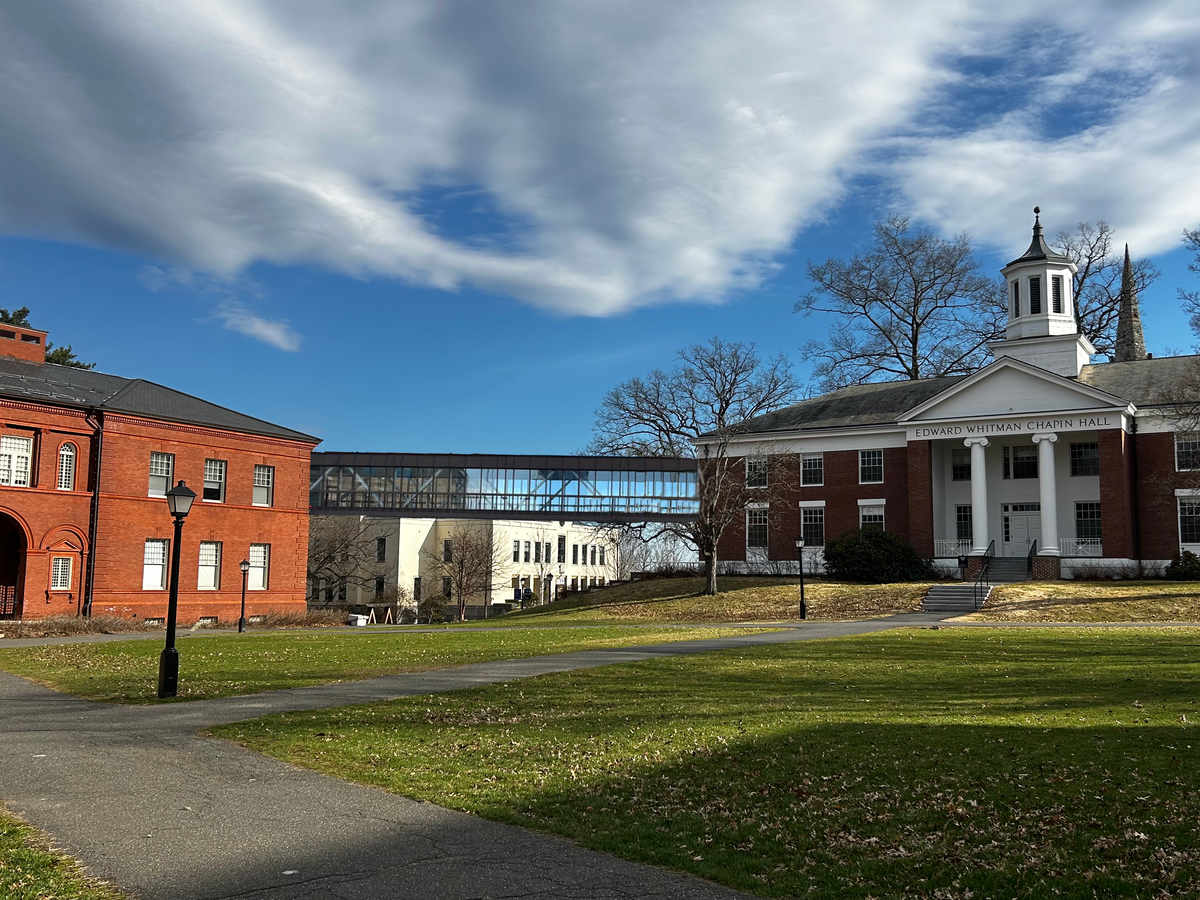
On Monday, the Association of Amherst Students (AAS) announced a bold new infrastructure initiative taking the place of all senate projects for the next year, aimed at shielding students from what it described as “the coldest winter in living memory, or at least since last year.” AAS revealed plans to construct a comprehensive network of land bridges connecting nearly every building on campus.
“Amherst is an intellectual community,” Bridget K. Nect ’26 said. “There’s no pedagogical reason anyone should experience weather. More broadly, the Amherst bubble should extend to precipitation.”
Each building on campus will now be connected to those in its immediate vicinity. Students should expect bridges between locations like the Science Center and the Greenway dormitories, Frost Library and Chapin Hall, and one across College Street from Arms Music Building to Garman House.
In its preparatory research, however, AAS has also identified several buildings that need to be connected otherwise. Certain bridges will be constructed to alleviate a great source of first-year confusion on campus. It is not uncommon to see lone freshmen searching aimlessly for Lipton House and the attractive upperclassman they met at a party, but instead wind up in Senior Lecturer in Chemistry Stephen Cartier’s class in Lipton Lecture Hall. The new construction aims to fix this issue by bridging between locations on campus that share the same name.
“I wish these bridges would have been an option when I started here. You can’t imagine the embarrassment I felt when I was trying to find my first therapy appointment with CCMH at Hitchcock House and ended up in the middle of a baseball mixer in Hitchcock Hall instead,” AAS senator Joseph Supik III ’27 said. A bridge will now connect Hitchcock Hall and Hitchcock House.
The senators also view this landmark project as an important step in bridging (no pun intended) the divide between different groups of students on campus. Bridges between the Hastings Apartments, the Zü, and Marsh Arts House aim to unify the farthest reaches of Amherst College property. AAS members anticipate that this novel manner of accessing the Hill will increase the popularity of dorms like Tyler and Plimpton. “Suddenly, my housing selection number of 4,583 isn’t looking too bad,” rising senior Hillary Walker ’26.5 said.
The bridges will serve a population much greater than just current Amherst students. A dedicated Alumni Bridge will span the gap between the Alumni House and the heavily anticipated Alumni Pub in the new Student Center and Dining Commons. AAS Senators maintain that this bridge is designed with the sole purpose of “making the lives of former mammoths more enjoyable.” Current students will be barred from utilizing the Alumni Bridge, and alums must present their Olio yearbook to be granted access.
AAS emphasized that the land bridges are not merely functional, but beautiful. Renderings released on Monday to The Student depict a series of sleek glass-encased corridors above campus, transforming Amherst into what many described as “part liberal arts college, part airport terminal.” When asked whether the bridges might fundamentally alter the character of campus, AAS reassured students that the design was carefully chosen to blend with Amherst’s historic aesthetic — by ignoring it entirely.
All bridges will feature airport‑style moving sidewalks, allowing students to arrive at class faster while standing completely still. Some longer routes will require students to take a glass elevator up to a dramatic height before seamlessly merging into the elevated bridge network. Solar panels will line the tops of the bridges as part of Amherst’s broader carbon‑neutral initiative, ensuring that every step students take on the moving walkways is at least morally sustainable.
To address lingering environmental concerns, AAS unveiled a series of supplemental measures described as “innovative,” “community‑based,” and “not optional.” Mandatory bike‑pedal desks will be installed in every dorm room, library, classroom, and informal study space on campus. To ensure compliance, AAS approved the creation of a new role — Community Safety Administrator for Sustainable Motion, whose sole responsibility will be to walk around campus observing students’ legs in motion. Students found not pedaling will have their bridge privileges immediately revoked for the exact duration they failed to pedal. They will be required to travel outdoors and be exposed to weather. AAS described this enforcement model as their commitment to “restorative justice.”
Through its partnership with Doshisha University in Japan, Amherst has received access to a new experimental technology that generates energy purely from walking. Details of how the technology works were limited, but AAS assured students it is “very real” and “very cutting‑edge”. By integrating this technology into the land bridges themselves, every footstep students take will contribute to Amherst’s energy grid, transforming daily movement into what they called “a shared act of sustainability and surveillance.”
AAS also unveiled a new student facing dashboard that tracks individual energy contributions in real time. Accessible through Workday, the interface displays each student’s output from pedaling, walking, and general kinetic participation, converting it into a single, easy-to-understand metric: the weekly “Sustainability Score.”
While AAS emphasized that the public leaderboard is “not intended to be punitive,” it will be visible to peers, professors, and “select members of the broader Amherst community who care deeply about collective responsibility.” Students in the top percentile will receive priority bridge access, faster-moving walkways, and “express lane” privileges during peak hours. Students in the bottom quartile, however, will be temporarily reassigned to ground-level routes, where they will be required to travel outdoors until their metrics improve.
To maintain traffic flow across the bridges, AAS will release a 47-page Bridge Etiquette Guide, described by one senator as “aspirational and enforceable.” Key rules include standing on the right, walking on the left, observing right of way, and maintaining a minimum forward velocity of 1.7 miles per hour on all moving walkways. Students who wish to stop and talk must relocate to designated “Conversation Bays,” small glass enclosures positioned at regular intervals along the bridges and acoustically engineered to amplify awkward silences.
As for particularly congested areas, student traffic coordinators will be stationed to direct flow using a system of hand signals, whistles, and “firm sensual eye contact.” The coordinators will also be authorized to issue on-the-spot citations for violations such as slow walking, distracted walking, and “walking with unclear purpose.”
Despite minor concerns, AAS leadership remains optimistic about the project’s rollout. Construction is expected to begin immediately, with the first phase slated for completion by this summer. Full completion of the bridge network is projected within the next three to five years due to the number of planned land bridges, though AAS clarified that students will begin experiencing the benefits “spiritually and conceptually” much sooner.
AAS encouraged students to remain patient during construction and to continue using existing ground-level pathways in the interim, describing them as “a valuable, if temporary, opportunity to engage with the natural world one last time.”

Comments ()