

Adventures Abroad: Rizwan Ayub ’27
In this edition of Amherst Adventures Abroad, Managing Features Editor Emerita Nife Joshua ’26 spoke with Rizwan Ayub ’27 on his time in Edinburgh, Scotland where, through housing, friendships, and outings, he felt the striking difference between a small college and a large university.

Studying abroad is often presented as a defining part of the college experience. For Rizwan Ayub ’27, a history major and member of the Amherst Students Association, studying abroad wasn’t really a long-time dream. In fact, because of his wide range of campus commitments, he had completely ruled out studying abroad, that was, until January of last year.
As the study abroad deadline approached, Ayub was worried that he would not be able to go: “Everybody else is going to have these wonderful experiences abroad; I’m going to miss out because of [commitments like] budgetary — and that sounds lame.”
Making the Decision
Halfway through sophomore year, Ayub decided he was, in fact, going to study abroad. From the start, he hoped to explore English-speaking options for his semester, but by the time Ayub began searching, many applications for the popular English-speaking programs (such as Oxford and Cambridge) had closed. So, he was pushed to Scotland, where he was introduced to the University of St. Andrews and the University of Edinburgh.
Ayub spent a lot of time weighing the two universities: “St. Andrews has about 8,000 students and is in a small town on the coast, [it] is really a nice, very pretty place. However, my concern was that [it] just felt too much like Amherst to be worth it to go.” In regards to the University of Edinburgh, a public university of roughly 45,000 students, Ayub shared that he has heard a lot of good things about Edinburgh — that it was “ ... beautiful, very walkable, and historic. Everyone who’s been to Edinburgh always recommends [going] there.”
Ultimately, differences in campus size, along with others’ recommendations, drew Ayub to the University of Edinburgh.. “I wanted to try out what it would be like to go to a huge school for a semester and live in a city, as I hadn’t lived in a city up until that point,” he said.
On Sept. 1, Ayub arrived in Scotland, and about two weeks later, Ayub started taking three courses, one course on social theory and two that dealt indirectly with the history of the British Empire — subjects that immediately piqued his interest.
“[These courses] were fascinating [because] they made you think about what British academia has said about the British Empire, and how the University of Edinburgh, as an institution, has benefited tremendously from colonialism, due to wealth that has flowed into the university.”
In his favorite class, “Revolution and Reform in the Modern Middle East,” Ayub worked closely with his professor and conducted research on Palestinian historiography.
“Palestinian historiography — that's two big words put together. [It’s] basically the history of how historians have interpreted the Palestine-Israel conflict. It was fascinating to delve into with [my professor], and working with her really was a pleasure,” he said.
He also reflected on how the coursework reshaped his understanding of Great Britain’s current population: “It’s fascinating to study the British Empire and the [United Kingdom]…To see firsthand how the Empire has affected the demographics of Britain, particularly the large numbers of [South Asian] and Muslim immigrants from countries like India, Pakistan, and Bangladesh that were formerly colonized by Britain.”
Finding a Voice in Community
While Ayub’s immersion into his classes and coursework was mostly seamless, adapting to the university’s large size was a more difficult adjustment to make. Though he had initially assumed that attending a large school would make it easier to befriend local students, he found that the opposite proved true.
“I ended up mostly being friends with other exchange students from schools in the U.S. similar to Amherst, like Claremont McKenna, Pomona, Colby, and Kenyon,” Ayub said.
Ayub noticed a substantial American population in Edinburgh: “What I’ve heard is … that, despite the international tuition rate being high, [University of Edinburgh] is cheaper to attend [than] Amherst at full tuition. My impression is that Edinburgh tends to attract students, American students, who are in the category of ‘not qualify[ing] for financial aid at Amherst, but also not able to afford to pay full tuition…’ Scottish universities have become quite popular with American students full-time for that reason.”
Ayub added that he ended up becoming friends with Americans largely by circumstance. “When you’re in a place where you’re surrounded by a lot of unfamiliar people, like being an American abroad, you gravitate toward people who feel familiar,” he said. “If you had told me before I went abroad that this would happen, I would have expressed some regret. But it was a valuable learning experience in understanding how social dynamics work.”
Over time, Ayub began to expand his social circle beyond American students. Interestingly, it was through a campus sketch comedy group called the Edinburgh Revue, that he began building friendships with local students.
“I randomly joined the WhatsApp group during welcome week; my friends and I were at the dining hall, and were like ‘we should go,’” he said. Though some of his friends stopped attending, Ayub gradually became more involved with the group: “I kept on going [to the club] because I had this idea for a sketch where this blackout-wasted posh kid would be getting visions of Biggie, Tupac, and Eminem, [and] he has to save the rap game. [So] I wrote about it, and they really liked it, and they put it on.”
Not only did he enjoy writing skits, but he also loved the company. “Comedy people are very chill. I was able to make friends with Americans, but also with Scottish students, English students, and other international students,” he said. “We would write comedy sketches together and act them out at a local comedy club. [It] was a great way to see how comedy transcends barriers.”
Ayub remembered moments when cultural differences surfaced in unexpected ways, particularly through humor: “There was this comedy sketch that got brought to a group that [I didn’t understand at all]. Then, I [was] told that it was a British sense of humor that I, as an American, could just not pick up. It was one of the most interesting moments to see ‘what are my limitations in understanding things as an American who is not British and does not have this cultural recognition.’”
Ayub also explained how the comedy group connected him to Edinburgh’s broader performance culture. He noted that the city is known for hosting the Edinburgh Fringe Festival each August, one of the largest performing arts events in the world, which draws hundreds of thousands to over a million visitors and fills the city with performances throughout the month.
“When I walked [around] Edinburgh, I would see Fringe posters up as decorations across the city,” he said. “[Fringe] is a big part of the culture in Edinburgh.”
In addition to forming friendships through comedy, Ayub found himself expanding his circle through journalism. He joined Leviathan, a student-run political journal, in the hopes of receiving feedback on an article he had written analyzing prison poetry from the 1971 Attica prison uprising in upstate New York.
His inspiration for writing the article stemmed from an interest he had developed while in the States. “I have been interested in prisons for a while due to things at Amherst. I took ‘Justice’, the Inside-Out prison course held at the Hampshire County Correctional Facility with local incarcerated people,” he said.
For Ayub, the university journal encouraged a type of writing that he would take back to Amherst with him. Writing for Leviathan gave him the opportunity to formalize his interest in prisons into a published academic article, which he said has been “really great” because that article is now likely serving as the bedrock for his thesis.
Ayub presented his article, and over the course of the semester, he received both feedback and friendship from the journal’s editors. “I became quite friendly with two editors whom I worked with … one of [whom] is from New York City and the other one is from Essex,” he said. “It was fun to work with them; white liberal girls are very similar between Scotland and the U.S.”
Ayub found common ground with his editors, who shared his obsessive political nature and often discussed campus political events, which helped him learn about British politics and culture. He recalled how one conversation highlighted the financial pressures many students faced. “How much money you have will directly affect your experience there,” Ayub said. “There was an article in the Edinburgh student newspaper saying that some students are going hungry because they cannot afford to buy groceries.”
That same conversation, he said, also noted differences in enrollment and tuition across student groups: “Scottish students get to go for free; however, it is a lot harder for them to get in because they go for free. English students pay more; it’s easier for them to get in. International students pay the most; it’s the easiest for them to get in. The university chooses to accept a fee from the Scottish Government to underenroll Scots versus enrolling more Scots.”
Political conversations like these were often held in the trio’s favorite coffee shop, Soderbeg Coffee, which Ayub reflected on most positively: “Through these small interactions about getting coffee with them, I felt much more included. They were very interested in what I had to say about Edinburgh University, how it compares to academics in the U.S., and what I think of the marking and grading.”
His experience living at a large university changed his understanding of how friendships form. Ayub reflected on the difference between making and maintaining friendships at Amherst versus Edinburgh, citing school size as a big factor in relationship building: “At a huge school, people disappear on you. I think that was one of the hardest things about cultivating these friendships, especially with [my two editor friends]. We just didn’t see each other very often, which was unfortunate, because I really did want to be [close] friends with them. I [found myself] intentionally texting ‘Hey, can we grab coffee before I leave? I’m gonna miss you guys.’ That’s how I would stay in touch with people.”
City Living
When Ayub first arrived in Edinburgh, his housing experience proved to be one of the starkest contrasts between Edinburgh and Amherst.
“So at Edinburgh, there are two forms of accommodation: self-catered and catered. In ‘self-catered’, you cook your own food, and in ‘catered’, you get breakfast and dinner every day. I knew nothing about Edinburgh housing going into this, so I just picked catering because I thought it would be easier not to have to cook myself.”
However, in hindsight, Ayub admits he should not have picked the catering option: “First, it was a lot more expensive than I thought it would be, because they don’t serve lunch. So you would have to buy your own lunch every day, and that got expensive quite fast. I had to dig into my own savings, which was unfortunate.”
He felt that these housing accommodations of “self-catered” versus “catered” cooking created a visible socioeconomic divide, especially since only some could afford to go out frequently.
Although Ayub’s catered experience was not entirely positive, it did have its highlights, particularly in allowing him to try a range of local foods; notably, some of his favorite spots were distinctly student-oriented. “There was this really good student restaurant called Nile Valley/African Wrap Cafe. It’s [actually] two restaurants run by the same family right next to each other,” he said. “They sold East African wraps with chicken, mayo, and hummus for four to five pounds. I miss that place, and it was cheap-ish for a city.”
He also recalls another staple, Mosque Kitchen. “In Edinburgh, after 9/11, the mosque set up a nonprofit kitchen to fundraise for the mosque and try to defuse the Islamophobia that came after 9/11. They had very good, very filling plates of food for like nine to ten pounds.”
In regard to Scottish traditional cuisine, however, Ayub found it fell short. “I’m not sure how much classic Scottish food is a thing, but I had haggis once or twice [and ] low-key it’s not that good. I think it’s more-so touristy.”
Regarding his other food pursuits, on Sundays, Ayub and his friends often went to Stockbridge Market, a weekly market in Stockbridge Park, a wealthier part of the city. “They had this really good East African roasted chicken and rice place for eight pounds that I would go to, and it would fill me up.”
Ayub recalled a funny anecdote at the Stockbridge Market: “There was this cheese vendor [and] she was offering free samples. I accidentally took too much, and I think she got concerned with my well-being because of how much blue cheese I had. But that was really good blue cheese. It was amazing.”
While Ayub’s off-campus experience was extremely rewarding, Ayub felt a real difference in the support he received abroad: “The thing about Edinburgh is that if you want to go, the university [mainly] wants to make money off of you … [even if there are] ... lots of good people at Edinburgh University who [would] care about you [individually] as a human being. It’s a different environment [than] Amherst, where the institution really does care about you and wants you to be supported.”
He explained that, unlike Amherst, where housing is assigned through a lottery and is not tied to how much a student pays to attend, housing at the University of Edinburgh is explicitly shaped by affordability. “In Edinburgh University … [housing] is quite explicitly based on how much you can pay,” he said.“If you have less money, those types of housing accommodations are much less available to you, and it creates a real social divide on campus. I noticed that wealthy students would tend to congregate amongst themselves and have their own apartments that are specifically designed to appeal to them.”
He also pointed to the broader economic landscape of the city itself. “Edinburgh is an expensive, wealthy city. It could be, I assume, if you’re lower income, … harder to afford living in the city, which is especially interesting because, as [one of my friends from Leviathan] put it, Edinburgh University is inseparable from living in the city of Edinburgh.”
Exploring Scotland
Aside from going to the city for food, Ayub was able to get a sense of Scottish traditions by visiting local pubs. “Pubs are a big part of British culture, and they serve as communal meeting spots for people,” he said. “I don’t drink, but I’ve been to pubs a fair amount of times, and I felt included, like I could sit there and hang out with my friends.”
He named The Pear Tree —near the University of Edinburgh — as a major gathering place, but also mentioned one pub that stood out as a cozy place to grab a drink and a bite, along with being a history major’s dream: The King’s Wark.
“It opened in 1453, which, as a history major, I can say is really old. They had fish and chips, which were not amazing, but I still strongly suggest that you go and visit … it was amazing to be in a restaurant that had been open longer than the discovery of the Americas,” Ayub said.
Ayub also explored the broader U.K., using the train system, which he enjoyed. “Britain has a program called the ‘rail card.’ If you are between the ages of 16 and 25 and pay 35 pounds, you get a discount of about a third off your train fares. So I bought a rail card, and it was great because I got to visit a bunch of towns in Scotland and in England,” he said.
With the rail card, he visited Berwick-upon-Tweed, the northernmost town in England, and a beautiful coastal fortress town. There, Ayub scored a history-buffs dream find: “I bought these retro National Geographic books from the ’80s and ’90s, authentic British National Geographic. It’s crazy, like you could not find those anywhere else.”
Ayub traveled to Dunbar, a town about a half-hour from Edinburgh, where John Muir was born, and took a day trip to Glasgow, where he visited the Kelvingrove Museum and appreciated it as a free art museum set in a historic neighborhood. He also visited St. Andrews twice, finding it so beautiful that he made it his phone background.
His program also took students to the Isle of Skye for a weekend. “It's this beautiful island on the Scottish west coast. They sent us straight in … when the remnants of Hurricane Humberto were hitting the Scottish west coast,” he said. He described it as chaotic, but also sobering, because he felt privileged to be able to leave as a visiting American student, while locals could be stranded when infrastructure shut down.

Closing Thoughts
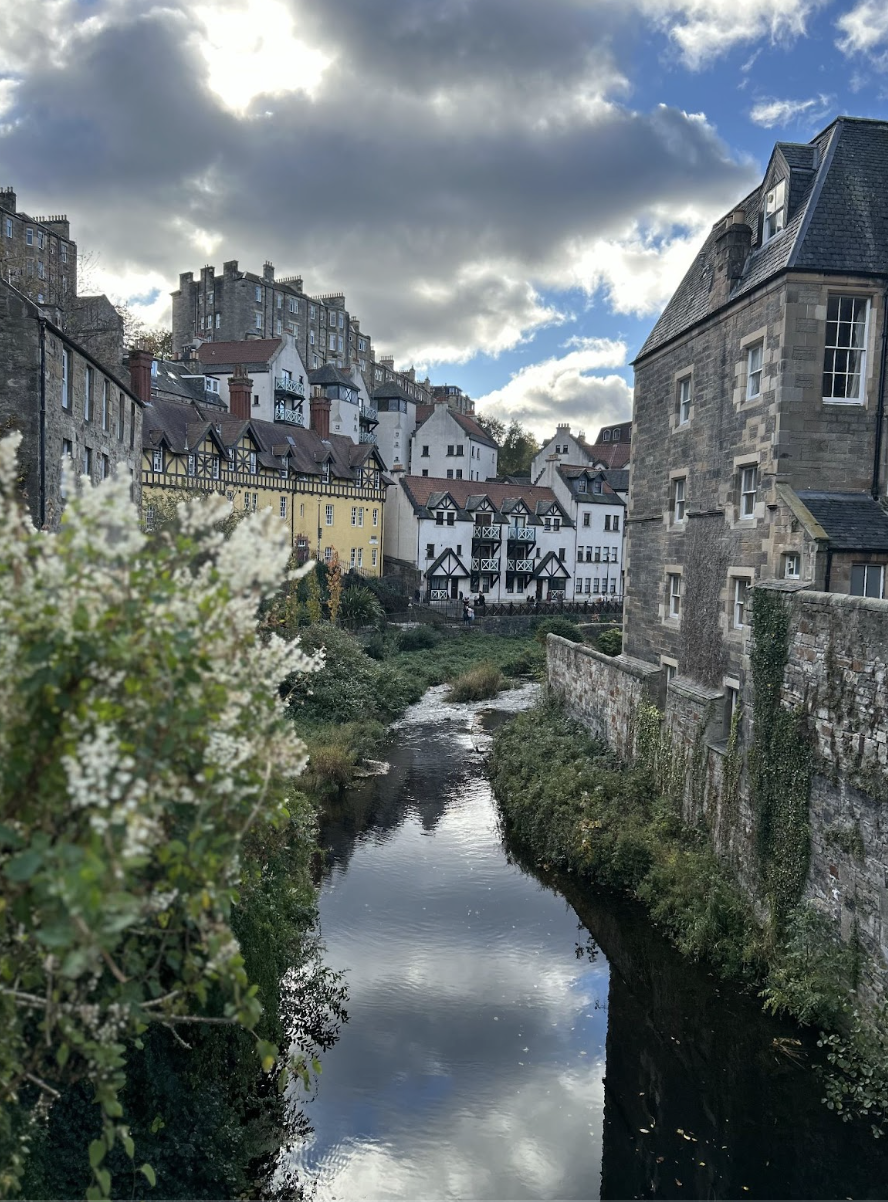
If you were to fly to Edinburgh tomorrow, Ayub’s recommendations are both classic and deeply personal. Specifically, Ayub emphasized two tourist attractions as must-gos: “Edinburgh Castle is gorgeous. You can walk around inside. It hovers over the city. The Royal Mile is pedestrian-only in the middle of the city.” In general, though, Ayub advised visitors to “just walk around the city. It’s truly one of the most walkable cities in the world. Never fails to disappoint.”
He’d also send you to Holyrood Park, his preferred escape when he wanted quiet. “I love to go on walks. It was a nice, peaceful escape from the city, and the views are beautiful, nice views of the city. I will have to send pictures,” he said.
For those interested in getting a keepsake from the area, Ayub would point you toward charity shops. “In Britain, the big charities like Oxfam and the British Heart Foundation, and Shelter Scotland run shops across the city,” he said. “People donate their goods, and then they sell [them] …too cheap[ly]. I love the shops. They are beautiful inside. I adore them to death. And [from one of them] I bought a super cute hat for three pounds.”
He also noted that one shouldn’t confuse a “fulfilling” study abroad experience with an “expensive” one. Ayub found that some of his most memorable and fulfilling moments were ones that didn’t cost much, including “joining a comedy club for free, buying a hat for three pounds at the charity shop, chilling with four white girls in the coffee shop [talking] about disability politics, and going on random walks with my boys in Holyrood Park.”
Ayub described the type of person who should visit Edinburgh. “Edinburgh is a weird place to go. It’s a weird place to decide to go abroad. While Ayub admits that places like Oxford and Cambridge might be better for academically rigorous programs, and another city on the continent like Copenhagen might be better for travel, Edinburgh calls for a certain type of student. “Edinburgh is in a very weird middle ground of who should go. I would say go because you can travel, just not as much as if you were in Copenhagen,” he said. “You can [be pushed] academically, just not as much as if you were in Oxbridge.”
His closing thought returns to what he learned about meaning: Studying abroad doesn’t have to look like a feed. “As I said before, there is more to studying abroad, having a fulfilling time abroad, than that classic Instagram experience, even if you go to a place like Europe. And quite honestly, I don’t know who Edinburgh would appeal to for study abroad,” he said.
His advice was to pursue your interests and make friends with those who share them: “Try your best to [make friends], even though it’s hard, try your best, be a bit chill, try to meet local students by joining societies and clubs. It’ll be tough. You’re gonna feel excluded. I felt excluded, but I still miss the friends I made.”
Ayub’s story about Edinburgh is both a warning and an invitation. He repeated in his interview once again very bluntly, "The University of Edinburgh ‘only wants to make money off of you’ and ‘will not support you or care about you.’” However, he emphasized just as strongly that there are “lots of good people,” and if you go, you have to find community through other students.


Comments ()