

Alum Speaks on Innovation and Artificial Intelligence in Liberal Arts
On Thursday, the AI in the Liberal Arts (AILA) speaker series welcomed Ahmed Aly ’24 to discuss how a liberal arts education taught him innovation through more human lenses. Aly spoke on how his Amherst education inspired his development of voice-based AI tools to address communication barriers.
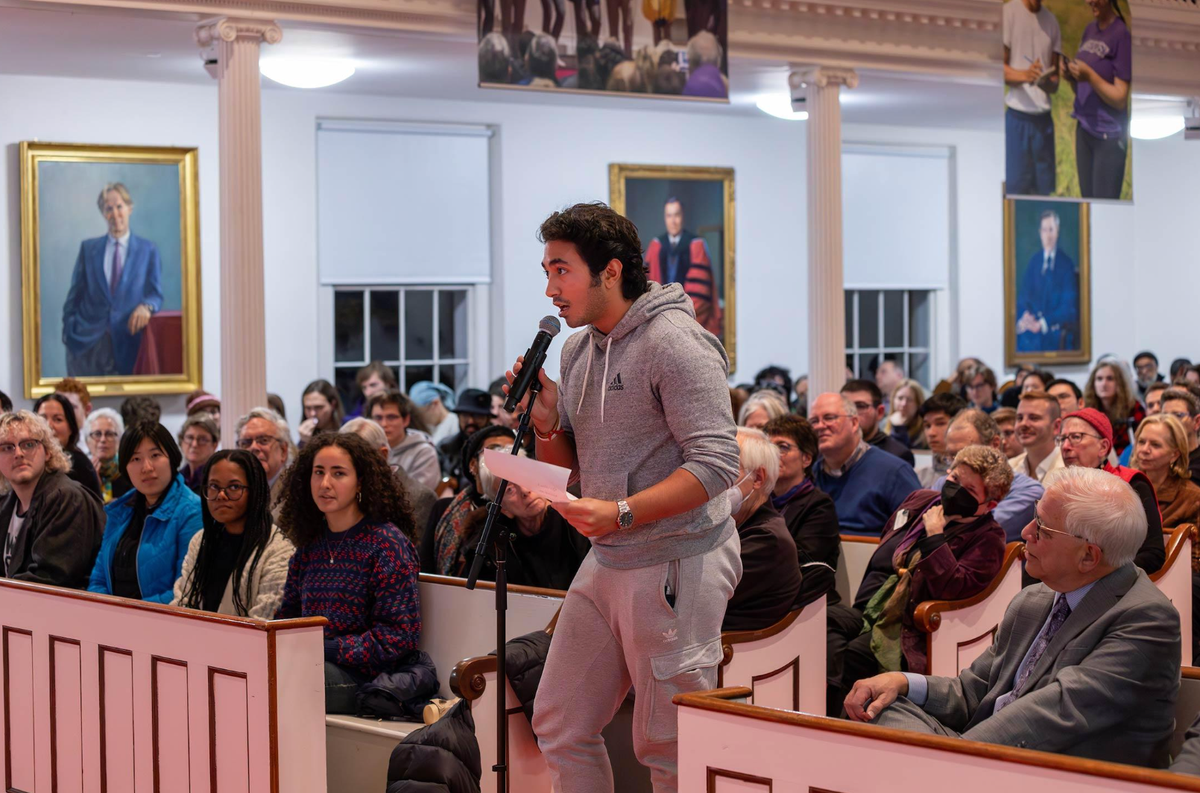
On Thursday, the Artificial Intelligence in the Liberal Arts (AILA) alumni speaker series welcomed Ahmed Aly ’24 for a conversation on how a liberal arts education can inspire bold innovation. Aly is the founder of Vship, a company that uses AI systems to empower truck drivers across the nation.
As an international student from Egypt, Aly shared that his interest in technology began after witnessing the 2011 “Facebook Revolution,” an online mobilization that overthrew Egypt’s dictator, Hosni Mubarak, after 30 years in power. He was fascinated by the power of digital technology to transform a country’s trajectory.
Aly spent most of his teenage years pursuing his interest in technology, but it was Amherst that introduced him to the value of the humanities and social sciences. Although he initially struggled to reconcile his passion for computer science with the interdisciplinarity of the liberal arts curriculum, Aly eventually came to understand how a liberal arts education could offer him a deeper understanding of how the world works.
“To me, that is what liberal arts boils down to. It teaches you how to think. It doesn't teach you how to become a great software engineer. It doesn't teach you how to be the best mathematician. But it teaches you how to think,” he said. “It makes you human.”
Aly said that his Amherst education offered him a unique advantage when he decided to pursue entrepreneurship after college. While many professionals in the tech industry focus solely on technical fields — such as coding, engineering, and programming — his liberal arts education allowed him to also think about innovation through the lens of social and cultural inequality.
“If you're crossing between the humanities and STEM, you have such a superpower that you can understand any system … with all its multidimensionality,” Aly said.
Vship develops AI co-pilots to handle phone calls and messages for truck drivers — especially those who are non-native English speakers — to address the language and communication barriers that often disadvantage immigrant workers in the industry. The technology enables drivers to communicate more easily with customers and logistics handlers. The company’s broader goal is to democratize access to advanced technology for independent truckers, giving them tools similar to those used by large corporations like Amazon or UPS, but without the top-down control imposed by those companies.
Aly argued that technology can be used for both positive and negative purposes. “More people are working to build technology to oppress rather than to help and support,” he said. He said this is one of the reasons students should approach technology with a more critical lens.
AILA Student Assistant Hena Ershadi ’26 enjoyed the talk. “I think that his perspective was refreshing, optimistic, and inspiring. Rather than treating technology as neutral or profit-driven, Aly frames it as a moral and creative tool to improve people’s lives,” she said.


Comments ()