

Amherst Hockey Alum Joins the Capitals
Managing Sports Editor Helena Henson ’28 sits down with Connor Leslie ’25 after his recent appointment as an Emergency Backup Goalie (EBUG) for the Washington Capitals.
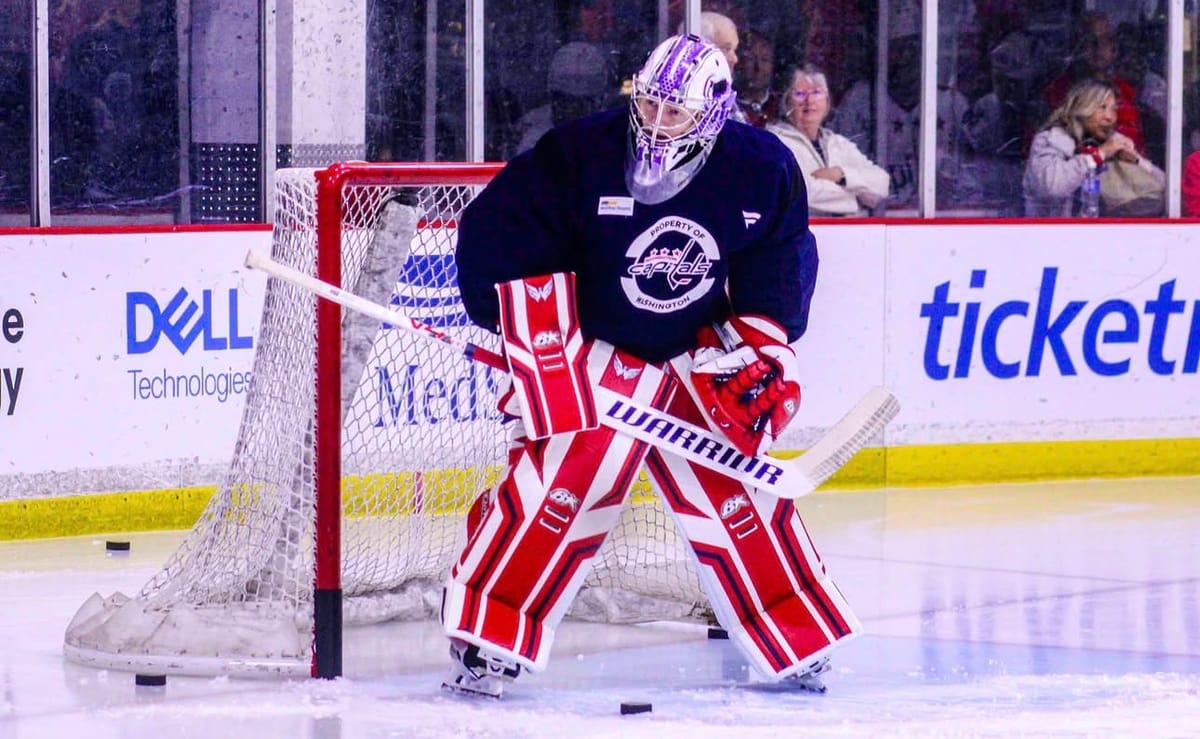
When Connor Leslie ’25 graduated from Amherst College in the spring of 2025, he thought his hockey career was over.
A political science and psychology double major, Leslie spent his senior year balancing a political science thesis with hockey. After four years as a Division III goalie, he was prepared to move on to the next chapter. Less than a year later, Leslie found himself joining the Washington Capitals as the team’s inaugural full-time Emergency Backup Goalie (EBUG).
A Hometown Connection
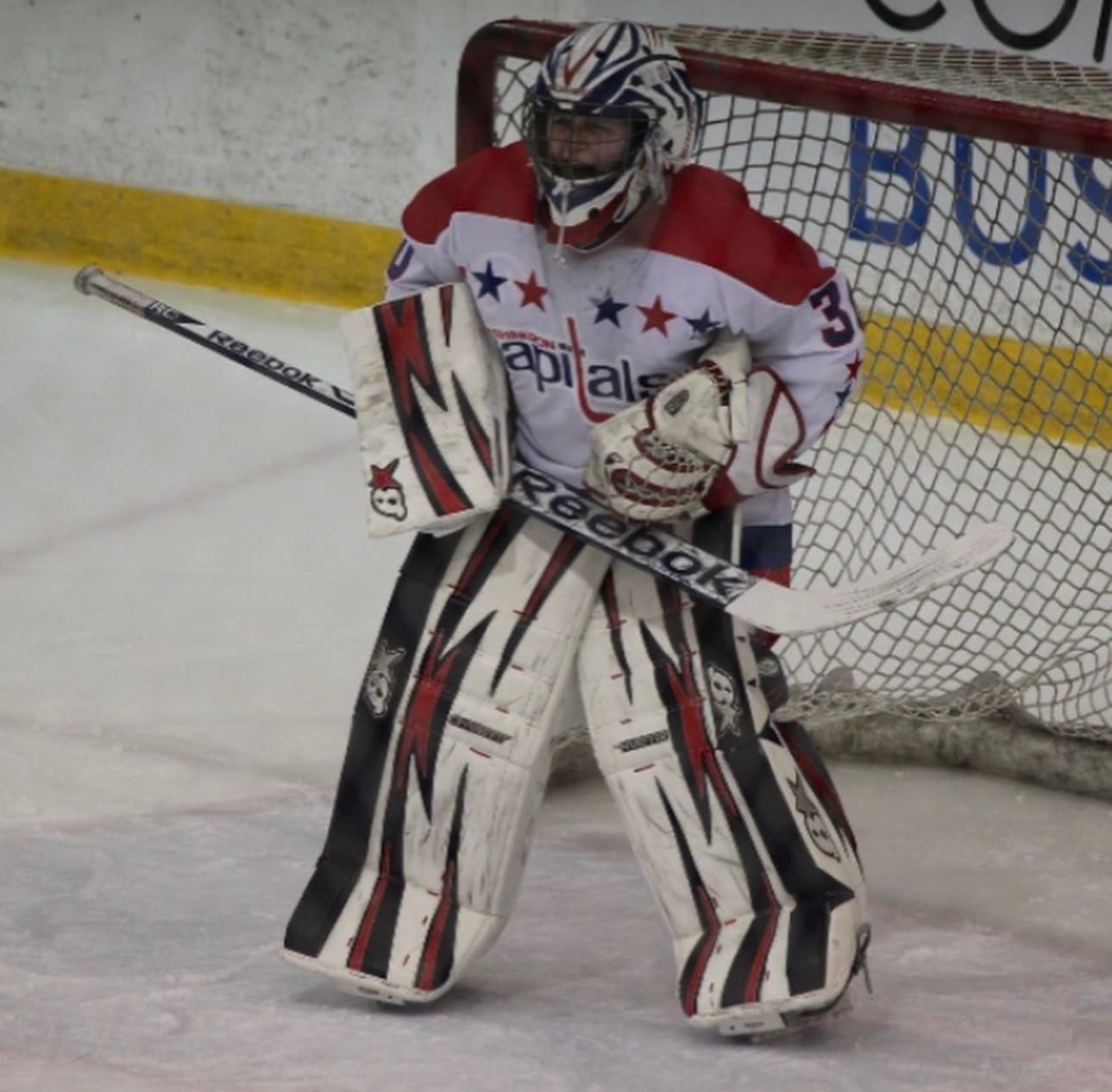
Leslie’s connection to the Capitals goes back much farther than his new role with the team. A native of Leesburg, Virginia, Leslie spent eight years playing travel youth hockey for the Washington Little Caps — a program that practiced and played at the MedStar Capitals Iceplex, the same building the NHL club uses as its practice facility. The Capitals were his favorite team growing up, and the rink he skated on as a kid is the one he would return to years later as an employee.
During his summers in college, Leslie searched for nearby skates in the Washington, D.C., Maryland, and Virginia (DMV) area. One set of skates, called DMV Three’s Hockey, put Leslie in the orbit of a mutual friend, Jack Spicer, who knew Capitals goaltending coach Scott Murray.
When Murray was looking for members for the Capitals’ summer skill sessions, he asked Spicer whether he knew “another good goalie in the area who would be willing to come out to these skates,” Leslie recalled. Spicer referred Leslie, who went on to skate with Capitals players for two or three summers.
For Leslie, these sessions were a way to train for next season at Amherst. “There’s no better way to prep than practicing with some of the players at the highest level,” he said.
Even though Leslie stopped attending these summer skates after graduation, Murray kept him in mind. In Feburary of 2026, Capitals starting goaltender Logan Thompson was given the day off from practice to recover from competing in the Winter Olympics, leaving an opening for Leslie to fill in. Murray texted him and asked if he was available to come to practice.
Leslie, who was then working as a golf caddie, said yes, not knowing the skate was effectively his audition for the Capitals’ newly expanded EBUG role. “In no way, shape, or form did he inform me that this was sort of like my tryout, which was honestly kind of a blessing in disguise,” Leslie said. “I thought hockey was done, so it was sort of my chance to go out [and] have fun.”
The skate went well. Afterward, Murray asked Leslie if he was interested in joining the team as an EBUG.
A New Kind of EBUG
Leslie’s opportunity comes as the National Hockey League (NHL) changes what it means to be an Emergency Backup Goalie.
In June of 2025, the NHL ratified a new collective bargaining agreement (CBA) that went into effect earlier this month. Among its changes, the agreement lengthened the regular season from 82 to 84 games, relaxed the player dress code, and legitimized the role of an EBUG.
Beginning this season, all NHL teams must designate a full-time employee as an EBUG who will travel with the team. There are a few eligibility requirements for the new EBUG, too: They cannot have played in an NHL game, more than 80 professional games, or professional hockey in the previous three seasons.
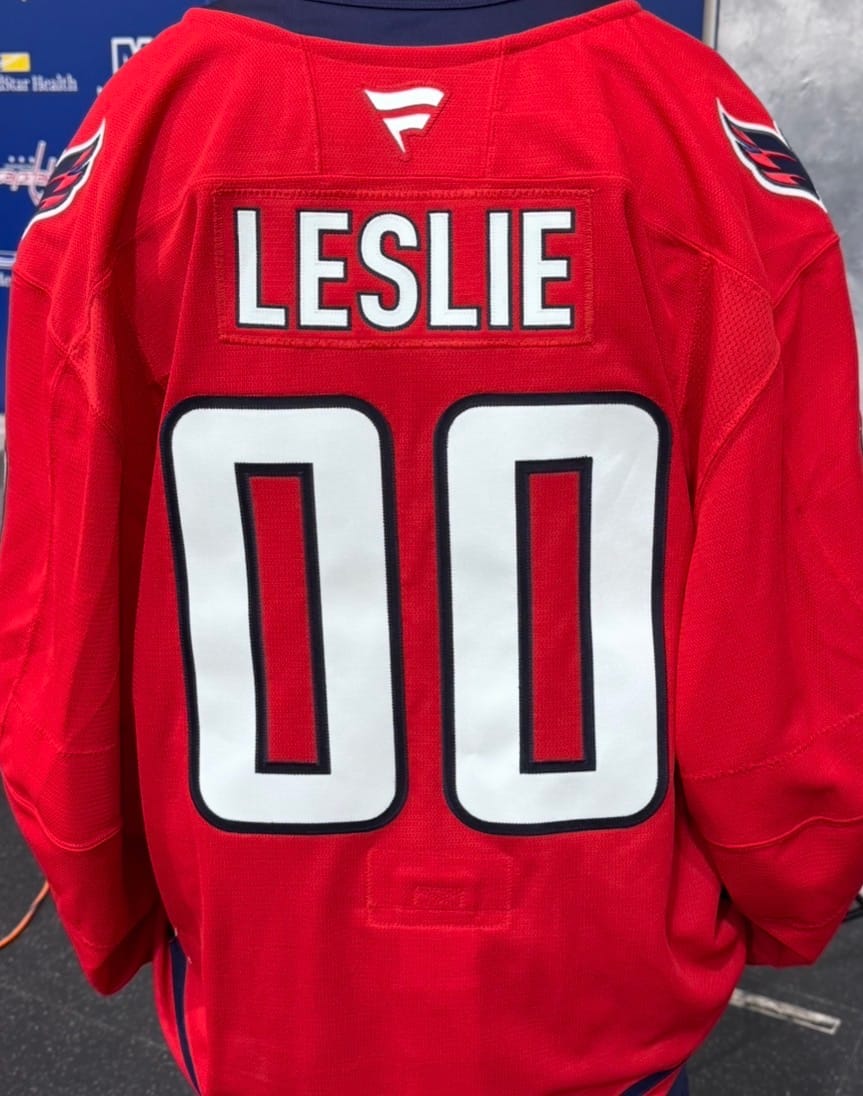
The new EBUG role is broad and, by Leslie’s own account, still taking shape. He will be the extra goaltender for practices, skill skates, and any additional sessions if a player wants to practice shooting. He is the “helping hand” who can step in whenever Thompson, Charlie Lindgren, or whoever is in net has taken enough shots. Leslie will travel with the team to be present at every game, home and away, as the third netminder. And if both goalkeepers were ever injured during a game — “which hopefully does not happen,” Leslie added — he would be there to be “that last line of defense … to help the team get the job done.”
But even with those responsibilities outlined, the position is still taking shape.
The Capitals have been direct with Leslie, telling him that his role will be fluid. “I’m also sort of the goalie assistant who is going to be helping out [Murray] with whatever he needs,” Leslie explained that his duties will extend off the ice, too, assisting the equipment staff however he can. “It’s pretty much just an honor to even be able to be associated with the Capitals … I show up every day with a big smile on my face. Whatever you need me for today, I’m here to do it.”
This follows a broader trend across the league in which new EBUGs will also take on other responsibilities within the organization. For instance, the Minnesota Wild hired Peter Thome as both a Hockey Operations Analyst and EBUG, and many other teams have nominated goalies who were already hired for other positions within the team.
Leslie added that, even as he continues to figure out his role, the Capitals organization has emphasized that they want him to feel integrated into the team. Even before officially starting on Sept. 17, Leslie was at the rink every day, meeting the players and staff, so when he could finally join on the ice, he says, “it [didn’t] feel like I’m a stranger to everyone.”
The hardest adjustment so far, he joked, has been learning everyone’s nicknames and receiving one of his own.
Dreams Are Still Coming True
The recent changes to the EBUG position have also sparked nostalgia for the previous version of the role.
Following the announcement of the CBA, coverage of the new rules frequently looked back at stories that made emergency backup goalies famous: David Ayres, the “Zamboni driver” (really a building manager for an AHL team) who helped secure a comeback win for the Carolina Hurricanes in 2020, and Scott Foster, a 36-year-old accountant who took the net for the Blackhawks in 2018. Examples include a Defector article titled “The End Of EBUGs Means The End Of Dreams Coming True” and an AP News article titled “Hockey’s beloved emergency backup goalies face an uncertain future with new NHL rule.” Both pieces reflect on the fantasy of an ordinary person getting a chance to play in an NHL game, and critics of the new system have argued that a salaried, full-time backup kills that story.
Leslie understands that sentiment. He agrees that those anonymous EBUG stories are “special moment[s] in hockey history.” But he does not see his own story as the end of the unlikely EBUG. If anything, he sees himself as proof that the spirit of those stories can still exist. “I was a D[ivision] III goalie. I thought hockey was done,” Leslie said. “I sort of still fit that mold of, if you keep at something, if you’re determined and you have great character, and you don’t give up on your dreams …anything can still happen.”
For Leslie, the unexpected opportunity carries another layer of meaning: he gets to continue to play alongside the players he grew up watching. “For me, being from the DMV … I idolized a lot of these players and look[ed] up to them,” Leslie remarked. Now, he shares a locker room with them.
“It’s cool that I even get an opportunity to continue playing, especially around players of this magnitude,” he reflected. “But don’t get me wrong, just because I say that it’s a really cool moment doesn’t mean that I’m striving to go into the net for a game or anything,” Leslie clarifies. He is quick to point out that his goal is simple: help the team however he can.
That mindset is one he developed long before he joined the Capitals.
Preparation at Amherst
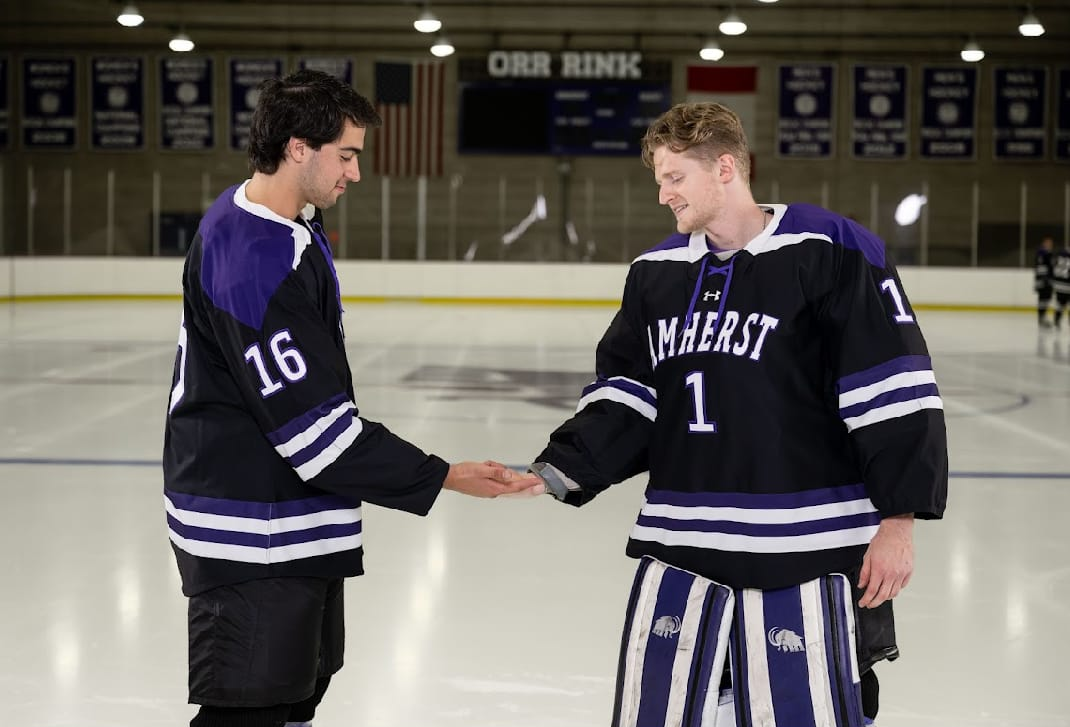
When asked to reflect on his four years at Amherst, Leslie did not hesitate. “Amherst 1,000% prepared me for something like this.” Amherst was more than where he played hockey; it was where he learned how to contribute to a team. “Amherst was by far one of the best times of my life,” he remembered. “It really showed me what it means to be a good person, a good teammate — just based on all the players that I played with throughout my time there — and what leadership looks like.”
That lesson came in part from Amherst’s approach to its goaltending. While at Amherst, Leslie said there was never a fixed starting goalie. The position was instead fluid: Whoever was playing well got the opportunity to start in net. When goalkeepers were playing well, they all had opportunities to play.
That environment taught Leslie that contributing to a team doesn’t always mean being the person on the ice. “One of the things I’m gonna have to get really good at is balancing my time and being there, and basically giving it my all for these players, even though it’s not like I’m truly playing in a game,” Leslie said. “But I know that what I’ll be doing for them could make them better and could give them the best results. And a lot of that I did at Amherst, too.”
He remembers that it was the times when he was not playing that he “truly got to embody just being a good teammate, being supportive no matter what, [and] being there for everyone, no matter what.”
That team-first mentality is something Leslie’s former teammates remember well.
Cristobal Tola ’28 remembers Leslie as the senior who immediately made younger players feel comfortable. “He always brought positive energy,” Tola said. “[He] never had a bad day, or at least never showed it to us.”
For Tola, that attitude extended off the ice as well. Leslie was someone teammates could rely on. “He was like one of my brothers,” Tola recalled. “[He] always had a hand out whenever you needed it.”
Vincent Velocci ’27 similarly remembers Leslie as “someone you enjoyed being around, always in a good mood.” He added that Leslie was “always joking [and] always had a smile on his face.”
It is those qualities that have made his former teammates especially excited to see him take on this new opportunity.
“I think I speak on behalf of everyone when I say we’re all so excited for him,” Velocci exclaimed. “It couldn’t happen to a better person … Good things happen to good people.”
Tola added that, “regardless of what happens, I think me and everyone else on the team, and Amherst Hockey as a whole, [are] behind him and supporting him every step of the way.”
Comments ()