

Panel Discusses Brazilian 2026 Presidential Elections
On Wednesday, BRASA Amherst hosted a panel on the 2026 Brazilian elections. Professors of Political Science Manuela Picq and Javier Corrales, and Professor of Theater and Dance Angelica Monteiro, shared their views on the relevance of the defeat of a far-right candidate for a polarized world.
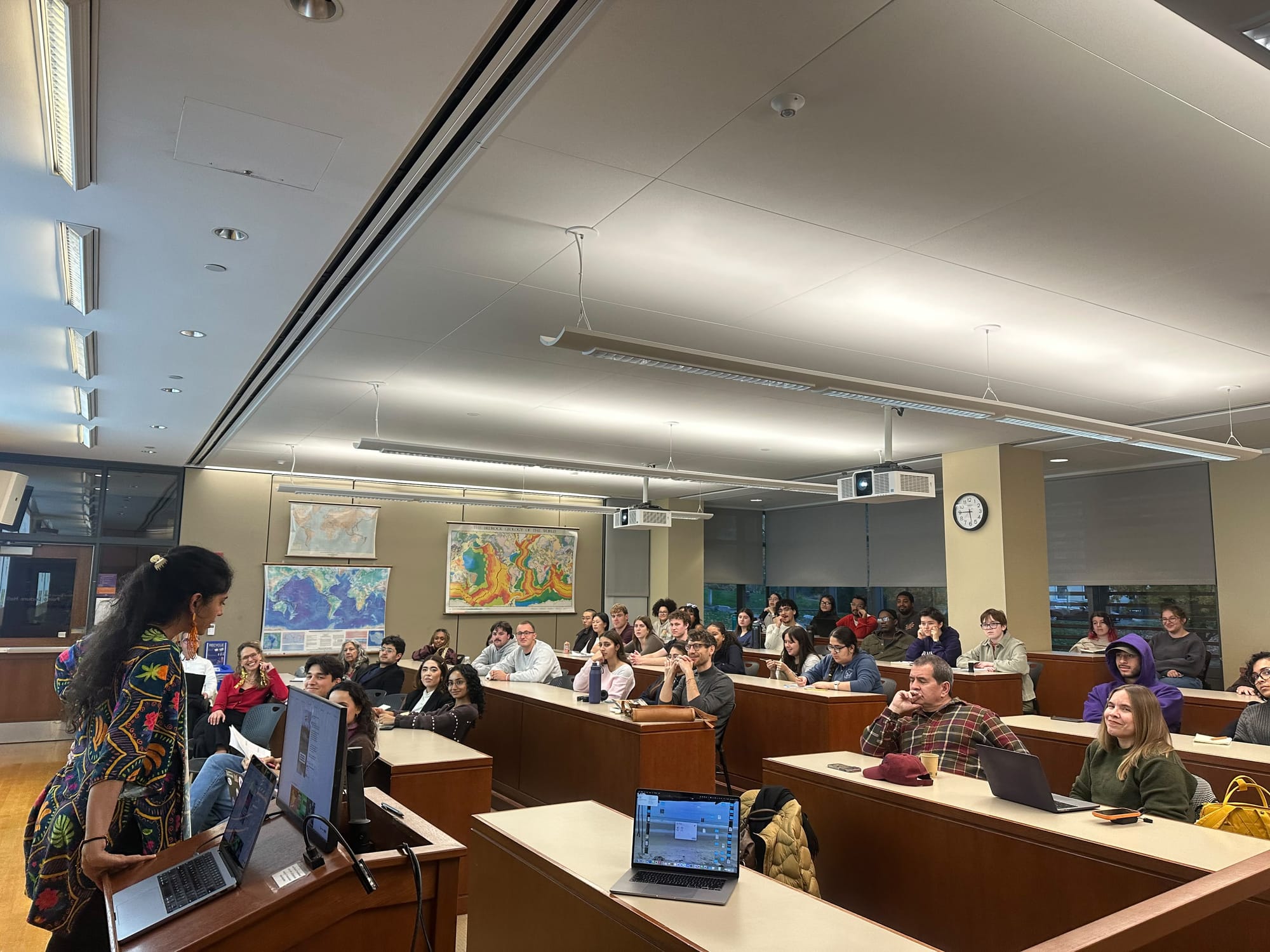
On Wednesday, Oct. 28, Karl Loewenstein, Senior Lecturer in Political Science and Sexuality, Women’s and Gender Studies Manuela Picq, Dwight W. Morrow 1895 Professor of Political Science Javier Corrales, and Assistant Professor of Theater and Dance Angelica Monteiro came together to discuss the implications of Brazil’s most recent general election results. Introduced and moderated by the Brazilian Student Association Amherst (BRASA), the discussion took place in the Beneski Paino Lecture Hall and was preceded by brief informational talks from each of the faculty members.
This year’s election was especially significant for Latin America’s largest country. The primary candidates were ultimately Luiz Inácio Lula da Silva, leader of the Workers’ Party, and Flávio Bolsonaro, whom Monteiro dubbed the “Trump of the tropics.” Son of former president Jair Bolsonaro and a proponent of right-wing policies, Flávio Bolsonaro fled Brazil immediately after losing to Lula in the 2026 elections, landing in Florida with the assistance of President Donald Trump. Bolsonaro’s quick escape was “not a surprise at all,” according to Picq. “We were already thinking, act faster, he is going to flee — and he did,” she said.
Lula’s victory has had a monumental impact on both the people of Brazil and other countries in Latin America. Picq called Brazil a “beacon of hope” in preventing the proliferation of an authoritarian alliance between Bolsonaro and the Trump administration. Although the nation succeeded this time in avoiding the return of what he called a “dictatorship,” Corrales emphasized that the election was “very close.”
Prior to the discussion, Corrales stated that the distinction between “right” and “left” can not fully capture modern-day politics; rather, he suggested defining the divide as being between those who prioritize protection and expansion of their rights and others who prefer “punitive populism.” He used the example of how a partnership of vastly different political groups emerged to defend democracy against Bolsonaro’s potential to become president. Having recognized the need for energy and mobilization, the people of Brazil were able to “fight fire with fire without burning everything to the ground,” Corrales said.
Given that 2026 marks the start of Lula’s fourth term, this election was a special instance of unity in the context of Brazil’s polarized political sphere. “What was specific to this election is that there was an alliance between the right and the left against Bolsonaro,” Corrales added.
In portraying the effects of the election, and what the process of choosing who to vote for looks like, Monteiro provided an example from her own life. Her mother was an avid supporter of Bolsonaro because she believed that “he [would] change everything and [make their] lives better.” She was truly convinced by his movement “because the dictatorship was amazing” in the past. Ultimately, though, Monteiro “flipped [her] mom” through conversation.
Furthermore, Monteiro and Picq touched on the influence social media and famous personalities had on helping Lula gain support. “Lula’s army” manifested in a WhatsApp group that, at its peak, contained 10.8 million followers and was led by the politician Andre Janones. “He was basically guiding us on which hashtags to use,” Picq said. Monteiro recalled being shocked that the Bolsonaro family was able to reemerge at all, which she says indicated a drastic change in the political scene. “Technology changed us as a population, so the way we think and do politics also has to change,” she said.
After their presentations, Picq, Corrales, and Monteiro answered questions from the audience. Brazil, an audience member highlighted, is one of two “red-painted,” or left-wing, governments in Latin America, so the public’s ability to “resist this movement” has meant a lot for the stability of democracy moving forward.
Learning about the overturn of the reigning political party in Brazil provided a sense of optimism as the audience prepared for midterm elections in the U.S. Following the talk, Ximena García ’30 commented, “I feel a sense of hope for the elections in the U.S.”
Comments ()