

Professor Discusses Impact of AI
On Monday, Department Chair of Computer Science Lee Spector joined President Michael Elliott, for a webinar “AI’s Impact: Culture, Society, and the Human Experience.” Spector discussed how AI is transforming society, its impact across disciplines, and uncertainty about AI’s trajectory.
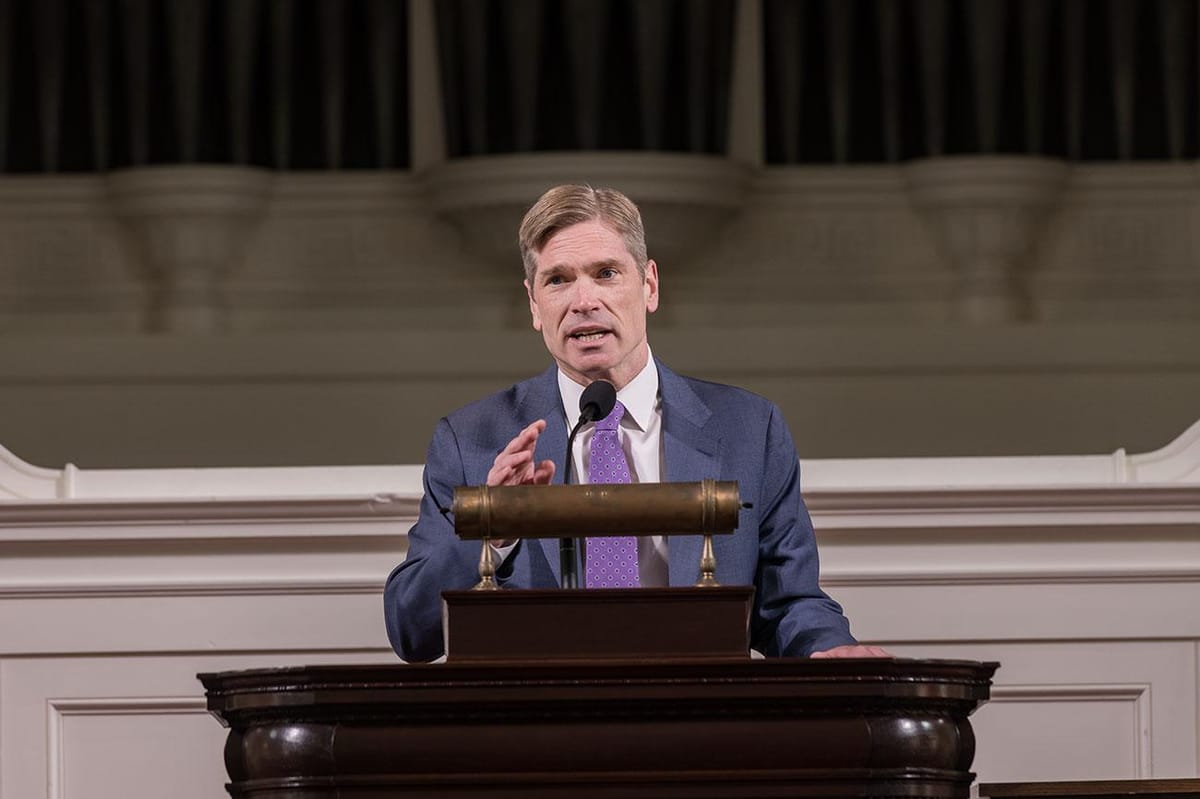
On Monday, Biddy Martin Professor in STEM and Department Chair of Computer Science Lee Spector joined President Michael Elliott for a webinar titled “AI’s Impact: Culture, Society, and the Human Experience,” part of the college’s presidential series. The conversation focused on how artificial intelligence (AI) is fundamentally transforming society.
Spector’s interest in AI began decades ago as an undergraduate at Oberlin College, where he grew curious about the creativity and possibilities of the human mind. Spector founded and leads the college’s AI in the Liberal Arts initiative (AILA), a cross-disciplinary student and faculty think tank.
Throughout the conversation, Spector returned to his belief that understanding and deciding what to do about AI requires perspectives from every discipline, as its impacts will reach all fields. The expertise of those disciplines, he said, is “crucial for helping humanity understand how to manage and make the most of this technology.”
When Elliott asked what has surprised him most about AI’s arrival into daily life, Spector pointed not to its disruptive power but to the public’s limited imagination about it. “The thing that surprises me most is actually the banality and cramped imagination of the public reception,” he said. Despite the large volume of media coverage and daily conversation, Spector said most of the public seems to imagine little about what the technology can do.
Spector said the uncertainty about AI’s trajectory stems from both technological and social factors. On the technological side, Spector mentioned recursive self-improvement, in which AI can be used to improve itself, as a key source of unpredictability. “One thing that can be predicted with near certainty is that [AI’s] capabilities will continue to increase pretty dramatically,” he said. “But we can’t really see beyond that because it’s going to be improving itself in ways that we can’t even do ourselves.” On the social side, Spector said understanding AI’s impacts requires “people with deep expertise in how societies work, and how psychology works.”
“Nobody has all that expertise, he added, “and so I think without all of those perspectives brought together, we don’t have a chance of understanding what’s going to happen.”
Spector said AI is raising questions in every discipline, including some beyond economics and science. “There may be something that impacts our sense of who we are and why we’re here, and questions that have been thought of in religion and scholarship of religion for millennia,” he said.
Spector referenced his podcast, “What AI Means,” where he speaks with Amherst faculty and others about how AI bears on their fields. He cited a conversation with Emily C. Jordan Folger Professor of Religion and Department Chair of Religion Andrew Dole about how people may begin relying on AI, rather than their religious communities, for answers to religious questions. Dole considered it almost certain that religions deifying AI will emerge, Spector said. He noted that the study of religion has something to offer to anyone feeling “this sort of existential dread or excitement about AI.”
Spector described another episode with Professor of Mathematics David Zureick-Brown, which focused on how AI is upending mathematics. “There is a palpable existential crisis happening in mathematics about what it is and why,” Spector said. He explained that mathematicians are drawn to the “creative exploration of the possibilities of formal structures.” In recent months, he said, AI models have shocked the mathematical world, leading mathematicians to question whether they are needed for work they believed required them.
Spector said the podcast facilitates “real conversations and real exchanges” and has reinforced his belief that all of these expert voices matter when no one truly knows what will happen. “I think that humanity writ large should be in a moment of deep listening to each other about this and respecting and challenging the expertise that comes from all areas,” he said. “I think that [a] liberal arts college is the ideal place for this to happen.”
Elliott then shifted the conversation toward Amherst’s approach to AI, which allows faculty to decide how to incorporate it into their teaching and how students should engage with it. The college asks faculty to set clear policies for students. The college has also offered tools for experimentation, while allowing faculty to opt out of using them entirely.
Spector commended the approach, noting that the choice to fully adopt or refuse AI is too simplistic to capture the issue’s complexity. “We should be leading on the thoughtfulness with which we engage with the questions raised by AI, and I think that we are,” he said.
For Elliott, the challenge is both to “teach students to use AI responsibly, ethically, but also continue to build those patterns of thinking that are the heart of a liberal arts education.” To Spector, the purpose of an Amherst education is growing the student’s mind. “The product you really want is the growth of your mind, and so the question is, what use of these tools helps that, and what hinders that,” he said, adding that the answer will vary “not only from discipline to discipline, but from course to course.”
The conversation then turned to students’ varying perspectives and concerns surrounding the adoption of AI. “What I mostly sense is very active attention to these questions and stepping up to the plate to play an active role,” Spector said. He argued the college’s job is to encourage students to participate in the conversations rather than impose an institutional answer, because “students have perspectives that those of us who are older lack, and we have to be listening to them as well.”
Elliott also asked how students should prepare for the workforce if their careers are no longer tied to skills that can be automated. Spector responded that there is not a lot that cannot be automated. He said the future job market and economy will likely look radically different in the long term, and that it would be “foolish to pretend that we know too much about where it’s going.” Spector’s advice to students is to be broadly educated and mentally agile, including learning to use new tools and, most importantly, developing “depth of thought and critical thinking.”
Elliott closed by asking Spector about the excitement and dread that he and many others feel about AI. Spector said he has always seen the technology as both. “I always viewed the potential of AI as incredibly exciting and incredibly frightening in equal measures because of the power of intelligence, the power of minds, and the power of artificial, potentially scalable minds and scalable cognitive processes,” he said.
On the frightening side, he cited bioweapons, new forms of propaganda, and runaway rogue AI as some of the “nefarious applications of AI, and nefarious side effects of AI acting on its own.”
On the brighter side, Spector stated that the “ability of humans to understand the universe and to understand ourselves and to understand everything that we value and love and that gives life meaning is going to be advanced radically.” He added that AI could also help address the mounting challenges humanity faces, including those AI itself creates, from climate change to human conflict to resource issues.
“For every one of them, I think we need the best minds we have, and that's going to include enhanced minds enhanced by AI,” Spector said.

Comments ()