

Better Unemployed Than Working in Private Equity
Staff Writer Max Feigelson ’27 interrogates Amherst's relationship with private equity, arguing that firms built on debt, asset stripping, and financial extraction have no place at a liberal arts college.
If you’re an Amherst College student during the worst entry-level job market in 37 years, you’re probably anxious about your future. You also probably attend parties, and at these parties, you might meet someone who strikes you as unusually certain about their path. They say they’re “selling their soul” on the finance track, and they laugh about it, and you also laugh to play along. You ask what they will be doing in their internship this summer, and soon they’re throwing out terms like “high frequency trading,” “leveraged buyout,” “buy side and sell side,” and “mergers and acquisitions.” You don’t know what those terms mean exactly, but you’re struck by how confident they seem, how much they know about themselves and their post-graduation plans. You begin to envy this person.
A good physicist can describe their work in plain English without sacrificing complexity. The field’s jargon is therefore not a gatekeeping device, but a shorthand for fluent experts. Financial jargon, on the other hand, is designed to be alienating, hyper-technical, and eye-wateringly dry. The open secret of finance is that there is no immense complexity that the jargon is attempting to approximate; rather, the goal of the financial vocabulary is obfuscation. It’s nearly a cliché at this point that if we described what much of Wall Street does in plain English, we’d understand the degree to which large swaths of the industry rest on deception, fraud, and shortsighted thinking. In few industries is this clearer than in the case of “private equity” (PE).
If a group of people takes over a business, racks up insurmountable debt, fires its employees, then sells all its most valuable assets for a profit, we call this group of people “the mafia.” In the organized crime world, this practice is known as a “bust out,” a form of theft that not only steals whatever someone has, but also destroys all means they would have to make the money back. In “The Sopranos,” when Tony and the gang seek to force Davey, a sporting goods store owner, to pay back his gambling debt by springing a bust-out on his business, Davey is driven to the brink of suicide.
“Bust-out” is an evocative term; from the word alone, you can guess that it’s some sort of crime. In comparison, “asset stripping” at a “private equity firm” running “leveraged buyouts” evokes little besides confusion. The only difference between a “bust-out” and a “leveraged buyout” is scale. While the former is accomplished by violent organized crime groups targeting small businesses, the latter is accomplished by wealthy firms targeting corporations. The first is strictly illegal; the second is perfectly legal. If you run a bust-out, you’re a member of an organized crime group; if you run a leveraged buyout, you’re a member of a private equity firm.
One cannot live in America today without having some contact with private equity. The industry now accounts for 7% of gross domestic product growth, and the industry’s size is attributable to its pioneering of the leveraged buyout. Here’s leveraged buyout 101:
- Identify a company or industry with financial anxieties and valuable physical assets.
- Go to the bank and ask for a loan to buy a majority stake in that company, and when the bank asks for collateral, put up the company itself (which you don’t yet own). The bank is fine with this as long as you can put up around a tenth of the total takeover price.
- With your new powers of ownership, do anything you can to increase the company’s value, including but not limited to firing employees, moving manufacturing overseas, cutting pensions, selling real estate, stiffing your suppliers, all the while charging fellow stockholders annual “advisory fees” for your wise stewardship.
- Sell the company at the highest price possible before anyone discovers its bombed-out core, now 18% more likely to go bankrupt.
Private equity has dragged us into a new era of professional sports and fans should be kicking and screaming. The growth of streaming and global fandom has made North American professional sports teams one of the most valuable asset classes in the world, meaning that individual millionaires and billionaires have been largely priced out of the industry, creating a unique opening for private equity. For most of their history, major sports leagues banned private equity ownership because of an innate conflict of interest: for these firms, profit is the primary incentive, and when profit is primary, winning isn’t so important.
In 2019, Major League Baseball lifted what had been a universal ban on private equity investments in North American sports, and since then every major league has followed suit. Private equity pounced immediately: more than 74 North American professional sports teams now have some level of private equity involvement. With private equity at the helm, teams like the Boston Red Sox become less interested in paying the contracts of beloved star players, like all-star third baseman Alex Bregman, and decide to ship them to other teams to boost the bottom line. Private equity also encourages teams to institute “dynamic pricing,” the reason why some sports tickets cost more than others. They seek to approve paid partnerships between leagues and sports gambling sites. They complicate streaming so that watching a full season of NFL football now requires six different streaming subscriptions and 1,200 dollars. These moves aren’t tailored to the fanbase’s expectations or the team’s strategic goals, they’re just meant to make money.
But sports only scratches the surface. There’s an account on Instagram called “@cadrecorp” that gives presentations on private equity according to a simple heuristic: let X equal any arbitrary American industry, show how private equity has ruined X.
Let X = retail and learn about the killing of Toys R Us, Sears, and JC Penney, and the abandonment of their employees. Let X = restaurants and learn about PE’s role in forcing small business bankruptcy and incentivizing declining menu quality. Let X = pet stores and learn about how, after private equity bought PetSmart, Petco, and Pet Supplies Plus, the companies began working with cheaper suppliers who cut costs by employing animal cruelty. Private equity-owned pet stores have been so understaffed that whistleblowers have discovered new stacks of animal corpses in pet store freezers, the result of neglect causing animal starvation, overheating, and freezing to death in cages. Let X = youth sports, therapy, higher education (see how the University of Massachusetts Amherst paid for its newest dorm renovations), the news, veterinary care, IVF clinics, HVAC, prisons, parking lots, and climbing gyms, and you’ll find similar stories.
Little compares with what we can discover when we let X = healthcare. It’s actually illegal for for-profit investors to buy healthcare facilities offices, but over the past 15 years, private equity’s lawyers and consultants have created the “management service organization” (MSO), which circumvents the law against ownership by creating a structure whereby a private equity firm only claims to own the administrative side of the hospital, not the medical side. But the MSO is just further obfuscation of private equity’s intent; if private equity is buying a company, they’re doing so because they expect to call the shots.
Under private equity’s orders, doctors are forced to claim that “physician’s assistants” (PAs) are working under their supervision even if they’re not even in the same building or even the same town. Offices begin compromising on the quality of medical equipment; after their acquisition by private equity, the country’s second-biggest skin-care group, U.S. Dermatology Partners, switched to a cheaper brand of needles and sutures with such poor quality that they would often break off inside patients’ bodies. After private equity buys a medical center, there follows a 38% increase in central line infection, a 25% increase in surgical infections and bed sores, and a 27% increase in in-hospital falls. Private equity now owns more than 10% of all American hospitals, alongside thousands more Urgent Care facilities, nursing homes, and specialty clinics, and in the period since their acquisition, about “22,500 additional deaths occurred due to PE ownership.”
Forget “Literary Amherst,” our liberal arts college is a veritable breeding ground for these forces of greed. Of the top twenty employers of freshly graduated Amherst College students, seven are either private equity funds or the consulting firms that function as private equity’s primary strategic advisor. You need not be anti-capitalist or even consider yourself a progressive to rally against the private equity breeding pool. The systematic defrauding of the public and the looting of American industry shouldn’t be a partisan issue.
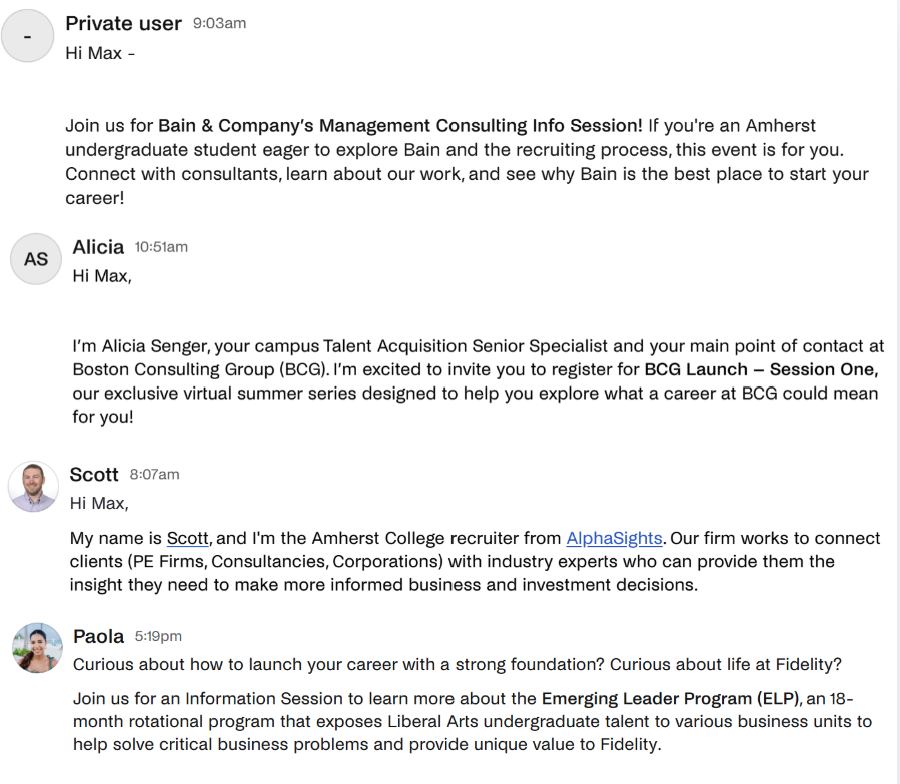
If the American public can now be divided into the massive majority that suffers at the hands of hyper-financialization and the select few that stand to gain from its fraud and deception, then Amherst College students briefly inhabit the rare and powerful space between. Many of us on substantial financial aid see the college not as a gateway to intellectual enlightenment, but as a golden ticket out of what many are calling the “permanent underclass,” and it makes sense that we don’t want to throw it away for the sake of abstract ethical principles. Unfortunately, nobody understands this anxiety better than private equity and consulting recruiters. The process by which undergraduates are convinced that these firms are their only plausible post-grad option is called “career funneling,” and it follows an eerily similar playbook to the one that PE has championed in the American economy. Evan Mandery’s article in Mother Jones, “How America’s Elite Colleges Breed High-Status Careers — and Misery,” elucidates career funneling 101:
First, identify a school of students with valuable intellectual training and anxiety about their future career prospects. Buy up space in the school’s career advisement office, and with the school’s reputation as your cover, make your pitch to as many students as early as possible. Present yourself as an industry for the wealthy and treat your first interns to swanky dinners at expensive hotels. Then, once they’ve signed their first six-figure contract, work them to death for up to seven days a week, 17 hours per day until they burn out like a third of the industry does.
Whether it’s companies to loot or undergraduates to hire, private equity firms are looking for the same thing: anxiety. Hospital administrators, Toys R Us executives, and convenience store owners, all fell prey to PE because they were uncertain about their futures. Mark Walter, the former owner of the Los Angeles Lakers, was recently compelled to sell his team to private equity just nine months after he first bought it because of fiscal anxiety stemming from a Securities and Exchange Commission probe into his previous companies. You, the anxious and talented undergraduate, fit this same bill for targeting. For private equity firms and their consultants, liberal arts college students are all assets to be stripped, resources to be mined, futures to be compromised.
If you look up “Amherst College Private Equity,” the first result (as of the writing of this article) is a page on the Loeb Center for Career Exploration’s website called “The History of Private Equity.” This page consists of a single video, produced by a PE firm called the Carlyle Group, featuring the company’s current CEO David Rubenstein, who summarizes the history of private equity in the most alienating, technically dense language possible. To conclude the video, set to optimistic, jangly music, Rubenstein speaks directly to Amherst undergraduates when he claims that “the best years are not behind the private investments market … they’re ahead of us.” But who is the “us” to which Rubenstein refers?
He’s certainly not referring to the thousands of patients at HCR ManorCare, one of the largest nursing home chains in the country who, after the Carlyle Group’s buyout, found that health code violations at their facilities rose by 26% every year. According to an investigative report by the Washington Post, family members of patients like Michelle Maldonado, whose father lived at a ManorCare facility after the sale, remembered that “One time we came in to visit him and he was sitting there in a wheelchair naked, with just a blanket on him — no pants, no underpants. He got bedsores, infections, and he had a couple of falls. It was like they would never check on him.” Soon after the initial buyout, Manorcore was saddled with mountains of debt and the corporation was forced to declare bankruptcy. Staff were fired or quit citing a decline in funding for everyday equipment, thousands of patients and their families suffered damages that were settled confidentially in court, and the Carlyle Group never had to admit that the quality of care ever fell. They recovered their initial 1.3 billion dollar investment, in addition to raking in around 100 million in advisory fees.
So when Rubenstein says that “the best years are ahead of us,” he must be talking about himself and his industry. The claim that this whole vampiric business model is not only profitable now, but will remain profitable for the foreseeable future would be Rubenstein’s biggest lie of all. The truth, which anyone with common sense already understands, is that a business model built on institutional rot, rampant fraud, and legalized theft is ultimately unsustainable. Private equity ruins nearly every industry it touches, and that includes itself. So how does private equity ruin private equity?
The private equity’s “looting,” as Senator Elizabeth Warren calls it in her bill to ban the practice, occurs in three phases: buying companies, looting companies, and selling companies. Recently, private equity hasn’t been able to find enough buyers for the final phase of the process, meaning firms now have tens of thousands of companies clogging up their sheets, which, according to the firms and their private consultants, should be worth around $4 trillion. But no matter what the firms say, assets can’t be valuable when they don’t have anyone willing to buy them.
If private equity is a human body, its inability to sell the companies on their sheets is a form of constipation, and constipation makes everything more difficult. Without proof that they can sell their companies, private equity firms’ portfolios no longer outperform the stock market, and as long as they can’t outperform the stock market, the firms have a harder time finding investors willing to invest the funds necessary to buy more companies. Without an exit strategy, there can be no consistent intake; private equity is discovering that if you’re suffering from constipation you’ll have a hard time convincing others to feed you.
While most articles written for a general audience must conclude with the usual call for government regulation, this article in an elite college newspaper can make a more actionable and specific request of its readers based on the role they play at Amherst. To the Loeb Center, stop permitting private equity and consulting firms from trapping children whose prefrontal cortexes haven’t yet developed. To any professors reading this, show those students who’ve been duped how their education offers them the freedom to pursue more than wealth and training in the rhetoric of scam artistry. To students, confront your friends. Shame them if need be.
Our friends have been lured into the grinding gears of a massive market machine. The machine promised them wealth and prestige, enough social credit to escape their bodily condition and transcend to a permanent upper class. Our friends have become infatuated by the market machine, by the beauty of its ungovernable network governing all we say and do. The machine is powerful, they’ve been told, it’s the only thing on earth that makes decisions. Our friends are vying for the privilege of replacing one of the cogs of this machine, a machine that burns greed and our passivity for fuel. Our liberal arts college is a recruiting hotspot for some of the most vile and exploitative institutions in American history. That this doesn’t present as a contradiction to the college’s administration means that the imperative to act, to throw bodies on gears until the mechanic operation halts, lies with the students. It’s time for our friends to wake up.
When someone tells you with a self-deprecating laugh that they’re “selling their souls,” it’s not acceptable to laugh and try to talk about something more pleasant. Think of the cats at PetSmart overheating in their cages, the number of ads that play during YouTube videos, the suicides in solitary confinement at private prisons, and of what it might feel like to have your grandparents suffering from neglect by their overworked nursing home attendants. Think of yourself and the many ways that private equity has already come to make your life worse, then realize that when someone tells you their plans to sell out, they’re not talking about their souls, they’re talking about yours.
Better sane than at Bain. Stay free and out of PE. Don’t join the mob, turn down that job.



Comments ()